

Measuring for an integrated dishwasher front requires precise calculations of the niche height, plinth clearance, and hinge mechanics to prevent the panel from hitting the baseboard when opened. Understanding these spatial relationships ensures a seamless kitchen finish without functional interference.
The Anatomy of Integrated Dishwasher Dimensions
Unlike standard freestanding appliances, an integrated dishwasher must fit perfectly within a designated cabinet niche while aligning structurally with adjacent units. To achieve this, you must analyze three primary vertical dimensions: the niche height (from the floor to the underside of the worktop), the appliance height (including its adjustable feet), and the cabinet front height of the surrounding kitchen furniture. Most standard integrated dishwashers are designed to fit niches between 815 mm and 875 mm high, thanks to heavy-duty adjustable leveling feet that compensate for uneven floors.
When selecting the front panel, the height is determined not by the dishwasher itself, but by the surrounding cabinetry. The goal is to match the top and bottom lines of the adjacent drawer runners or doors. However, the physical height of the dishwasher body dictates the maximum weight and thickness of the panel it can support without straining the door tension springs.
Measuring the Niche and Appliance Clearances
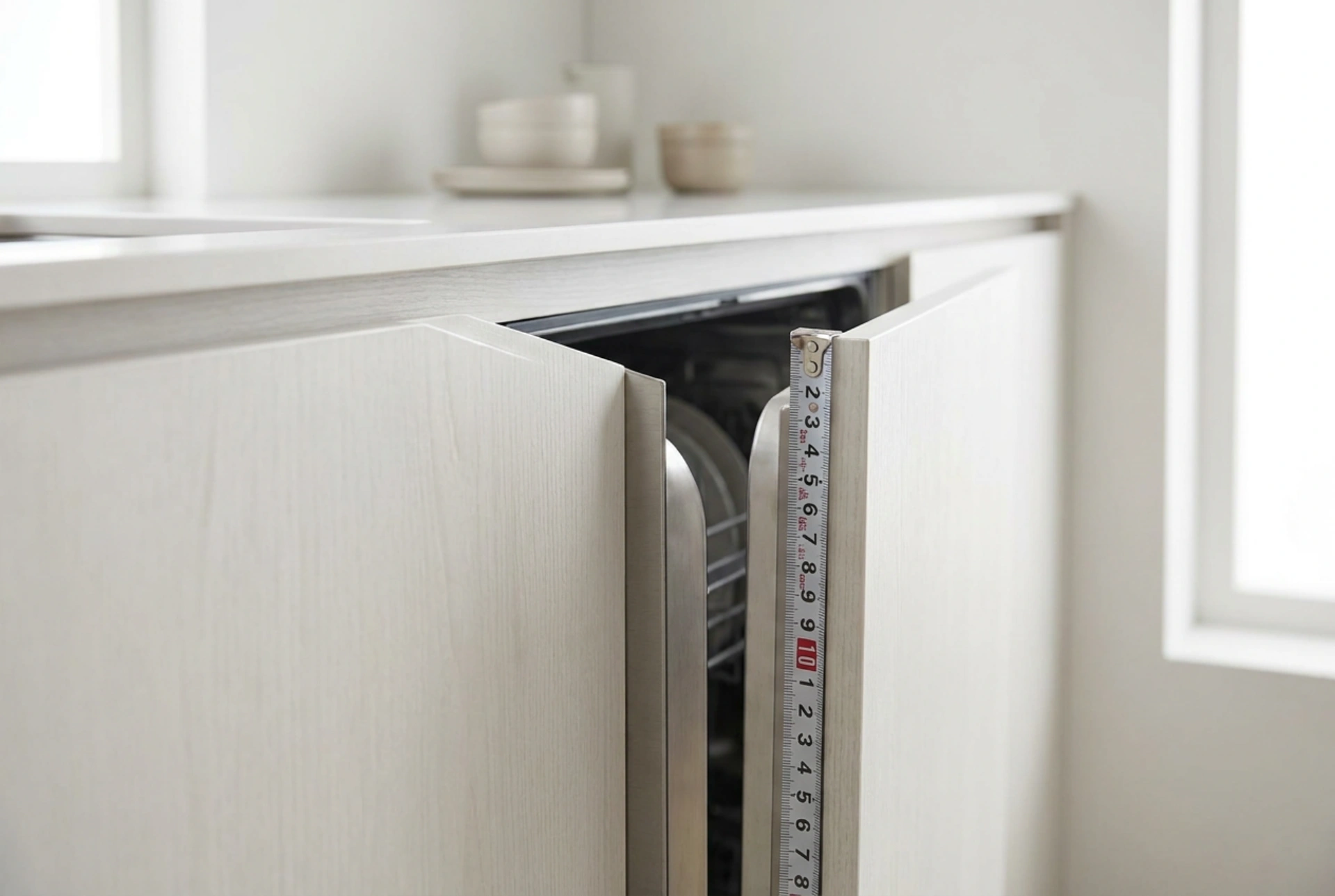
Before ordering your custom front panel, you must take precise physical measurements of the installation space. Do not rely solely on the theoretical kitchen plan. Use a steel tape measure to check the height at the front, middle, and rear of the recess. Uneven subfloors can create variances of several millimetres, which will affect how the dishwasher sits relative to the worktop.
- Total Recess Height: Measure from the finished floor (including tiles or laminate) to the lowest point of the worktop's underside.
- Appliance Height Range: Check the technical datasheet of the dishwasher. Ensure the maximum extension of the adjustable legs can reach the underside of your worktop to secure the appliance against tipping.
- Plinth Depth and Height: The plinth must be recessed sufficiently to allow the dishwasher door to swing open. Measure the vertical distance from the floor to the bottom edge of the adjacent cabinet carcasses.
Hinge Mechanics: Fixed vs. Sliding Systems
The movement of the front panel during opening depends entirely on the hinge mechanism of the dishwasher. This mechanical factor determines how tall your front panel can actually be before it collides with the plinth at the bottom of the kitchen run.
In a fixed hinge system, the decorative front panel is mounted directly to the appliance door and rotates on a fixed axis. When the door is opened, the bottom edge of the front panel swings downwards and backwards. If the front panel is too long, or the plinth is too high, the bottom of the panel will strike the plinth, preventing the door from opening fully to a 90-degree angle. To avoid this, you may need to cut a notch out of the plinth, which compromises the clean lines of your kitchen.
A sliding hinge system solves this issue through kinematics. As the dishwasher door opens, the decorative front panel slides upward relative to the appliance door. This movement lifts the bottom edge of the panel away from the plinth, allowing for taller door fronts (up to 800 mm or more) and very low plinths (down to 50 mm) without any physical interference. Knowing which system your appliance uses is critical before specifying the exact height of your custom front.
Calculating the Perfect Front Panel Height
To calculate the required height of the front panel, subtract the desired floor clearance (plinth height) and the top gap (usually 2 to 4 mm below the worktop) from the total niche height. For a fully integrated model, the panel must cover the entire face of the appliance. For semi-integrated models, you must subtract the height of the exposed control panel—typically around 110 mm to 150 mm—from your total front panel calculation. Always verify the maximum load weight limits of the dishwasher hinges, as oversized panels made of heavy materials like solid oak or dense MDF can cause the door to fall open too quickly or fail to remain open at a partial angle.