

Positioning a rubber boot tray effectively is not just about placing it near the door; it is about intercepting dirt and moisture at the precise point of motion transition. By understanding the physics of human gait and the chemistry of floor protection, you can eliminate mud tracking and prevent moisture damage to sensitive wooden or laminate subfloors.
The Physics of Entryway Dynamics: Strategic Placement
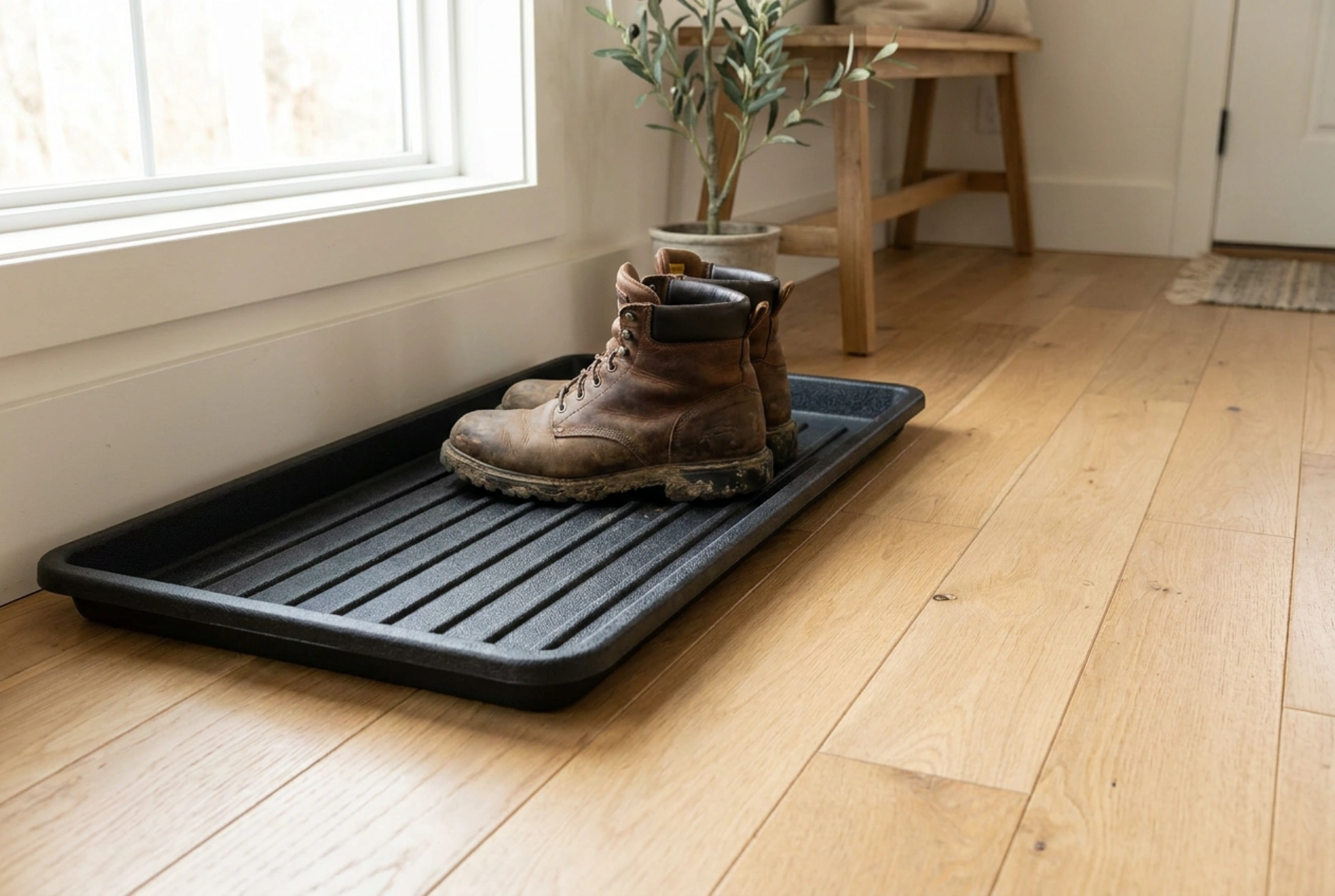
To stop mud from spreading, the boot tray must sit within the natural step-off zone of your entryway. When a person enters a home, their natural instinct is to take one or two steps inside before stopping to balance and remove their footwear. Placing the tray too close to the door arc forces a person to step awkwardly, often stepping off the tray onto the bare floor to maintain balance. The tray should be positioned parallel to the door's opening path, exactly where the secondary foot lands during the shoe-removal pivot.
Additionally, consider the flow of gravity and air. Placing the tray near a low-level heat source, such as a radiator or underfloor heating manifold, accelerates evaporation. However, direct contact with high heat can degrade certain synthetic rubbers over time. The ideal location is a cool but ventilated corner adjacent to the main traffic path, ensuring shoes are stripped off immediately upon crossing the threshold without blocking the door's clearance.
Material Science: Why Rubber Works and How to Protect the Floor Beneath
Rubber is highly hydrophobic, meaning it repels water and prevents liquid from soaking through to your flooring. However, this non-porous nature creates a secondary problem: condensation and trapped moisture underneath. When cold, wet boots are placed on the tray, the temperature differential between the cold rubber and a warm wooden floor can cause atmospheric moisture to condense underneath the tray. Over time, this trapped moisture can warp wood or ruin laminate through capillary action.
- Air Circulation: Choose a rubber tray with small integrated feet or raised nodules on the underside to allow a thin layer of air to circulate beneath it.
- Felt Buffers: If the tray has a completely flat underside, place thin adhesive felt pads at the corners. This lifts the tray by a millimetre, preventing vacuum seals and allowing trapped vapour to escape.
- Routine Checks: Lift the tray once a week to inspect the floor underneath. Any micro-condensation should be wiped dry immediately to prevent mould growth.
Optimising Internal Mechanics: Ridges, Channels, and Convective Drying
A flat tray is highly inefficient. Effective boot trays utilise raised geometric ridges or grid patterns. These ridges serve a vital mechanical purpose: they elevate the shoe soles above the collected pooling water. If the sole remains submerged in water, the materials (especially leather or porous synthetic mesh) will continue to absorb moisture, delaying the drying process and leading to unpleasant odours.
By elevating the footwear, air can circulate underneath the sole. This initiates convective drying, where air warmed by the room rises, drawing moisture away from the wet shoe. When placing boots on the tray, ensure they are aligned with the grid pattern rather than crossing over multiple ridges, which can block the airflow channels and trap pockets of stagnant, humid air.
The Chemistry of Cleanliness: Managing Mud and Road Salt
Mud is a suspension of fine clay, silt, and organic matter in water. Once the water evaporates, these fine particles consolidate into a crust. To clean the tray without degrading the rubber polymer, avoid harsh petroleum-based solvents or chlorine bleach, which can dry out and crack the rubber. Instead, rely on simple physical removal and mild surfactant chemistry.
In winter, road salt (sodium chloride and calcium chloride) creates stubborn white rings on both boots and trays. These alkaline salt deposits do not dissolve easily in plain water once dried. To neutralise them, use a highly diluted acidic solution, such as one part white vinegar (acetic acid) to four parts water. The acetic acid reacts with the calcium carbonate and salts, breaking down the crystalline structure so they can be easily wiped away with a microfibre cloth, restoring the rubber's protective barrier.