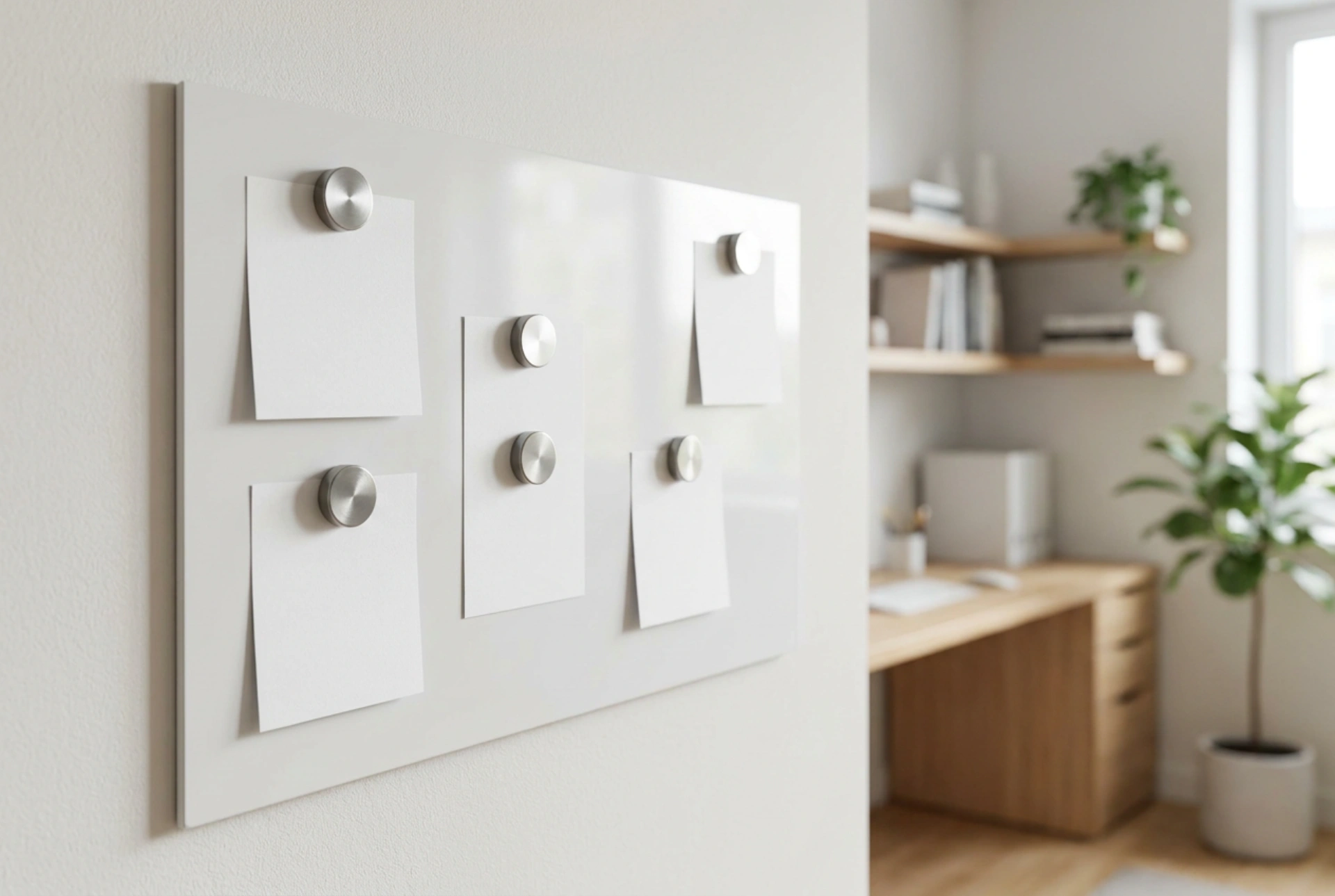


A wall-mounted magnetic board serves as more than just a surface for notes; it acts as a high-visibility, physical information hub that leverages cognitive psychology and spatial memory to streamline household management. Understanding the physics of magnetic forces, structural mounting mechanics, and surface chemistry allows you to optimize this tool for maximum durability and organization.
The Physics of Magnetic Materials and Holding Power
To design an effective magnetic board system, you must first understand the materials involved. Not all metals are magnetic; only ferromagnetic metals—such as iron, nickel, and cobalt—attract magnets. Most commercial magnetic boards are made of steel sheets, which are iron alloys carbonized for strength and coated to prevent oxidation. The thickness of the steel sheet directly influences magnetic attraction; thicker steel allows more magnetic flux lines to pass through, creating a stronger hold.
When choosing magnets, you generally encounter two types: ceramic (ferrite) and neodymium (rare-earth) magnets. Ceramic magnets are inexpensive but have a lower magnetic energy product, meaning they must be physically larger to hold heavy paper or cardstock. Neodymium magnets, made from an alloy of neodymium, iron, and boron, produce exceptionally strong magnetic fields in a compact size. However, their sheer holding power can make them difficult to slide or remove.
A common issue is magnets sliding down the board under the weight of paper. This is governed by the coefficient of static friction between the magnet's surface and the board's coating. High-gloss powder coatings have low friction. To prevent sliding, utilize magnets with a thin rubber or silicone backing. The elastomer increases the coefficient of friction, converting the magnet's strong perpendicular pull force into resistance against downward shear force, keeping documents firmly in place.
Spatial Organization and Cognitive Friction
Physical organization systems succeed because they exploit peripheral vision and spatial memory—cognitive traits that digital applications often fail to engage. A physical board provides constant, passive exposure to tasks, reducing the "out of sight, out of mind" phenomenon. However, an unorganized board leads to visual clutter and cognitive fatigue.
To prevent this, segment your board into distinct functional zones based on logical urgency:
- The Active Zone: Positioned at eye level, this area is reserved for immediate, high-priority tasks, such as weekly schedules or time-sensitive correspondence.
- The Reference Zone: Located on the periphery (usually the left or bottom), this holds semi-permanent information like emergency contact numbers, utility schedules, or frequently used recipes.
- The Archive/Holding Zone: A designated corner for items waiting to be filed or discarded, preventing them from mixing with active priorities.
By color-coding documents or magnets (e.g., warm colors for high urgency, cool colors for reference), you utilize pre-attentive processing—the brain's ability to filter visual information in milliseconds before conscious focus occurs.
Structural Mechanics of Mounting
A magnetic board must withstand repetitive physical stress. Every time a magnet is pulled from the surface, a perpendicular tensile force is applied to the board and its mounting hardware. Over time, these micro-pulls can loosen wall fixings if the installation is inadequate.
For standard masonry or concrete walls, plastic expansion anchors paired with appropriate screws are sufficient, as the solid substrate absorbs the force. However, mounting on drywall (plasterboard) requires specific mechanical considerations. Standard expansion plugs should be avoided, as they rely on friction within a crumbly material. Instead, use metal toggle bolts or self-drilling threaded drywall anchors. Toggle bolts spread the pull force across a larger surface area on the back of the plasterboard, preventing the mount from pulling through when strong neodymium magnets are removed. Always pull magnets off at an angle rather than straight outward to minimize direct pull stress on the wall anchors.
Surface Chemistry: Cleaning and Preventing Ghosting
The utility of a magnetic board is often enhanced by dry-erase capabilities. The surface coating is typically made of melamine, painted steel, or porcelain-on-steel. Melamine is porous and degrades over time, whereas porcelain and high-quality lacquer coatings are non-porous and highly resistant to staining.
"Ghosting"—the faint residue left behind by dry-erase markers—occurs when pigment particles penetrate microscopic pores or scratches in the surface. To prevent this, never use abrasive scrubbers, steel wool, or harsh acidic cleaners, which micro-scratch the protective coating. Instead, clean the board using a soft microfiber cloth. For stubborn ink residue, utilize isopropyl alcohol (rubbing alcohol). Isopropyl alcohol is an effective polar solvent that breaks down the resin binder of the ink without damaging the underlying polyurethane or porcelain coating. Regular application of a specialized silicone-based whiteboard conditioner can also seal microscopic pores, maintaining a smooth, hydrophobic surface that repels ink stains.