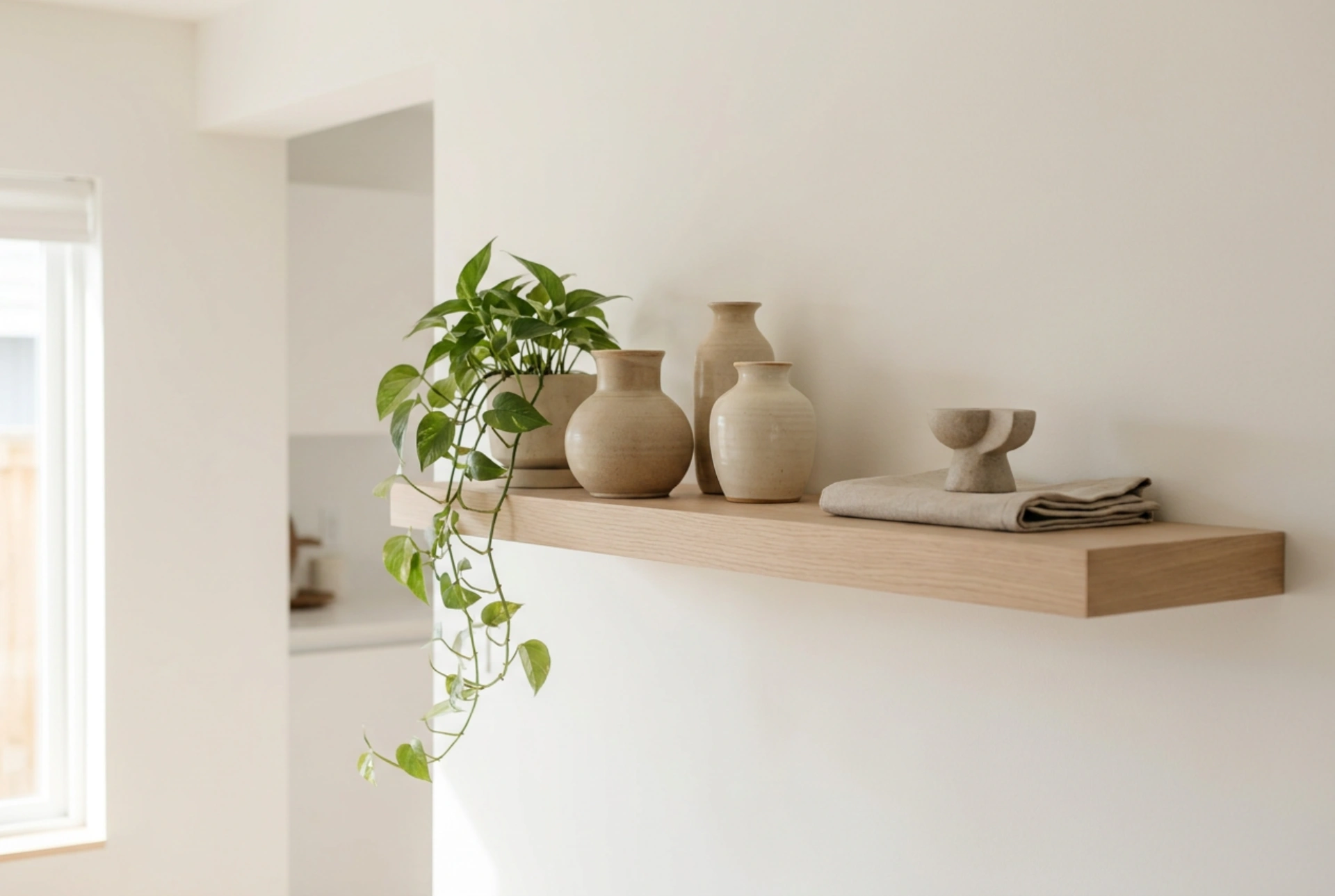


Floating shelves offer an elegant, minimalist way to display cherished items, but without a structural plan, they quickly turn into cluttered dust-collectors. Achieving a balanced, clean look requires an understanding of visual weight, structural physics, and material science.
The Mechanics of Visual Weight and Structural Leverage
When arranging objects on a floating shelf, physical balance and visual harmony go hand in hand. Every object placed on a shelf exerts downward force. Because floating shelves are supported by concealed internal brackets, they are subject to the law of leverage (torque). Objects placed far from the wall exert a greater rotational force on the bracket than those placed close to the wall. To prevent sagging and structural fatigue over time, always position your heaviest items, such as thick books or heavy ceramic vases, towards the back of the shelf and closer to the support brackets. Lighter, delicate ornaments can then be placed near the front edge.
Visual weight operates on a different principle of human perception. Dark, solid, and highly textured items appear heavier to the eye than light-coloured, translucent, or smooth objects. To create a balanced aesthetic, avoid clustering all visually heavy items on one side. Instead, distribute them diagonally across different shelves to guide the eye smoothly through the space. Using a triangular composition—where similar colours, textures, or shapes form the points of an imaginary triangle—creates a sense of natural order and stability.
Managing Dust and Electrostatic Charges on Open Shelving
One of the main challenges of open shelving is its exposure to dust. Airborne dust is composed of skin cells, fabric fibres, and microscopic soil particles, which constantly settle on flat surfaces. Furthermore, synthetic materials and high-gloss painted surfaces can develop a negative electrostatic charge, which actively pulls dust particles out of the air.
To minimise dust accumulation, opt for decorative items made from natural materials with low electrostatic affinity, such as unglazed ceramics, stone, metal, or matte-varnished wood. When cleaning, avoid using feather dusters, which merely launch particles back into the air to settle elsewhere. Instead, use a slightly damp microfiber cloth. Microfiber is manufactured with split polyester and nylon fibres that carry a microscopic positive charge, physically grabbing and holding onto the negatively charged dust particles. For intricate sculptures or delicate books, an anti-static soft-bristled brush is highly effective at neutralising surface charges and lifting dust without scratching the material.
The Order of Operations for Curated Styling
Creating an organised shelf display requires a systematic, step-by-step approach rather than random placement. Start with a completely empty shelf to clear your visual field.
- Step 1: Position the Anchors. Begin with your largest items. These could be large books stacked horizontally or a substantial ceramic vessel. Place these anchors slightly off-centre to avoid a rigid, symmetrical look that feels sterile.
- Step 2: Introduce Height and Flow. Add tall, slender objects such as candlesticks or a trailing plant. The soft, cascading lines of a plant break up the harsh horizontal geometry of the shelf, introducing organic movement.
- Step 3: Group the Accents. Integrate smaller objects in odd-numbered groups, particularly clusters of three. Odd numbers force the eye to move around the grouping, creating a dynamic visual experience.
Crucially, leave at least thirty percent of the shelf surface empty. This negative space acts as a visual buffer. Without it, the brain perceives the shelf as chaotic and cluttered. Negative space allows the individual beauty of each curated piece to be fully appreciated.
Preventing Surface Damage and Material Wear
Placing objects directly onto wood or painted shelves can lead to micro-abrasions, scratches, and water damage. Ceramics and stone objects often have rough, unglazed bases that act like sandpaper when moved. To protect your shelves, apply small self-adhesive felt or silicone pads to the underside of every heavy or textured decorative piece. These pads raise the item slightly, preventing direct friction and allowing air to circulate underneath.
Water damage from indoor plants is another common hazard. Porous materials like terracotta can absorb water from soil and release it through the bottom of the pot (transpiration), causing wood shelves to swell, warp, or rot. Always use a non-porous saucer or a sealed coaster underneath potted plants to catch excess water and block moisture transfer. By implementing these physical and material safeguards, your floating shelves will remain clean, structurally sound, and beautifully organised for years to come.