

Choosing the correct tool for carpet maintenance is the difference between preserving the structural integrity of your flooring and causing permanent fiber degradation. While agitation is essential to release embedded soil, an overly stiff brush causes mechanical abrasion that destroys the carpet pile.
The Physics of Pile Agitation
Carpet cleaning relies on a combination of chemical action, temperature, dwell time, and mechanical agitation. Agitation serves to loosen dry soil clinging to the fibers and distribute cleaning solutions evenly. However, the mechanical force must be carefully calibrated. Carpet fibers—whether natural wool or synthetic nylon—are anchored into a backing material with latex adhesive. When a brush is too rigid, the friction generated exceeds the tensile strength of the fiber tips. Instead of gently dislodging soil particles, stiff bristles shear the outer protective layer of the fiber, leading to fiber fraying, untwisting, and accelerated wear.
Every carpet fiber has a specific elastic limit. When you apply a brush, you exert shear stress. A soft, resilient bristle deforms elastoplastically, meaning it bends when it encounters the resistance of the carpet tuft, absorbing the kinetic energy. A rigid, stiff bristle does not bend; instead, it forces the carpet fiber to bend beyond its elastic limit. Over time, this breaks down the structural twist of the yarn, transforming a plush, structured saxony or loop pile into a fuzzy, disorganized surface that traps dirt even faster.
How Fibres React to Excessive Hardness
The damage caused by an incorrect brush varies significantly depending on the carpet's material science:
- Wool and Natural Fibres: Wool fibers possess a delicate, scaled structure similar to human hair. Stiff bristles strip these natural protective scales, causing the wool to lose its natural luster, elasticity, and soil resistance. Once damaged, wool carpet undergoes irreversible pilling and matting.
- Nylon and Synthetic Fibres: Synthetic fibers are highly durable but prone to mechanical distortion under high friction. A brush that is too hard generates localized heat through friction. This heat can micro-melt or warp the tips of nylon or polyester fibers, resulting in permanent shading differences that look like dark spots but are actually distorted light reflections.
Evaluating Bristle Flexibility and Material
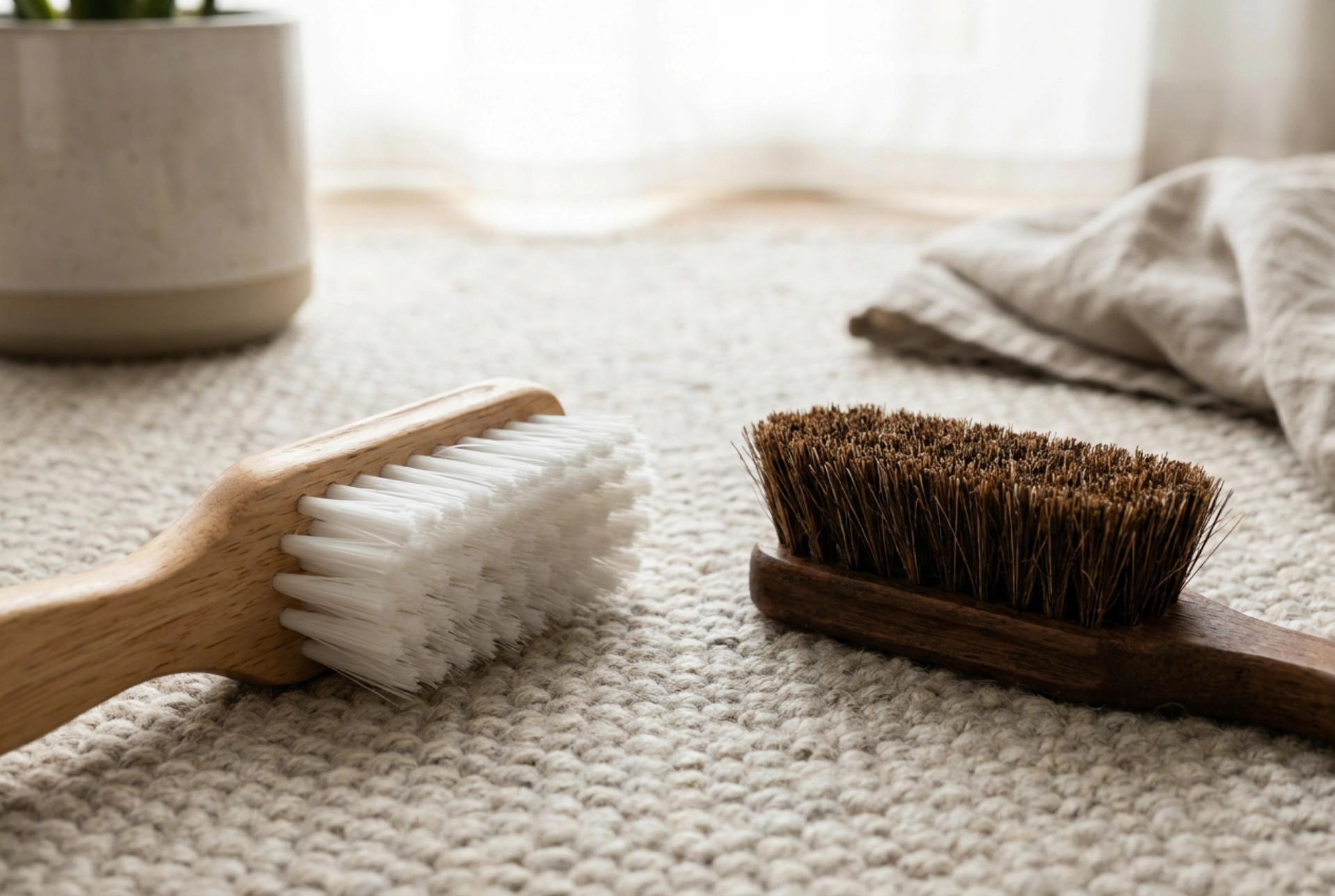
A high-quality carpet cleaning brush is engineered to bend precisely at the point of resistance. To determine if a brush is suitable, perform a simple deflection test: press your thumb into the center of the bristles. A proper carpet brush should deflect easily, absorbing the pressure and spreading it across a larger surface area rather than focusing it into sharp, pinpoint forces. Look for bristles made of high-grade nylon or soft polypropylene with flagged (split) ends. Flagged bristles multiply the contact points at the fiber tip, allowing for thorough soil removal without the need for aggressive downward pressure.
The diameter of individual bristles dictates their stiffness. Optimal carpet brushes feature bristles with a diameter of no more than 0.2 to 0.3 millimeters. This thin profile ensures high elasticity. Avoid brushes with thick, unyielding plastic spikes, which are designed for hard surfaces like grout or concrete, not fibrous textiles.
Order of Operations for Safe Agitation
To clean effectively without risking damage, follow a structured physical approach:
- Dry Vacuuming: Always remove loose, abrasive particulate soil first using a vacuum cleaner with adjustable height settings to prevent grinding dirt deeper into the backing.
- Chemical Application: Apply a mild, neutral-pH surfactant or oxygen-based cleaning solution. Allow it to dwell for five to ten minutes to loosen molecular bonds between dirt and carpet fibers.
- Controlled Agitation: Use the brush in a systematic, overlapping pattern. Do not scrub back and forth with heavy pressure. Instead, employ gentle, circular motions that allow the flexible bristle tips to flick the soil upwards.
- Extraction and Grooming: Blot or extract the moisture, then use a carpet rake or a soft-bristled brush to lift the pile in a single direction, ensuring uniform drying and preventing pile crushing.