

Maintaining an organized socket drawer is not just about workshop aesthetics; it is a systematic approach to preventing workflow disruption and protecting chrome-plated steel alloys from premature degradation. By applying physical principles of spatial arrangement and understanding how storage materials interact with metal, you can create a highly efficient, rust-free environment for your tools.
The Physics of Placement: Sorting by Mass and Drive Size
A primary challenge when storing heavy steel sockets in sliding tool cabinet drawers is kinetic energy. When a drawer is opened or closed rapidly, unsecured tools slide, collide, and chip their protective coatings. To mitigate this, sockets should be arranged systematically based on their drive sizes—typically 1/4-inch, 3/8-inch, and 1/2-inch—and placed in dedicated compartments that restrict lateral movement.
Position the heaviest 1/2-inch drive sockets toward the rear or the center of the drawer. Placing higher-mass items closer to the drawer slides minimizes the torque exerted on the drawer mechanism, ensuring smooth operation and extending the lifespan of the slides. Within each drive category, arrange the sockets in ascending order of their metric or imperial sizes. This linear progression matches human visual scanning patterns, allowing you to instantly identify the exact size you need without lifting multiple pieces to read the stamped markings.
Material Science of Organizers: Foam vs. Plastic vs. Magnetic Rails
The choice of organizer material directly impacts tool longevity and ease of access. Different materials offer distinct mechanical and chemical properties:
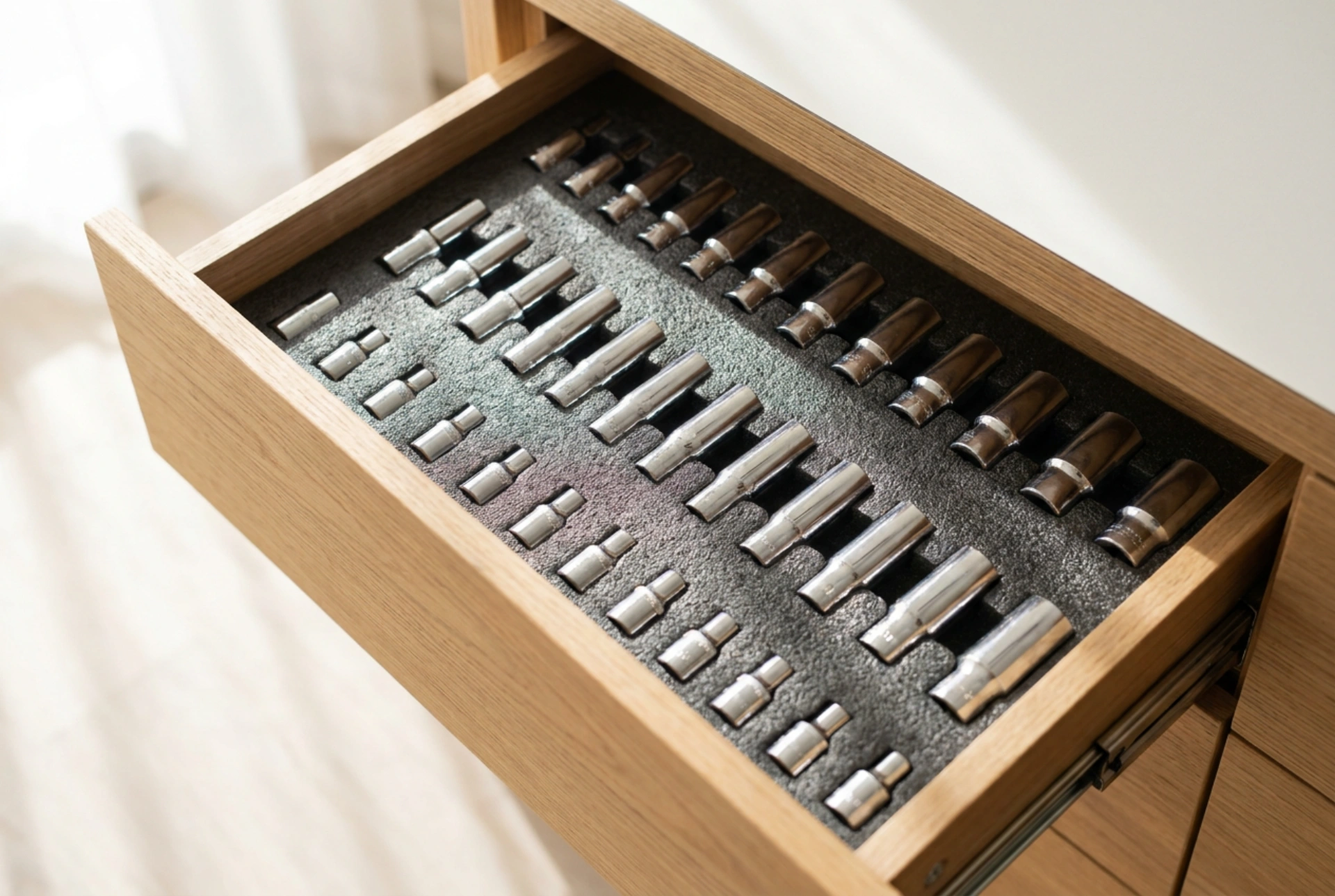
- Closed-Cell Polyethylene Foam (Shadow Boards): Unlike open-cell foam, which acts like a sponge, high-density closed-cell foam does not absorb moisture or oils. Laser-cut or CNC-routed custom foam inserts cradle each socket precisely. This prevents metal-on-metal contact and provides a clear visual cue—often enhanced by a contrasting bottom layer of foam—when a tool is missing.
- Rigid Plastic Trays: Typically molded from impact-resistant polymers like ABS, plastic trays are highly durable and chemical-resistant. However, because they lack the high-friction grip of foam, they should feature deep, molded posts or clips to prevent the sockets from rattling or dislodging when the drawer is moved.
- Magnetic Socket Rails: Utilizing permanent neodymium magnets, these rails secure sockets firmly even in vertical orientations. However, a key physical consideration is residual magnetism. Over time, high-strength magnetic fields can slightly magnetize the chrome-vanadium steel of your sockets. While this helps hold fasteners during assembly, it also causes the sockets to attract fine metallic dust and filings, requiring more frequent cleaning.
Managing Micro-Climates and Preventing Oxidation
Chrome-vanadium and chrome-molybdenum steels are resilient but not immune to oxidation. Toolboxes stored in unheated garages or workshops are subject to rapid temperature fluctuations. When warm, humid air contacts cold metal tools, condensation forms. If these tools are tightly enclosed in non-breathable storage slots, the trapped moisture initiates electrochemical reactions, leading to rust.
To prevent this, ensure that your organizer setup allows for adequate airflow. Avoid packing sockets so tightly that air cannot circulate around their outer circumferences. Before placing sockets back into their designated slots, wipe them down with a clean microfiber cloth slightly dampened with a technical-grade light mineral oil. This leaves a microscopic, hydrophobic barrier that repels moisture. Avoid organic oils, which can degrade and become sticky over time, attracting dust and binding to the surface of your storage inserts.
The Ergonomics of Visual Verification
The ultimate goal of tool organization is to minimize cognitive load during a task. Implementing a clear labeling system on or adjacent to each socket slot eliminates the need to squint at faint laser-etched sizes on oily metal surfaces. High-contrast labels—such as white lettering on a black background—work best in low-light environments. By dedicating a fixed, immutable space to every individual socket, you leverage the psychological phenomenon of spatial memory, training your hand to reach for the correct tool automatically without conscious searching.