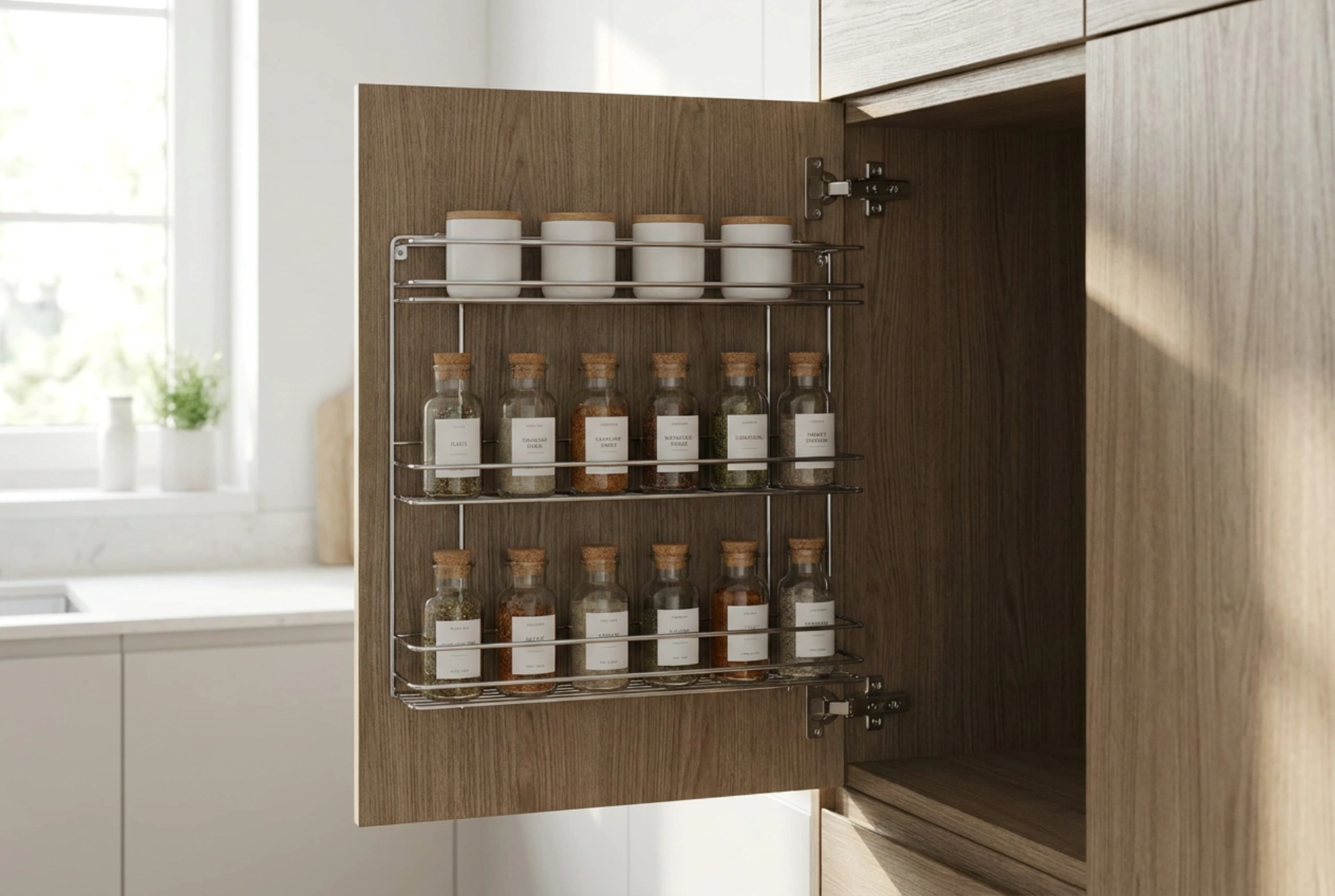


Utilising the shallow space behind kitchen cabinet doors is one of the most effective ways to expand storage capacity, yet it requires careful consideration of physics and spatial geometry to avoid damaging cabinet joinery. By understanding weight distribution, rotational torque, and material limits, you can convert idle door surfaces into highly functional, organised zones without compromising the structural integrity of your cabinetry.
The Mechanics of Door Load and Rotational Torque
Every cabinet door operates as a cantilevered beam supported by hinges. When you add weight to the inside of a door, you introduce additional rotational force, known as torque. Torque is calculated as the force applied multiplied by the distance from the pivot point (the hinge). To minimise the risk of door sagging, misalignment, or hinge failure, you must apply specific physical principles when loading your organiser.
- Load Distribution: Keep the heaviest items as close to the hinge side of the door as possible. Placing weight near the hinges reduces the leverage arm, significantly lowering the bending moment experienced by the mounting screws.
- Weight Limits: Standard concealed hinges are typically engineered to support the weight of the door itself plus a modest margin (usually between 3 to 5 kilograms per pair). Heavy glass jars or liquid containers should be kept off the door to prevent permanent deformation of the metal hinge arms.
- Dynamic Force: Remember that closing a door increases the load dynamically. Rapid deceleration when the door hits the cabinet frame transfers kinetic energy into shear stress on the mounting screws. Dampening pads or soft-close buffers are essential to absorb this kinetic energy.
Spatial Geometry and Clearance Dynamics
Before installing any organiser, you must map the three-dimensional "envelope of motion" of the door and the static internal shelving. The most common error is failing to account for the depth of internal cabinet shelves, which usually extend nearly to the front edge of the cabinet box.
To determine the maximum allowable depth for your door organiser, use a simple depth-clearance test. Measure the distance between the closed door's inner face and the front edge of the internal shelves. In most standard frameless cabinets, this gap is less than 20 millimetres. To utilise this space, you must either recess the internal shelves by cutting them back by 50 to 80 millimetres or align the door-mounted baskets so they sit precisely in the vertical gaps between the shelves.
Additionally, observe the swing path. Because hinges rotate on a specific arc rather than a straight line, the organiser must not collide with the cabinet frame as the door swings open. This requires leaving a lateral buffer zone of at least 15 millimetres on the hinge side.
Mounting Methods: Adhesives vs. Mechanical Fasteners
Selecting how to attach your organiser depends on the door's material properties (solid timber, medium-density fibreboard, or particleboard) and your willingness to make permanent alterations.
Pressure-Sensitive Adhesives
For lightweight organisers, high-performance acrylic foam tapes offer a non-destructive mounting solution. These adhesives rely on viscoelasticity to create a strong molecular bond with the door surface. To ensure maximum adhesion, the surface must be meticulously prepared. Clean the area with isopropyl alcohol to remove grease films that lower surface energy. Apply firm, uniform pressure for at least 30 seconds to activate the polymer flow, and allow the adhesive to cure fully for 24 hours before loading the organiser.
Mechanical Fastening
For heavier wire baskets, short wood screws provide superior mechanical interlocking. However, drilling into thin cabinet doors (often only 15 to 18 millimetres thick) carries a high risk of splitting the wood or puncturing the outer face. Always use a drill stop or a collar on your pilot bit to control the depth precisely. Select thread-forming screws with a deep thread pitch to maximise pull-out resistance in engineered woods like particleboard, which have lower density cores than solid timber.
Thermal and Environmental Considerations
The micro-climate inside your cabinets should dictate what you store on the doors. Kitchens experience rapid fluctuations in temperature and humidity, which can affect items stored in shallow door racks. Avoid storing dried herbs, spices, or sensitive oils on cabinet doors located adjacent to the oven or hob. The heat radiating from these appliances accelerates oxidation and thermal degradation, rapidly depleting the essential oils that give spices their flavour. Instead, reserve these high-movement zones for non-perishable utility items, cleaning cloths, or dry measuring tools.