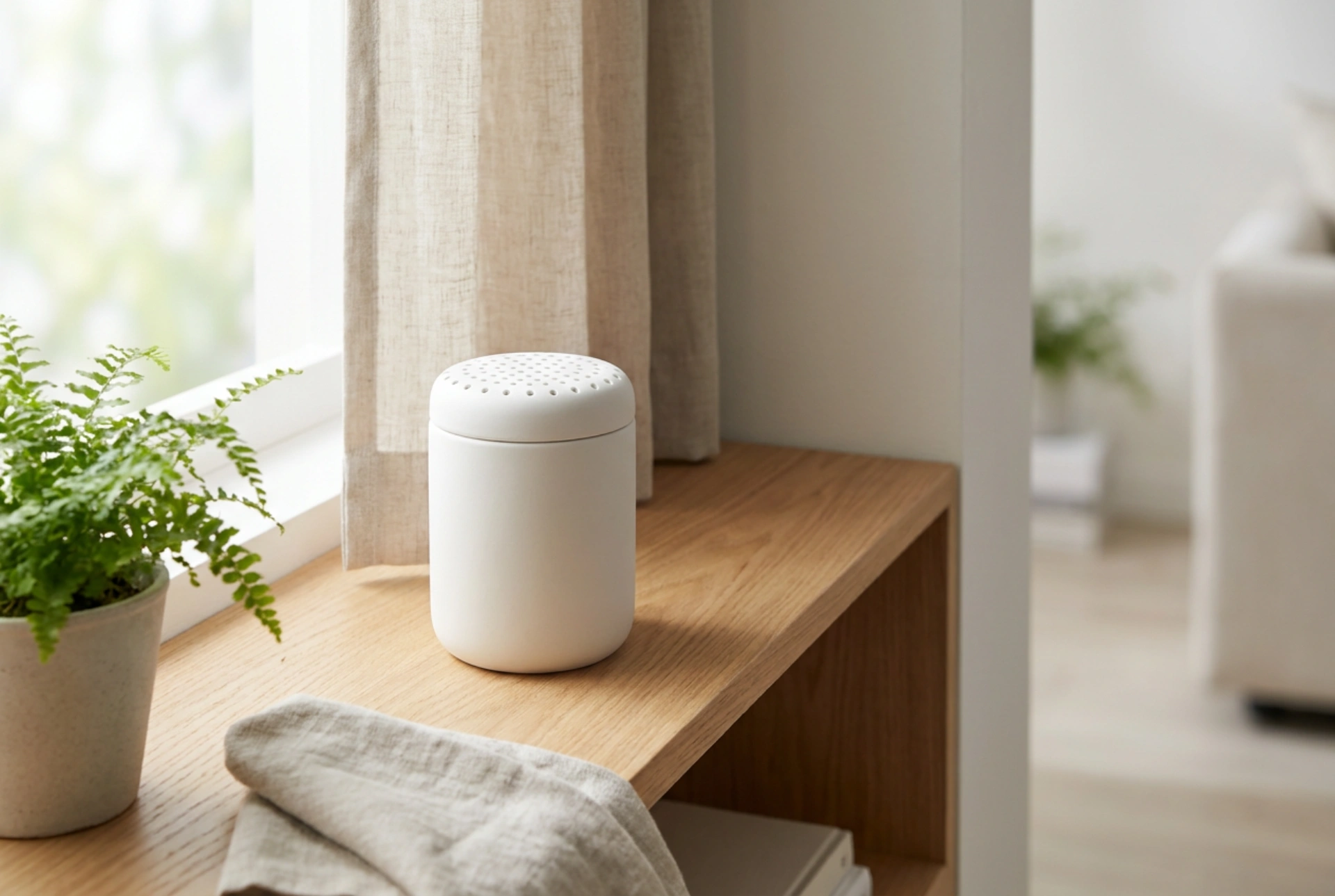


Strategic placement of passive moisture absorbers is essential for controlling indoor relative humidity and preventing localised condensation on cold structural surfaces. To maximise the efficiency of hygroscopic materials, you must position them where stagnant air accumulates and thermal bridges occur.
The Thermodynamics of Moisture and Airflow
To understand where to place moisture absorbers, you must first understand how water vapour behaves indoors. Warm air holds more moisture than cold air. When warm, humid air encounters a cold surface—such as an external wall, window frame, or uninsulated corner—its temperature drops. As the temperature falls, the relative humidity of that local air mass rises until it reaches the dew point, resulting in liquid condensation.
Hygroscopic desiccants, typically utilising anhydrous salts like calcium chloride, operate via deliquescence. This chemical process involves the salt absorbing water vapour from the ambient air until it dissolves into a liquid brine solution. Because this process relies on physical contact between air molecules and the salt crystals, placing an absorber in an area with completely stagnant air limits its zone of influence. Conversely, placing it in a high-draft area might exhaust the desiccant too quickly without solving the root moisture issue. The goal is to find zones of slow, convective air movement near potential condensation points.
Strategic Placement in High-Risk Zones
Different areas of the home present distinct humidity profiles, requiring specific placement strategies to achieve optimal molecular absorption:
- Bathrooms: High-humidity spikes occur during showering. Place the absorber at mid-height, such as on a shelf or windowsill, away from direct water contact. Avoid placing it directly on the floor, as colder floor-level air can slow down the absorption rate of the chemical media.
- Kitchens: Cooking releases significant steam. Position absorbers near external walls or cold corners, but at least two metres away from cooktops. Direct heat from cooking can increase the kinetic energy of water molecules, making it harder for the desiccant to capture them effectively.
- Basements and Utility Rooms: These subterranean or ground-level spaces suffer from lack of natural ventilation and cold masonry walls. Place absorbers centrally or along the dampest wall, raised off the concrete floor on a shelf to prevent the unit itself from cooling down too much, which hinders the chemical reaction.
Navigating Microclimates: Wardrobes and Behind Furniture
Heavy furniture placed flush against external walls creates a stagnant air pocket with a high risk of mould growth. Without convective airflow, the temperature in these gaps drops significantly below the room average. To protect these vulnerable areas, place slim, compact moisture absorbers in the gap between the furniture and the wall, ensuring there is at least a 5 to 10-centimetre clearance for minimal air circulation.
Inside wardrobes, stagnant air combines with organic materials like cotton and wool, which naturally hold moisture. Hang desiccant pouches or place small tub absorbers on the floor of the wardrobe. Since cool air pools at the bottom of enclosed closets, a floor-level placement inside a wardrobe is highly effective at capturing moisture before it can settle into fabrics and cause musty odours.
Optimising Elevation and Air Currents
Height plays a crucial role in how effectively a desiccant interacts with the surrounding environment. Placing an absorber too high (near the ceiling) or too low (directly on a cold tiled floor) can reduce its efficiency. The optimal height for a free-standing moisture absorber is between 1 and 1.5 metres above the ground. At this level, room air currents are generally stable, allowing for a balanced, continuous exchange of air across the salt medium without premature saturation of the chemical compound.