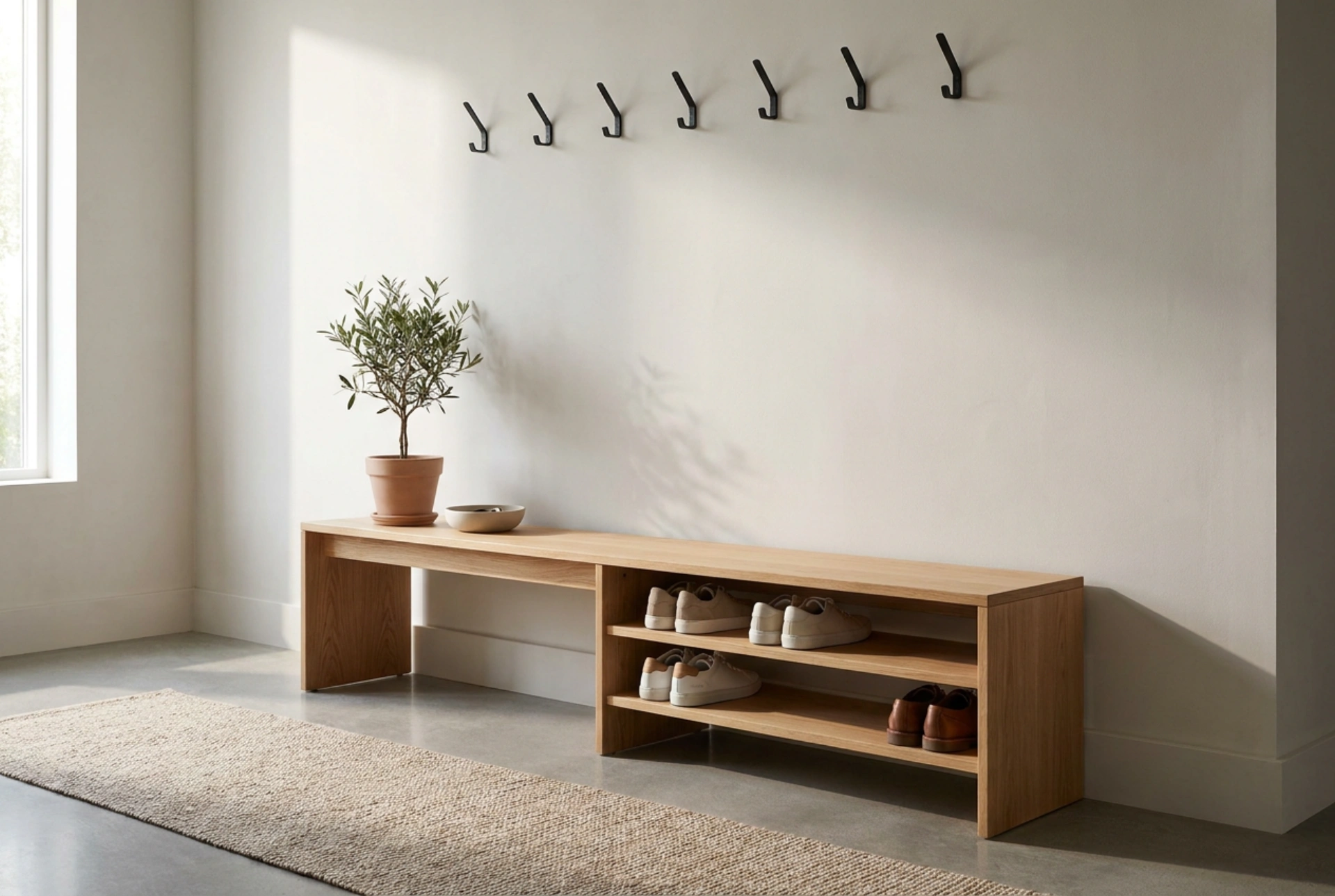


Optimising an entryway requires balancing spatial ergonomics with highly durable material choices to streamline daily physical transitions. Integrating a shoe storage bench with a coat rack creates a functional decompression zone, managing moisture, dirt, and gravitational load before you cross into the living areas of your home.
The Ergonomic Mechanics of Entryway Design
An effective hallway layout relies on the physical sequences of arrival and departure. When entering a home, the body performs a series of deceleration and bending motions that require precise clearance zones. A standard shoe bench should feature a seating surface positioned between 40 and 45 centimetres from the floor, an elevation that minimizes knee and hip strain during footwear removal.
To prevent outer garments from touching stored footwear, the vertical clearance between the coat hooks and the top of the bench must be carefully calculated. A minimum clearance of 110 to 120 centimetres is required for short jackets, whereas trench coats and overcoats require up to 150 centimetres of unobstructed vertical hang. Ensuring this physical separation is critical: it prevents wet or dirty coats from transferring moisture and external particulates onto dry shoes stored below.
Material Science: Combatting Grit and Moisture
Hallway furniture is subjected to extreme mechanical friction and chemical stress. Road grit brought in on shoes consists largely of silica particles, which possess a hardness rating of 7 on the Mohs scale. Without appropriate protective finishes, this abrasive grit will rapidly shear through soft timber lacquers and laminate veneers.
- Powder-Coated Steel: For the primary frame and coat hangers, electrostatic powder coating offers superior impact resistance compared to standard liquid paints. The cured polymer skin resists chipping when struck by heavy metal zippers or keys.
- Cured Wood Finishes: If timber is used for the bench seating, it must be treated with hardwax oils or polyurethane-based sealers. These coatings penetrate the wood grain to block liquid water ingress while allowing internal moisture vapor to escape, preventing the wood fibers from swelling, warping, or cracking.
- Non-Porous Flooring Integration: The area immediately beneath the shoe rack should feature high-density floor materials such as polished concrete, porcelain tiles, or luxury vinyl tiles that resist water pooling and chemical cleaners.
Air Circulation and Odour Prevention
Enclosed shoe cabinets are highly susceptible to moisture trapment. Damp footwear placed inside a non-ventilated wooden enclosure raises the internal relative humidity, creating an optimal microclimate for the proliferation of anaerobic bacteria and fungi. This biochemical process leads to material degradation and persistent odours.
To mitigate this risk, opt for an open, slatted shelf design for shoe storage. Slatted shelves, whether made of metal tubes or treated timber dowels, leverage natural indoor air currents. This convection process accelerates the evaporation of perspiration and external moisture from shoe linings. It also protects the structural integrity of footwear, as prolonged exposure to dampness can weaken the water-based polyurethane adhesives used in modern shoe manufacturing.
Structural Stability and Weight Distribution
A freestanding unit must be structurally engineered to withstand asymmetrical loads. When a person sits on one side of a bench to tie their shoes while heavy winter coats hang from the opposite side, the unit is subjected to severe lateral shear forces and tipping moments. High-tensile wall anchors should secure any combined bench-and-hanger system to the wall studs, transferring the dynamic load safely into the building structure rather than relying solely on floor friction.