

Cleaning tile grout does not require harsh chlorine bleach or exhausting scrubbing if you leverage the principles of household chemistry and capillary action. Understanding how porous cementitious materials interact with organic soils allows you to lift deep-seated grime effortlessly using simple, non-toxic agents.
The Material Science of Tile Grout
To clean grout effectively, one must understand its physical structure. Most household grout is cement-based, making it highly porous and alkaline by nature. These microscopic pores act like a sponge, pulling in moisture, skin oils, soap scum, and environmental dust through capillary action. Over time, these contaminants solidify inside the grout matrix. Applying harsh chlorine-based bleach might mask the discolouration by oxidising the pigments of mould or dirt, but it does not actually remove the physical soil. Furthermore, highly acidic or highly alkaline commercial chemicals can degrade the cement binder over time, causing the grout to crumble and weaken. The key is to lift the dirt out of the pores rather than bleaching it in place.
The Power of Alkaline and Acidic Dissolution
Different types of grime require specific chemical approaches. Soap scum and mineral scale are typically alkaline, whereas greasy kitchen residues and skin lipids are acidic. For general bathroom grout, a mild alkali like sodium bicarbonate (baking soda) is highly effective. When mixed with water, it creates a slightly basic paste that hydrolyses fats and breaks down organic proteins. For areas with hard water buildup or light lime deposits, a mild organic acid such as diluted acetic acid (white vinegar) can dissolve the calcium carbonate bonds. However, because cement is acid-sensitive, acids must be used with caution, diluted properly, and never left on the surface for extended periods to prevent etching the grout structure.
The Role of Temperature and Contact Time
Effective cleaning relies on the four variables of Sinner’s Circle: chemistry, mechanics, temperature, and time. When you eliminate aggressive mechanics (hard scrubbing), you must compensate by increasing contact time and temperature. Warm water (around 50°C to 60°C) significantly increases the solubility of lipids and accelerates chemical reactions. Creating a thick paste of sodium bicarbonate and warm water allows the mixture to remain wet on the grout lines. Leaving this paste undisturbed for 15 to 20 minutes gives the active ingredients time to penetrate the pores via capillary action, loosening the bond between the dirt and the cement walls. As the paste begins to dry slightly, it draws the suspended dirt particles up to the surface.
Gentle Mechanical Agitation Technique
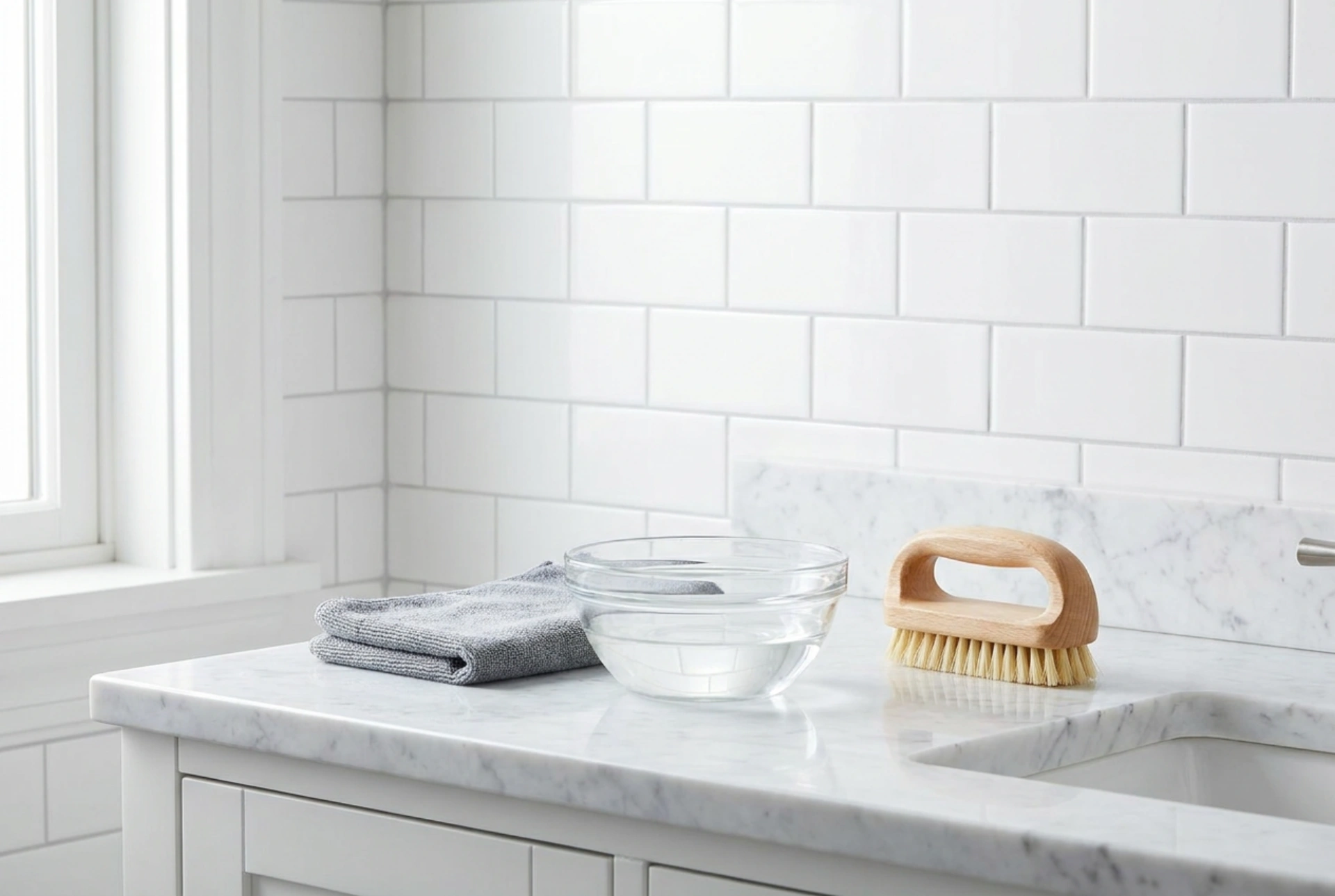
Once the chemical paste has loosened the soil, heavy scrubbing is completely unnecessary. Instead, use a soft-bristled brush or a dedicated grout brush with nylon bristles. The goal of this step is not to scrape the grout, but to create micro-agitation that displaces the loosened particles from the pores. Use light, circular motions rather than harsh back-and-forth sawing movements. Circular agitation ensures that the bristles reach the contour of the grout line from multiple angles, dislodging dirt without wearing down the cement matrix. After agitation, immediately wipe the surface with a damp microfiber cloth to absorb the suspended grime before it can settle back into the pores.
Post-Cleaning Rinsing and Preservation
The final, crucial step is thorough rinsing with clean, warm water to remove any chemical residue. Residual sodium bicarbonate can leave a white, powdery film that attracts new dust. Once the grout is completely dry, consider applying a penetrating grout sealer. Sealers fill the microscopic pores with hydrophobic fluoropolymers or silanes, preventing water and oil from penetrating the grout matrix in the future. This transforms a porous, high-maintenance surface into an easy-to-clean, water-repellent barrier.