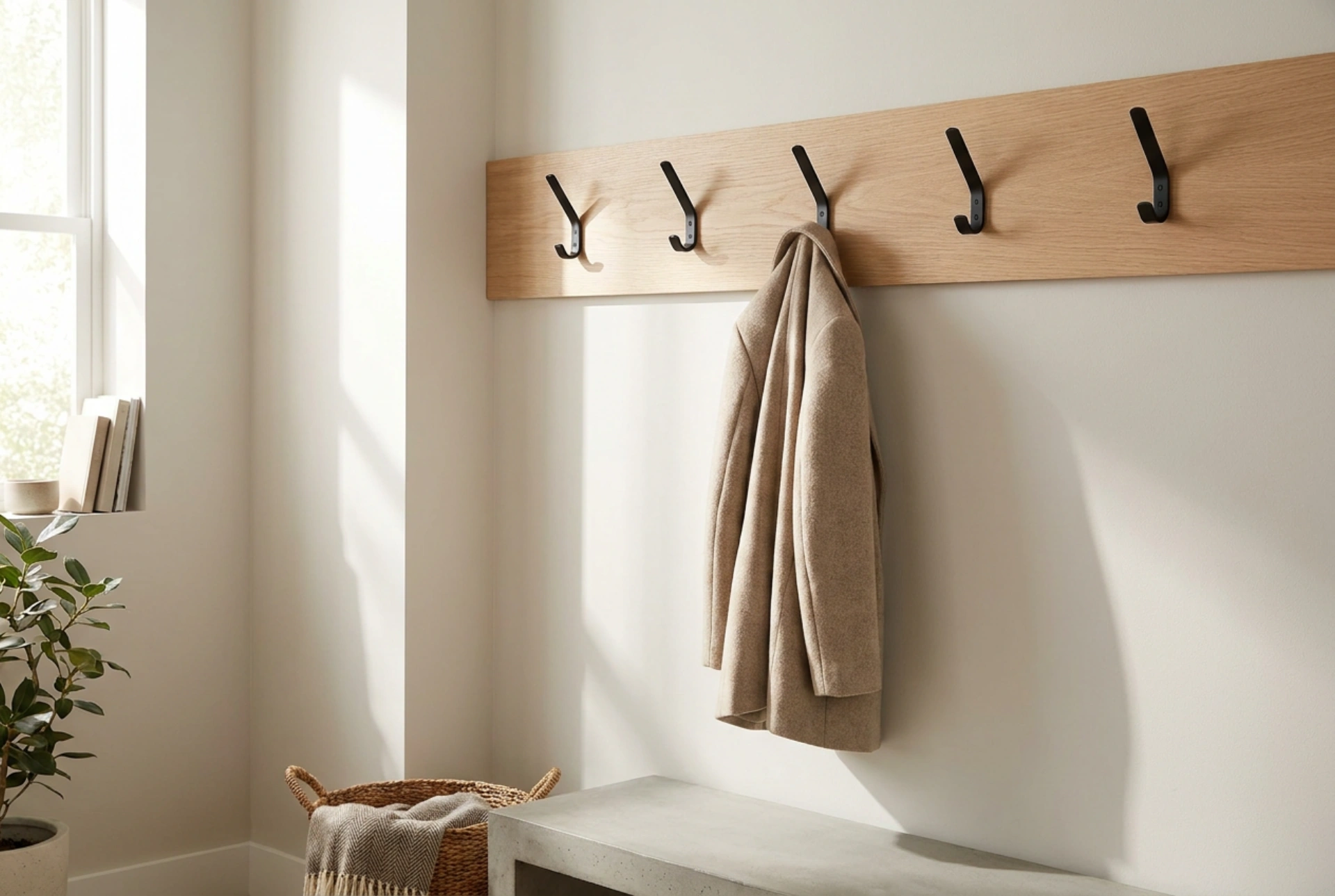


Organising hallway coat hooks requires more than just marking a random line on the wall; it demands an understanding of human ergonomics, garment volume, and wall physics. By calculating proper heights, horizontal spacing, and load distribution, you can create a clutter-free entrance that preserves both your garments and your walls.
The Ergonomics of Hanging: Height Guidelines
The height of your coat hooks should correspond to the natural reach of the household members while keeping garments clear of the floor. For the average adult, the optimal height for primary coat hooks lies between 150 cm and 170 cm from the floor. This range aligns with the standard human shoulder line, allowing you to hang and retrieve heavy coats without straining your shoulders or lower back.
Accommodating Different Coat Lengths
To determine the absolute minimum height for your hooks, you must consider the physical length of your longest garments. A standard winter trench coat or wool overcoat can measure up to 120 cm in length. When hung on a hook at 150 cm, the hem of the coat will sit approximately 30 cm above the floor. This clearance is crucial: it prevents the fabric from dragging in pooled rainwater, salt, or dirt brought in from outside, and leaves sufficient vertical space underneath for a low-profile shoe rack.
Creating Multi-Level Systems
In homes with children, a single-tiered hook system often leads to coats piled on the floor or children stretching unsafely. Installing a secondary tier of hooks at a height of 100 cm to 110 cm allows younger family members to independently manage their belongings. This lower tier can also serve as a dedicated zone for bags, umbrellas, and dog leashes, keeping the primary higher hooks clear for heavy outwear.
Horizontal Spacing and Volume Management
The most common mistake in hallway planning is positioning hooks too close together. While a bare hook occupies very little horizontal space, a heavy down jacket or thick wool coat expands significantly in volume when hung.
Preventing Compression and Overlap
To avoid a crowded, overlapping jumble of fabrics, you should maintain a minimum horizontal distance of 15 cm to 20 cm between individual hooks. When hooks are placed closer than this, the bulk of adjacent jackets compresses the filling (especially down or synthetic loft). Continuous compression reduces the thermal efficiency of insulation materials over time. Furthermore, tight spacing limits airflow, making it difficult for damp coats to dry and increasing the friction that can snag delicate linings when pulling a coat down.
The Staggered Layout Technique
If you have limited wall width but need to hang a high volume of garments, use a staggered, dual-row layout. Mount the upper row of hooks at 170 cm and a lower, offset row at 145 cm. The lower hooks should be positioned horizontally midway between the upper hooks. This creates a zigzag pattern that prevents the shoulders of the coats from colliding, effectively doubling your hanging capacity without increasing the width of the coat rack area.
Structural Integrity and Load-Bearing Mechanics
A single heavy winter coat saturated with rain or snow can easily weigh up to 5 kg. A row of four or five wet coats exerts a continuous downward shear force of over 20 kg on the wall. Securing your hooks requires matching your fasteners to the specific material of your wall.
- Masonry and Concrete: These walls offer excellent load-bearing capacity. Use plastic or nylon expansion plugs that grip the solid boreholes through friction.
- Drywall and Gypsum Board: Hollow walls cannot support heavy, concentrated loads with standard screws. You must use metal toggle bolts or hollow-wall expansion anchors that spread the load across a wider surface area behind the plasterboard.
- The Backboard Solution: To prevent localized structural failure of drywall, mount a solid timber or plywood backboard (at least 15 mm thick) to the wall studs first. You can then screw the individual coat hooks securely into this wooden board at any spacing you require, distributing the overall weight evenly across the wall's structural frame.
Moisture Control and Wall Protection
Wet outerwear transfers moisture to whatever surface it touches. Hanging damp garments directly against a painted or plastered wall blocks air circulation and can lead to peeling paint, plaster degradation, and mold growth. Mounting hooks onto a wooden backboard creates a protective physical barrier. For maximum wall safety, choose hooks with a deeper projection (at least 5 cm to 8 cm from the wall). This physical offset allows air to circulate behind the hanging coats, utilizing natural household convection currents to dry the fabrics quickly and protect your wall's finish.