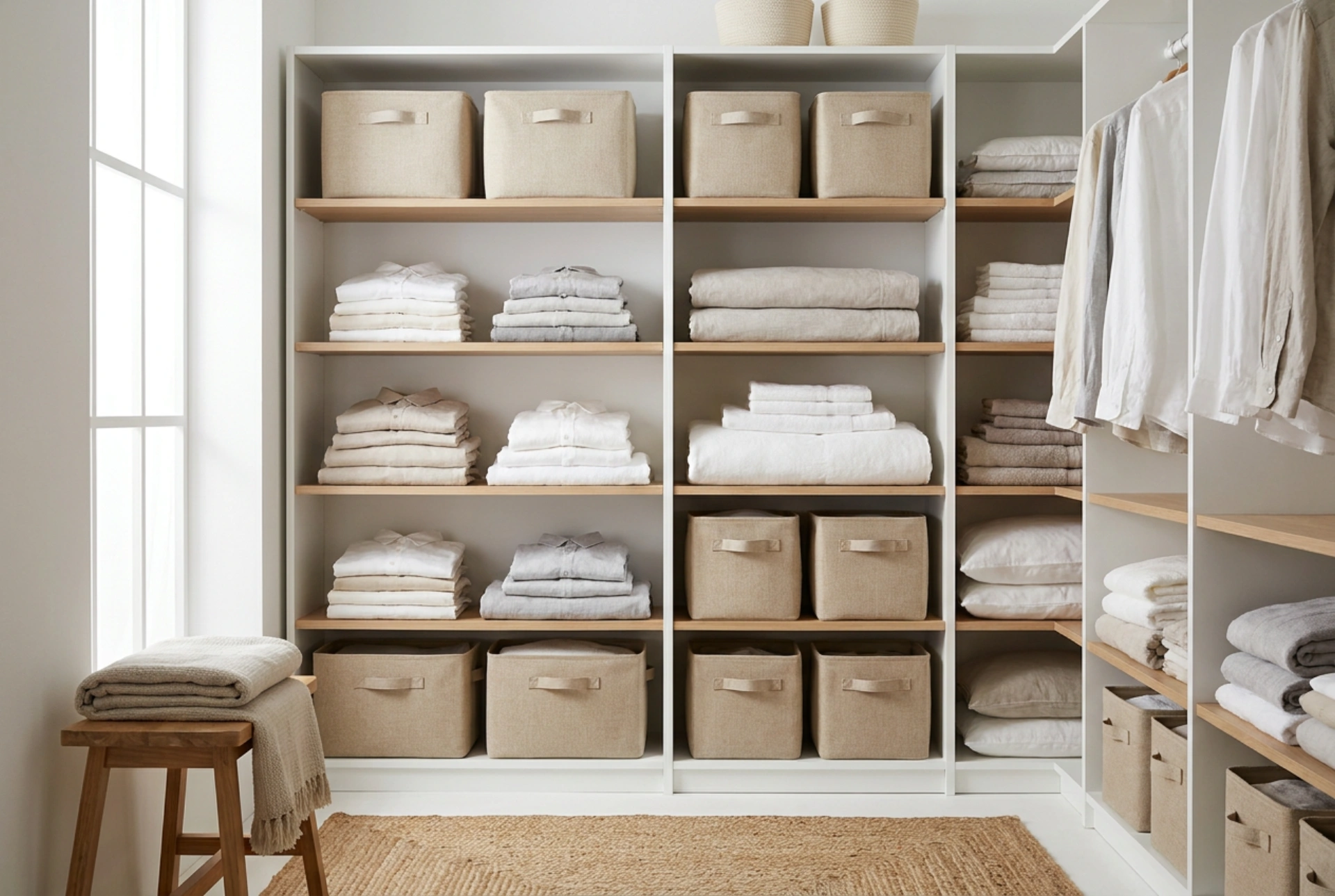


Organizing a white closet with open shelves requires a precise balance of physics, visual discipline, and material science to prevent immediate visual clutter and physical disarray.
The physics of folding and fabric friction
The foundation of a neat shelf lies in how fabrics interact with each other. Different textiles have varying coefficients of friction and structural integrity. Heavy cottons and denim have high friction and hold their shape well, making them ideal for traditional flat stacking. In contrast, slippery synthetics, fine knits, and silk have low friction and tend to slide, causing stacks to topple. To prevent this, implement the filing method (folding items into self-contained rectangles that stand vertically) inside fabric bins. For open shelves, limit stacks of heavy items to five pieces, and lighter items to eight. This limits the gravitational pull on the lower items, preventing them from compressing and sliding outward when you retrieve a single garment.
Visual weight and light reflection in white closets
White closets reflect a high volume of ambient light, which amplifies shadows and color contrasts. Any disorganization or dark, chaotic pile becomes immediately visible. To maintain a serene aesthetic, organize your garments by visual weight and color density. Place lighter, airy fabrics and pale colors on the upper shelves where the light is strongest. Heavy, dark garments should occupy lower shelves. This creates a natural grounding effect. Furthermore, keep the front edges of all folded stacks perfectly aligned with one another, approximately two centimeters back from the shelf edge. This consistent alignment creates a clean shadow line that tricks the eye into seeing absolute order, even if the folding behind it is not entirely perfect.
The chemistry of storage materials
Selecting the right containers for your shelves directly impacts the preservation of your textiles. Avoid cheap plastic bins that emit volatile organic compounds (VOCs) or trap moisture, which can lead to yellowing of fabrics on white shelves. Instead, utilize breathable canvas, linen, or untreated wooden storage boxes. These materials allow air circulation, preventing mustiness. If you use baskets woven from natural fibers like seagrass, always use a fabric liner. The rough fibers of unlined baskets can snag delicate threads and cause micro-tears in knitwear when pulled from the shelf.
Operational flow and shelf zoning
An organized closet must support natural physical movement. Zone your shelves based on frequency of use and the reach zone. The golden zone (between eye level and hip level) must be reserved for daily essentials. Store off-season garments, bulky bedding, and rarely used items on the highest shelves, contained in sealed cotton storage bags to protect them from settling dust. The lowest shelves are ideal for heavy storage bins. When retrieving an item, always use a two-handed technique: lift the garments above the desired item slightly with one hand, and slide the target piece out with the other. This prevents the friction-induced drag that pulls entire stacks out of alignment.