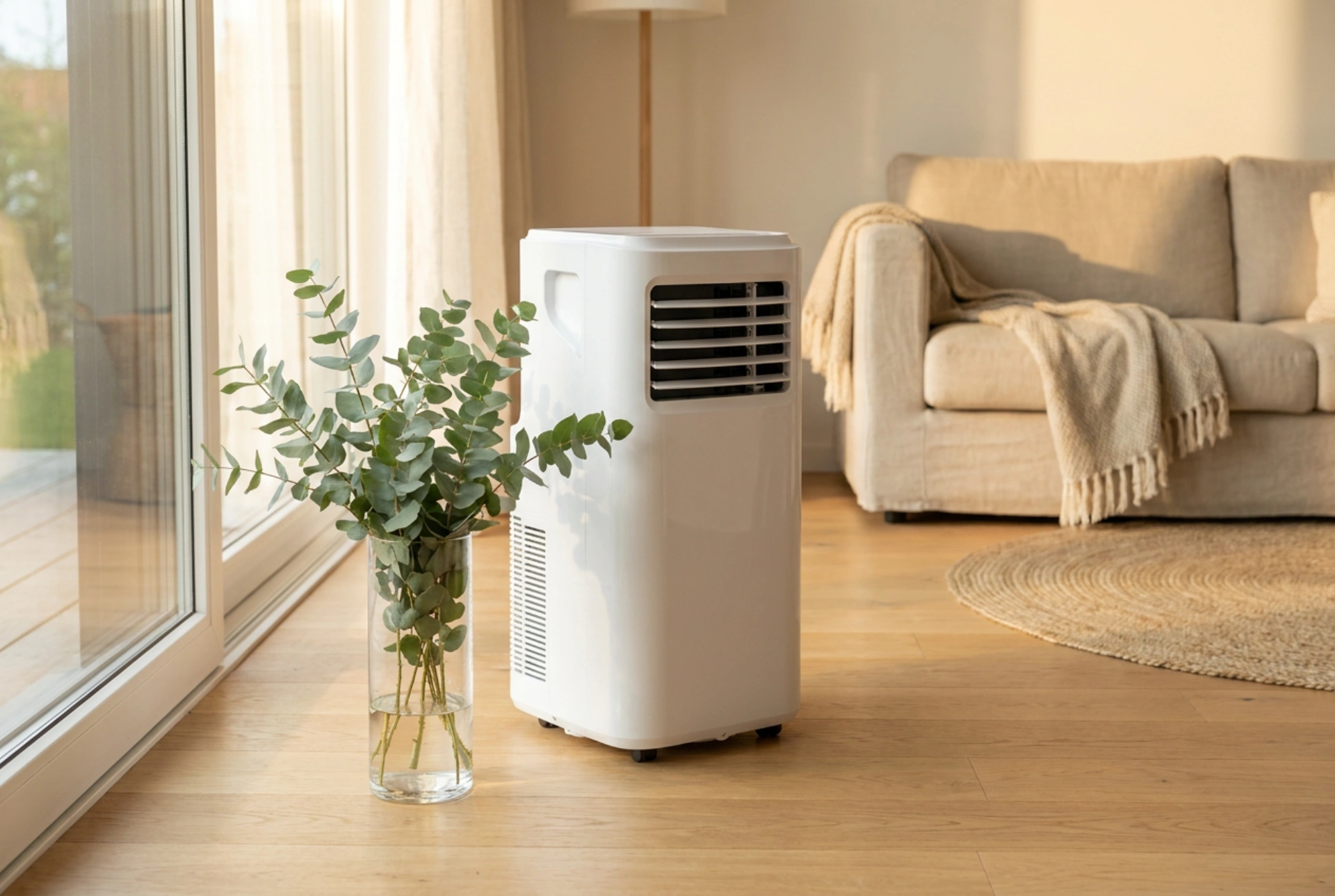


When summer temperatures soar, many search for a quick cooling solution, frequently encountering devices marketed as tubeless portable air conditioners. Understanding the underlying thermodynamic laws of these units is essential to managing indoor temperatures effectively and avoiding common consumer pitfalls.
The Fundamental Physics of Indoor Cooling
To cool an enclosed space, you must physically remove heat energy from the air and transfer it outside. Standard air conditioning systems achieve this through a vapor-compression cycle. In this cycle, a chemical refrigerant absorbs heat from the indoor air at the evaporator coil and releases it outside through a condenser coil. A physical barrier, such as a duct or hose, is required to transport this hot air out of the living space.
Without an exhaust hose routed through a window or wall, any heat extracted from the air by a compressor unit is immediately exhausted back into the same room through its cooling vents. According to the first law of thermodynamics, energy cannot be destroyed, only transformed. Consequently, a true compressor-based air conditioner operating without an exhaust tube will actually increase the room temperature due to the waste heat generated by its own electrical motor.
How Evaporative Coolers Actually Work
Most devices sold as tubeless air conditioners are not actually air conditioners, but evaporative coolers, often called swamp coolers. These appliances utilize a completely different physical mechanism known as evaporative cooling, which relies on the latent heat of vaporization.
- The Process: A fan draws warm, dry indoor air through a wet honeycomb membrane or filter saturated with water.
- The Phase Change: As the air passes through the wet membrane, liquid water absorbs heat from the air to transition into a gaseous state (water vapor).
- The Result: The sensible temperature of the air drops, and a stream of humid, cooled air is blown back into the room.
This process lowers the air temperature without a compressor, but it does not remove heat energy from the room. Instead, it converts sensible heat (which you feel on your skin) into latent heat (stored in the water vapor), raising the absolute humidity of the indoor environment.
The Impact of Relative Humidity on Cooling Efficacy
The performance of an evaporative cooler is strictly limited by the ambient relative humidity. As the air in a sealed room becomes saturated with water vapor, the rate of evaporation slows down significantly. Once the relative humidity reaches a critical threshold (typically around sixty percent), water can no longer evaporate efficiently from the cooling pad or from human skin.
When this saturation point is reached, the device ceases to cool the air and instead creates a damp, sultry microclimate. This high humidity inhibits the body's natural cooling mechanism—the evaporation of sweat—making the room feel warmer and more uncomfortable than before. Therefore, these devices are highly effective in hot, arid climates but are fundamentally inefficient in naturally humid coastal or temperate summer conditions.
Optimizing Air Circulation and Temperature Control
To get the most out of an evaporative cooling unit, specific operational techniques must be applied. Unlike traditional air conditioners, which require sealed windows to keep hot air out, evaporative coolers require constant ventilation to prevent humidity buildup.
Positioning the unit near an open window allows it to draw in fresh, dry outdoor air. An opposite window or door should be cracked open slightly to create a cross-draft, allowing the warm, humid air to escape the room. Additionally, using cold water and adding ice to the internal reservoir can maximize the temperature drop during the initial phase change, providing a more noticeable localized cooling effect.