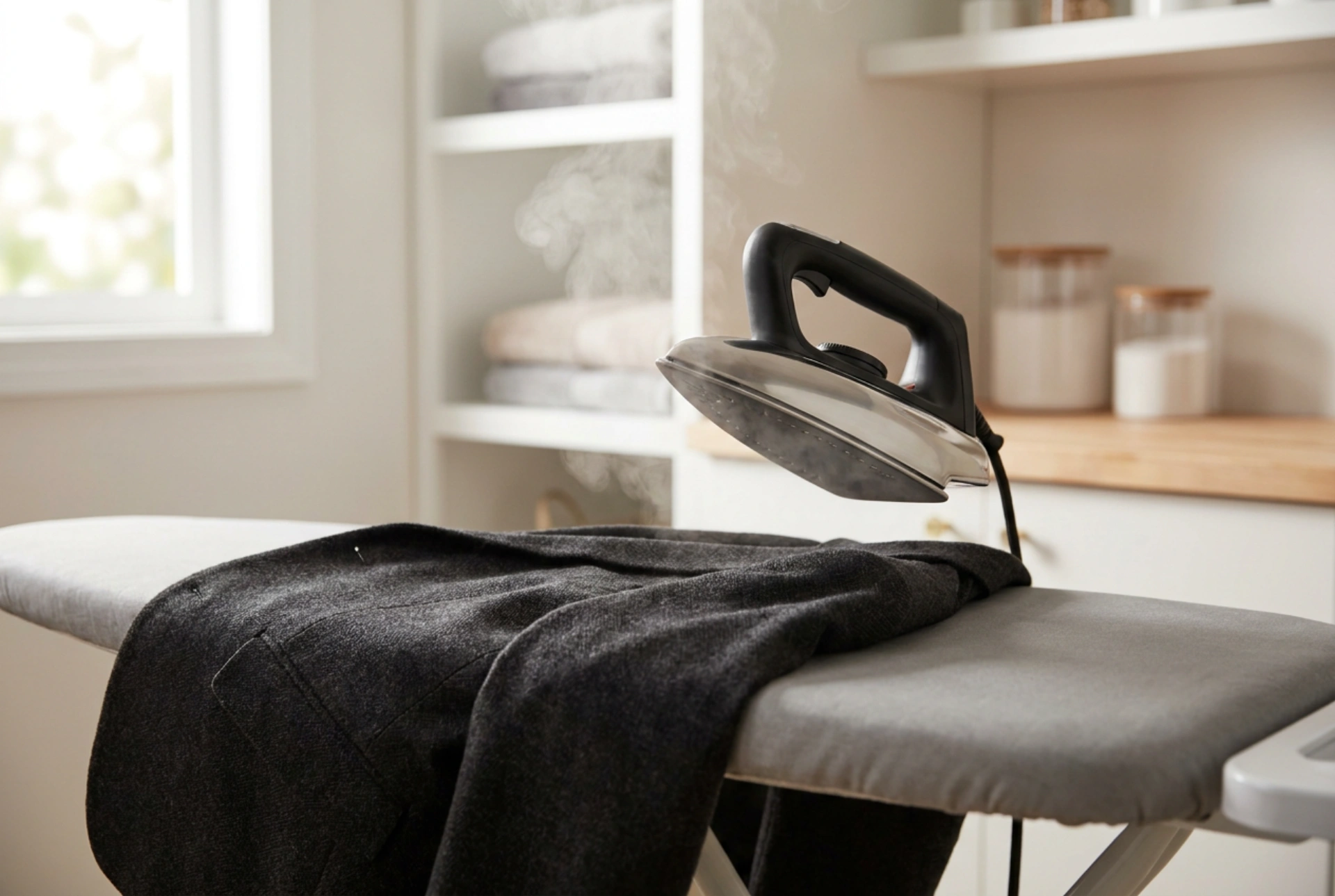


Ironing a tailored suit jacket at home requires a precise balance of temperature, moisture, and pressure to prevent permanent fabric damage and structural warping.
The Physics of Fabric Shine and Fiber Flattening
The dreaded shiny patches that appear on ironed suit jackets are caused by a combination of excessive heat and direct mechanical pressure. Most high-quality jackets are constructed from natural protein fibers like wool, or synthetic blends containing polyester. When subjected to the hot, flat metal soleplate of an iron, these delicate fibers melt slightly or flatten permanently. Instead of diffusing light naturally, the flattened surface reflects light uniformly, creating an unsightly sheen. To prevent this, you must always create a physical barrier. A clean, damp cotton pressing cloth or a professional Teflon shoe attachment for your iron acts as a thermal buffer, diffusing the heat and preventing direct contact between the metal soleplate and the delicate textile fibers.
Preserving the Roll of the Lapel
One of the most common mistakes when ironing a jacket is pressing the lapels completely flat against the chest panel. Tailored lapels are designed with a natural, soft roll rather than a sharp, creased fold. Pressing a hard crease into the lapel ruins the three-dimensional silhouette of the jacket and strains the internal canvas lining. To maintain this crucial structural curve, you should never iron directly over the lapel fold. Instead, place the jacket on the ironing board, gently press only the body of the lapel from the front side using a pressing cloth, and allow the rolled edge to curve naturally over the edge of the board or a rolled-up towel without applying any direct pressure to the crease line itself.
The Correct Order of Operations for Jacket Pressing
Structuring your workflow prevents you from wrinkling sections of the jacket that you have already finished. Follow this precise sequence for the best results:
- Sleeves and Shoulders: Start with the sleeves. Use a sleeve board if available, or insert a rolled-up heavy cotton towel inside the sleeve to act as a firm, curved pressing cushion. Work from the shoulder seam down to the cuff, avoiding pressing hard creases into the sleeve edges.
- Yoke and Shoulders: Fit the shoulder area over the narrow end of the ironing board. Press gently, rotating the jacket to follow the natural curve of the shoulder seam.
- Back and Side Panels: Lay the back of the jacket flat on the board. Ensure the internal lining is smoothed out underneath to prevent pressing deep wrinkles into the fabric. Press with vertical movements, following the direction of the grain line.
- Front Panels and Lapels: Finish with the front panels, paying close attention to pockets and buttons. Place a thick cloth over the pocket flaps to prevent their outlines from embossing onto the main fabric of the jacket.
Harnessing Steam and Gravity
For high-quality wool jackets, high temperature is rarely necessary; moisture and tension are far more effective. Wool fibers are highly hygroscopic, meaning they readily absorb water vapor. When exposed to steam, the hydrogen bonds within the wool fibers temporarily relax, allowing the fabric to shed wrinkles naturally under its own weight. If you do not have a dedicated garment steamer, you can use the burst-of-steam function on a standard iron. Hold the iron two to three centimeters away from the fabric, hover over the wrinkled areas, and let the steam penetrate the fibers. Immediately smooth the fabric with your hand or a wooden tailor's clapper to set the fiber shape without applying direct heat.
Post-Pressing Stabilization
Freshly ironed or steamed fibers are highly susceptible to deformation while they are still warm and damp. Never wear or pack a jacket immediately after pressing. Hang the garment on a wide, contoured wooden hanger that matches the width of the jacket's shoulders. Allow the jacket to cool down and dry completely in a well-ventilated area for at least thirty minutes. This stabilization phase ensures the structural shape sets properly and prevents new wrinkles from forming immediately upon wear.