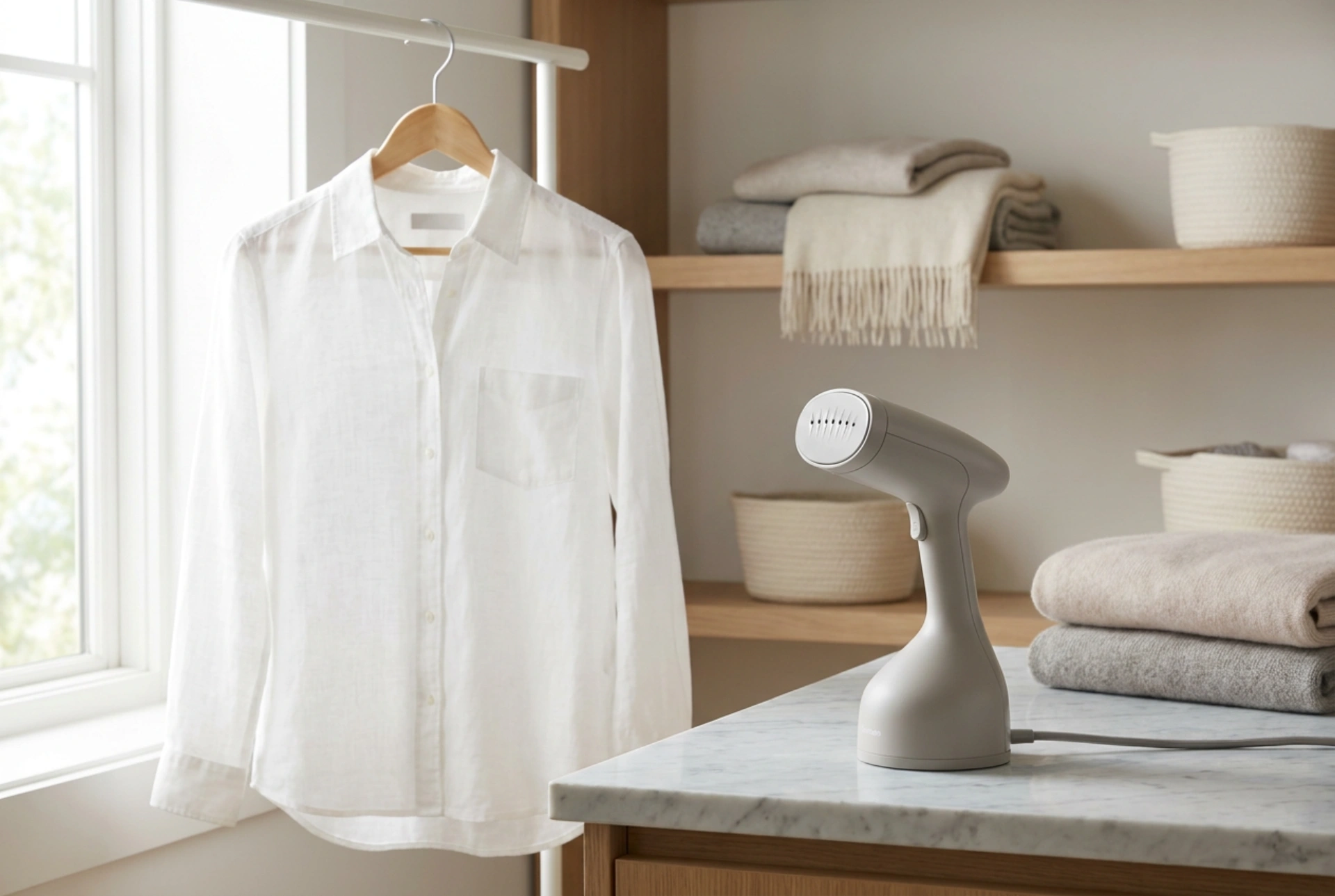


Choosing the right garment steamer for daily clothing maintenance requires understanding how steam volume, thermal kinetics, and fabric physics interact to relax textile fibers without causing damage.
The Physics of Steam and Fiber Relaxation
To understand why steam is highly effective for daily refreshing, we must look at the molecular structure of woven fabrics. Natural fibers like cotton, linen, and wool are held together by hydrogen bonds. When garments are worn, folded, or compressed, these bonds lock into distorted positions, creating visible creases. High-temperature water vapor acts as a catalyst, breaking these temporary hydrogen bonds. As the heat relaxes the polymer chains within the fiber, the natural weight of the fabric pulls it back into its original, smooth shape. Unlike traditional ironing, which uses heavy physical pressure and direct thermal contact, steaming relies on moisture and gravity. This minimizes the risk of friction damage, structural flattening, or the unsightly shine often left on delicate synthetics.
Key Technical Parameters: Output and Heat-Up Time
When selecting a garment steamer for daily use, several technical specifications dictate its actual performance in a busy morning routine:
- Steam Flow Rate: Measured in grams per minute (g/min), this is the most critical metric. For lightweight fabrics like silk, polyester blends, and thin cotton, a hand-held device delivering 15 to 22 g/min is sufficient. For heavy denim, wool coats, or thick linen, a continuous output of 25 to 35 g/min is necessary to penetrate the denser weave.
- Water Tank Capacity: A small reservoir (under 150 ml) allows for rapid heating but may only handle one or two garments before requiring a refill. Larger tanks (200 ml to 350 ml in hand-held units) provide longer runtimes at the expense of added physical weight during operation.
- Heating Element Wattage: Units ranging between 1200W and 1800W offer the best balance. Higher wattage translates directly to shorter heat-up times (often under 45 seconds) and more consistent steam generation without water spitting.
Soleplate Material and Temperature Control
The interface where the steam meets the fabric is crucial. Modern garment steamers generally feature either plastic, aluminum, or ceramic-coated soleplates. Aluminum plates conduct heat rapidly but can friction-drag on delicate synthetics if they are not perfectly clean. Ceramic-coated plates provide the smoothest glide, distributing heat evenly and minimizing static electricity buildup. For daily refreshing, select a device with a heated soleplate. This design reheats the steam right at the exit nozzle, preventing condensation from forming water droplets that can leave water spots on delicate fabrics like silk or satin.
The Mechanics of Correct Steaming Technique
Proper physical movement is vital to maximize the efficiency of your device. Always hang the garment at eye level. Tension is the key to successful crease removal: hold the bottom hem of the clothing taut with one hand while moving the steamer head vertically with the other. Move from top to bottom, allowing the rising steam to pre-heat the fabric above. For heavier materials, press the soleplate directly against the fabric to force the steam deep into the weave. For highly delicate, sheer, or embroidered items, maintain a distance of two to three centimeters from the surface to prevent thermal distortion.