

Installing a slim tumble dryer in a confined bathroom requires a precise understanding of thermodynamic principles and ventilation dynamics to prevent moisture accumulation and equipment overheating.
The Thermodynamics of Condensation and Heat Exchange
Most modern slim tumble dryers utilize condenser or heat pump technology. Unlike traditional vented models that expel moist air through a duct, these systems rely on internal thermal cycles. A heat pump dryer works by circulating warm air through the drum to absorb moisture from wet fabrics. This humid air is then directed across an evaporator, where it cools rapidly, causing the moisture to condense into a liquid state for collection. The dry air is then reheated and recirculated. For this heat exchange process to remain efficient, the appliance must continually dissipate excess heat into the surrounding environment. If a slim dryer is squeezed into a tight recess without adequate space, the ambient room temperature climbs. As the ambient temperature rises above thirty degrees Celsius, the condenser struggles to cool the internal damp air efficiently. This thermal bottleneck slows down the cycle, dramatically increases energy consumption, and places unnecessary mechanical stress on the compressor.
Calculating Spatial Clearance and Convective Air Currents
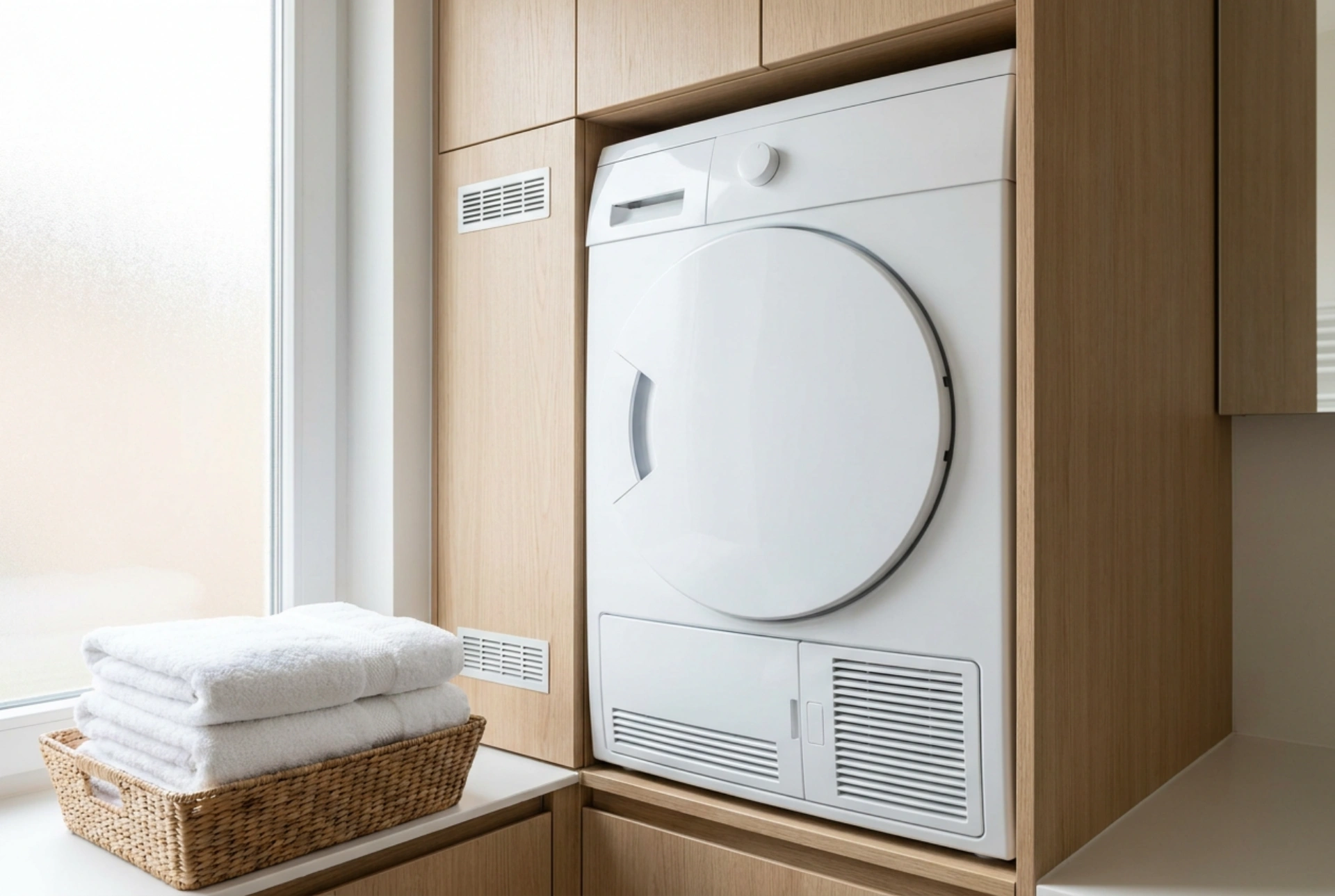
Installing a slim dryer, which is defined by its reduced depth of forty-five to fifty centimeters, often tempts homeowners to push the unit flush against walls or partition panels. However, air movement requires physical space. You must maintain specific clearances to facilitate natural convection. At least twenty millimeters of clearance on the sides and fifty millimeters at the rear are necessary to prevent heat traps. Warm air naturally rises due to its lower density, creating a low-pressure zone near the floor that draws in cooler air. If this airflow is blocked, the machine will draw in its own exhausted hot air, short-circuiting the cooling cycle. When integrating a slim dryer under a countertop, ensure there is a clear ventilation pathway at the back or integrate an open-mesh ventilation grille into the worktop surface directly above the rear of the machine.
Integrating Bathroom Ventilation with Dryer Cycles
A small bathroom is naturally prone to high relative humidity, which directly interferes with the condensation efficiency of a dryer. To optimize air quality and machine performance, active air exchange is vital. Bathroom extraction fans should remain operational throughout the entire drying cycle. Furthermore, the bathroom door must feature a sufficient bottom gap, typically a minimum of twenty millimeters, or an integrated ventilation grille to allow makeup air to enter the room. This prevents a localized vacuum and ensures that fresh, cooler air can replace the warm, moist air being displaced by the dryer. Managing the room's dew point prevents water vapor from condensing on cold tile surfaces, mirror glass, or plaster walls, which can lead to mold growth.
Maximizing Heat Transfer Through Strict Maintenance
Proper air circulation is not just about the space surrounding the machine; it is also about the internal airflow velocity. The internal fan relies on unobstructed paths to push air through the drum and heat exchanger. Lint accumulation acts as a thermal barrier and physically blocks the micro-meshes of the filters. Cleaning the lint screen after every single cycle is critical to maintaining designed air velocity. Additionally, the fine fins of the condenser unit must be inspected and vacuumed regularly. Dust build-up on these metallic fins reduces their thermal conductivity, forcing the system to run longer and hotter. Ensuring the condensate collection tank is emptied or that the gravity drain hose is free of kinks also reduces thermodynamic load, allowing the pump to operate within its engineered pressure parameters.