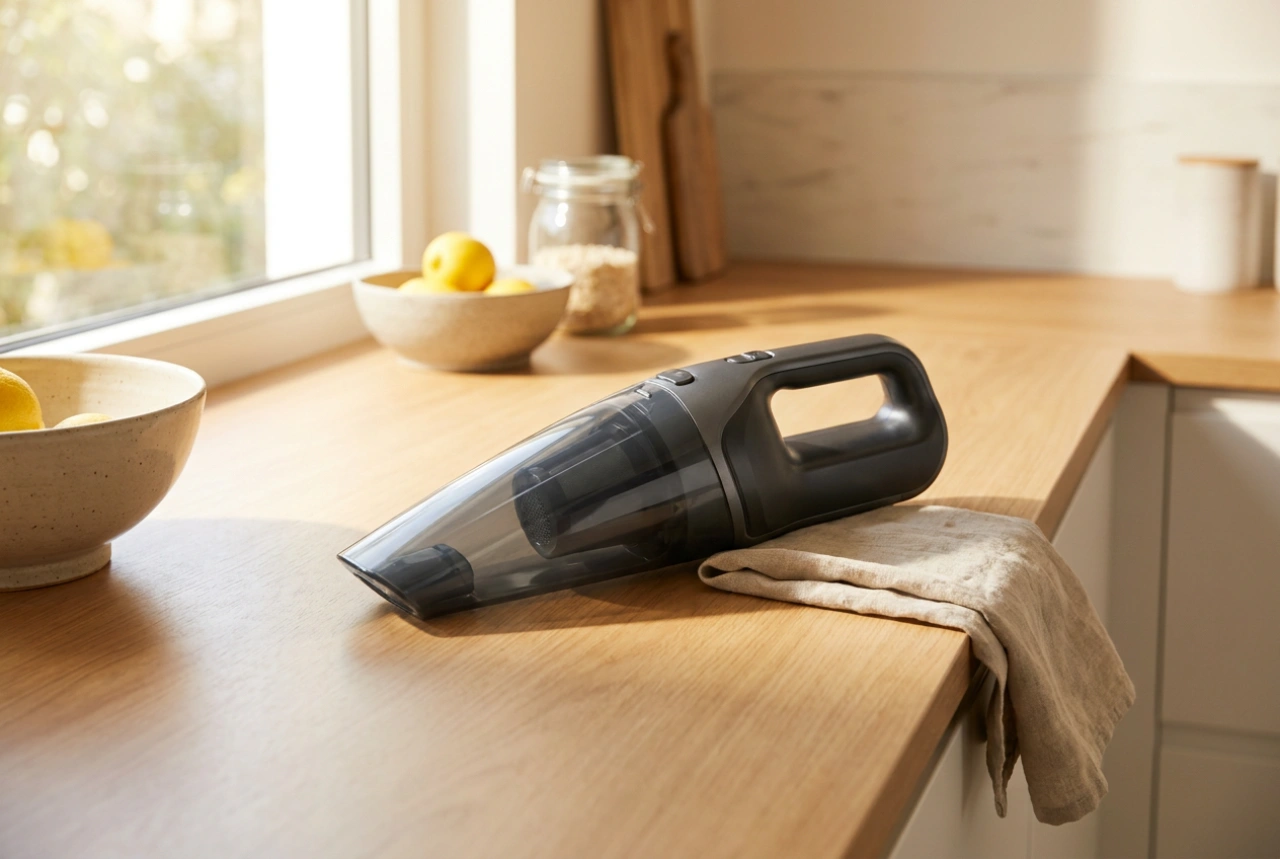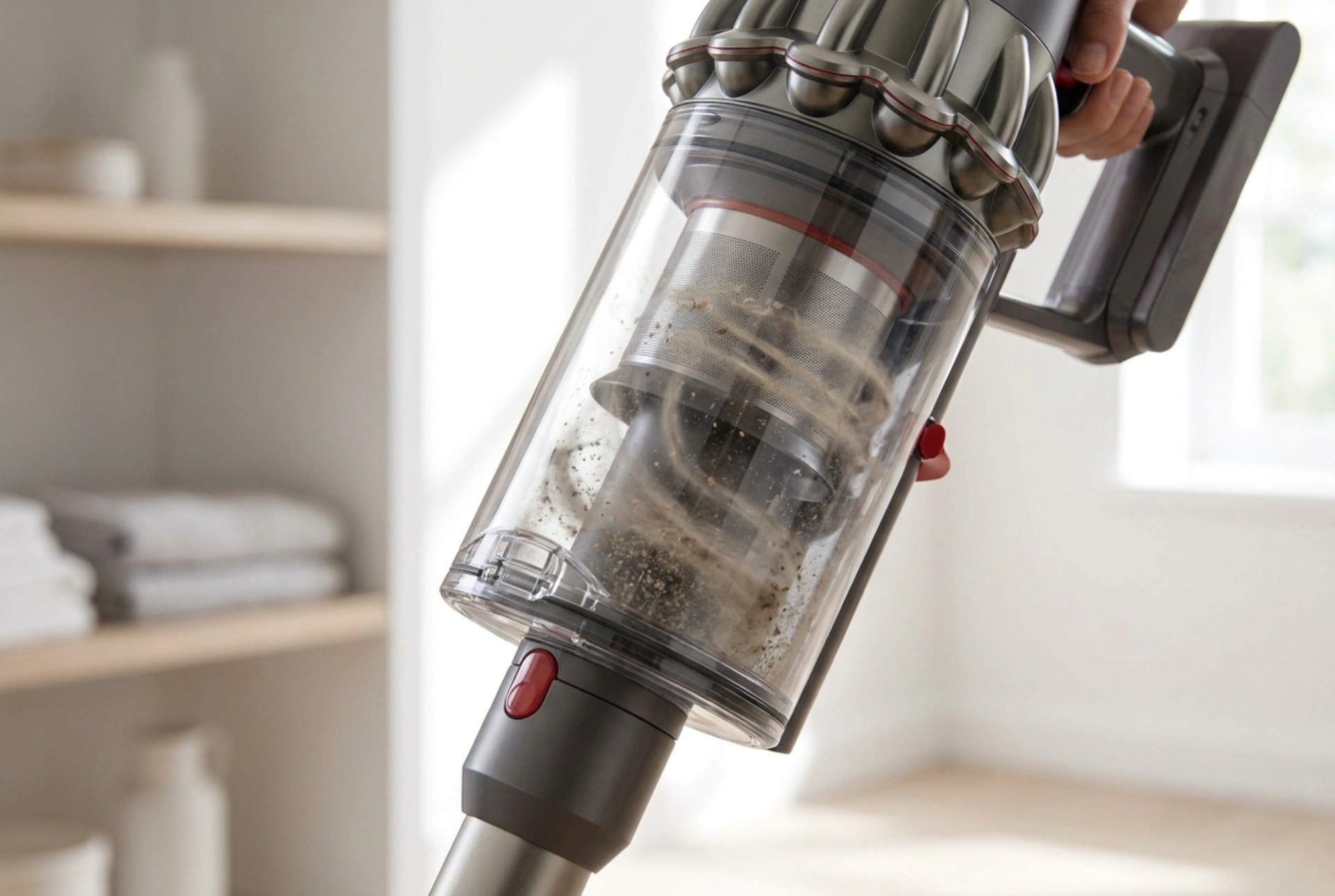


Cyclonic separation uses centrifugal force to isolate dust and debris from the airflow without relying on a traditional porous paper bag. Understanding the physics of this process is key to maintaining your vacuum cleaner’s suction power and extending its operational lifespan.
The Physics of Cyclonic Separation
Traditional vacuum cleaners rely on bags that act as physical barriers, trapping dust while allowing air to pass through. However, as the pores of the bag fill with particles, air resistance increases, causing suction power to drop. Cyclonic vacuum cleaners solve this problem using fluid dynamics. When air is drawn into the cylindrical chamber, it enters tangentially. This offset entry forces the air to spin rapidly, creating a powerful vortex.
As the air rotates, centrifugal force acts on the suspended particles. According to physical laws, the force acting on a particle is directly proportional to its mass and the square of its velocity, and inversely proportional to the radius of the turn. Because dust particles are significantly denser than air molecules, they are slung outward toward the walls of the cyclone chamber. Once they hit the walls, they lose kinetic energy and slide down into the collection bin. The cleaned air, now free of larger particles, moves toward the center of the vortex where it exits upward through a central tube known as the vortex finder.
Multi-Stage Filtration and the Shroud
Most modern vacuum cleaners do not rely on a single cyclone. They utilize a multi-stage system. The first stage, or the primary cyclone, removes large debris, pet hair, and coarse dirt. The air then passes through a fine metallic or plastic shroud containing thousands of micro-perforations. This shroud blocks fibers and hair from entering the inner chambers.
After passing the shroud, the air often enters a series of smaller, secondary cyclones. These mini-cyclones have a much smaller radius. According to the formula for centrifugal force, a smaller radius dramatically increases the G-force acting on the remaining microscopic dust. These high-speed micro-vortices separate fine dust particles that escaped the primary stage. Finally, the air passes through a pre-motor foam filter and a post-motor particulate filter (often a HEPA filter) to catch any remaining sub-micron particles before the air is exhausted back into the room.
Why and When to Clean the Cyclone System
While cyclonic systems do not clog in the same way as bags, they are not maintenance-free. Over time, fine dust particles, held together by static electricity or ambient moisture, begin to coat the inner walls of the cyclones and the microscopic holes of the shroud. When these passages become restricted, the velocity of the air spin decreases. Since centrifugal separation relies entirely on velocity, any reduction in airspeed causes the cyclone to fail. Instead of separating, fine dust is carried directly into the secondary foam and HEPA filters, clogging them rapidly and straining the motor.
You should inspect and clean your cyclonic assembly when you notice the following signs:
- A noticeable drop in suction power, even when the dust bin is empty.
- The motor pitch changes, sounding higher or more strained, which indicates air restriction.
- Visible dust cake blocking the fine mesh of the metal shroud.
- A musty smell during operation, indicating organic matter is trapped in the damp dust layer.
A Step-by-Step Cleaning Protocol
To restore the system's aerodynamic efficiency, follow a systematic cleaning approach. First, disconnect the appliance from its power source or remove the battery. Empty the dust bin completely, tapping it gently to release electrostatic dust.
Carefully separate the cyclone assembly from the motor housing. Use a dry, soft-bristled brush to sweep away dry dust build-up from the shroud and the entry ports of the mini-cyclones. Always perform this dry cleaning step first; adding water directly to thick dust creates a muddy paste that can easily clog the narrow vortex passages.
If the manufacturer allows wet cleaning of the cyclone pack, rinse the plastic and metal components under cold or lukewarm running water. Do not use chemical detergents, solvents, or abrasive pads, as these can degrade the seals and alter the smooth plastic surfaces required for optimal airflow. Never submerge any part containing electrical contacts or the motor.
The most critical step in the entire process is drying. All components must dry completely for at least 24 to 48 hours in a well-ventilated space. If even a small amount of moisture remains inside the cyclone chambers when the vacuum is turned on, dry dust will instantly stick to the wet surfaces, creating an impermeable crust that is nearly impossible to remove and can lead to mold growth.