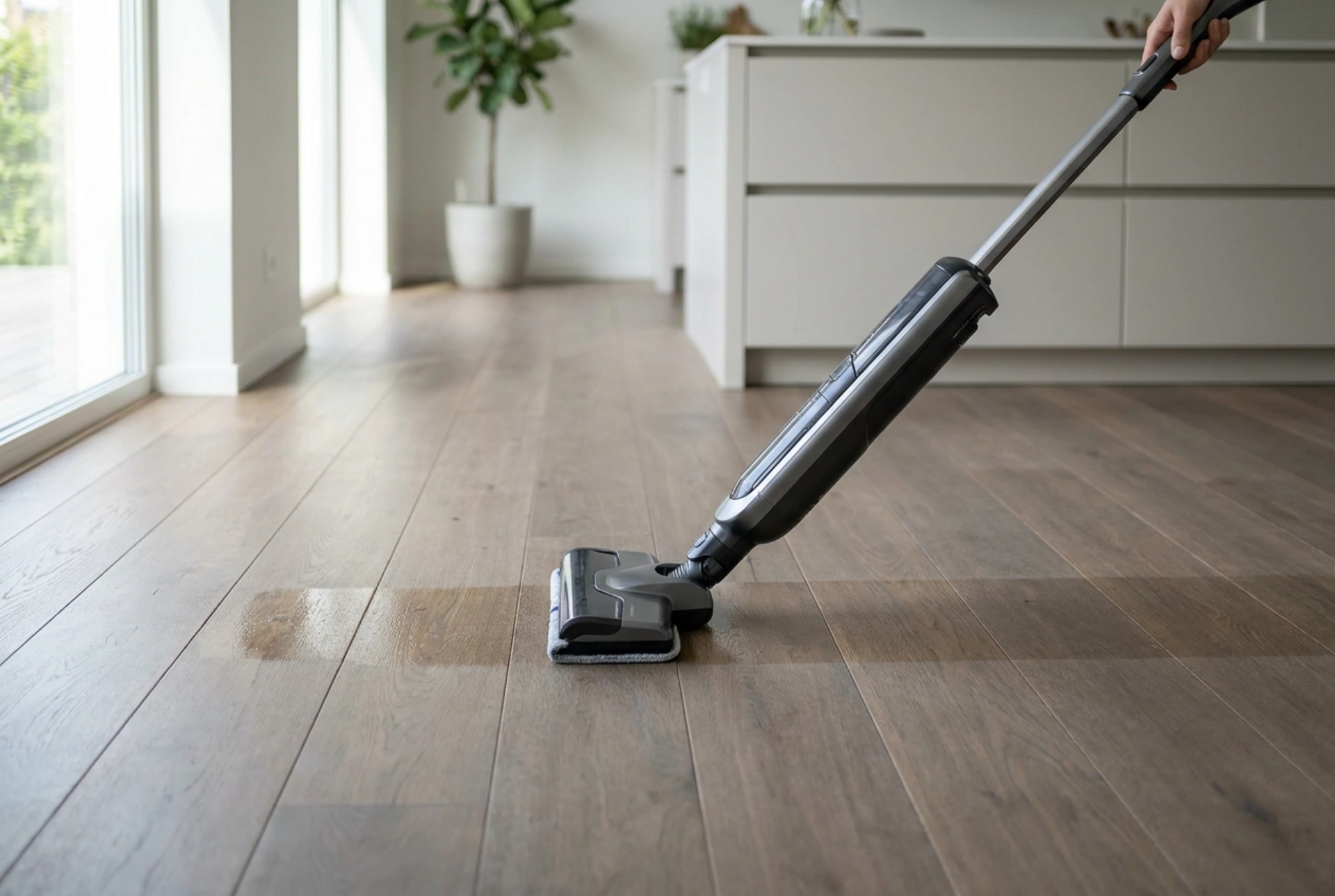


Achieving a bone-dry, streak-free finish with a wet-and-dry vacuum mop depends less on the power of the machine and more on understanding fluid dynamics and surface tension. By adjusting your cleaning speed, direction, and liquid temperature, you can drastically reduce evaporation times and protect sensitive floor materials.
The Mechanical Science of Suction and Extraction
Unlike traditional mopping, which redistributes dirty water and relies entirely on natural evaporation, a wet-and-dry vacuum relies on mechanical extraction. The key to rapid drying lies in maximizing the air velocity at the nozzle head. When water is applied, it forms a microscopic liquid film bound to the floor by surface tension. The squeegee and suction channel must create a brief, airtight seal to break this tension and lift the moisture.
Moving the machine too quickly prevents the suction boundary from forming. This leaves behind fine micro-droplets that slowly evaporate, leaving mineral deposits and streaks. To prevent this, your movement must align with the extraction speed of the vacuum engine, allowing the squeegee to scrape and the airflow to lift the moisture in a single, fluid pass.
The Two-Step Stroke Technique
To optimize both cleaning efficiency and drying speed, decouple the washing and drying phases. Continuous water application during both forward and backward movements oversaturates the floor and overwhelms the extraction channel. Implement the following sequence:
- The Forward Wash: Push the machine forward at a steady pace while engaging the water trigger. The rotating roller mechanically agitates the surface, loosening soil, while the clean water solution lowers the friction coefficient between the roller and the floor.
- The Backward Dry: Release the trigger completely and pull the machine backward over the exact same path. Pulling the vacuum backward tilts the suction nozzle and squeegee blade at the optimal angle against the floor surface, sealing the vacuum chamber and pulling every drop of residual water into the recovery tank.
Water Temperature and Surface Tension Dynamics
The physical properties of the water in your clean tank play a critical role in drying times. Using cold water increases both viscosity and surface tension, making it harder for the vacuum to lift and causing it to cling to the micro-textures of the flooring.
Using warm water, ideally between 35 and 40 degrees Celsius, lowers the surface tension. Warm water spreads more evenly, allowing the roller brush to distribute it as an ultra-thin film rather than pooling. Furthermore, warm water absorbs heat energy from the floor and surrounding air, accelerating the kinetic energy of the water molecules. This triggers rapid phase change from liquid to vapour for any molecular moisture left behind. Always avoid excessive foaming detergents; surfactant bubbles trap moisture on the floor and block the vacuum's airflow pathways.
Stroke Alignment and Room Ventilation
To avoid leaving wet streaks at the turn-around points, overlap each path by approximately 5 to 10 centimetres. This ensures that any moisture pushed sideways by the outer edges of the roller brush is captured by the central suction zone of the next pass. Always work in straight lines parallel to the grain of timber or the long joints of tiles, which prevents water from pooling in the recesses.
Finally, support the mechanical extraction with natural airflow dynamics. High relative humidity stalls evaporation. Creating a gentle cross-draft by opening windows on opposite sides of the space ensures a continuous supply of dry air, keeping the vapour pressure gradient steep and pulling remaining moisture off the floor surface instantly.