

Cordless vacuum cleaners offer unmatched mobility, but their utility is strictly bound by the thermodynamic and chemical limitations of their power source. Opting for a model with a removable battery pack fundamentally changes how you manage home maintenance by eliminating downtime and extending the lifetime of the appliance.
Thermal Dynamics and Cell Degradation in Cordless Vacuums
Lithium-ion cells power modern cordless vacuums because of their high energy density and lightweight profile. However, high-draw appliances like vacuums pull substantial current from these cells, which generates considerable internal heat. When a battery is integrated permanently inside the unit, it cannot dissipate heat quickly during continuous use, leading to accelerated thermal degradation of the cathode and anode materials.
A removable battery system allows you to decouple the thermal stress of discharging from the thermal stress of charging. By swapping a hot, depleted battery for a cool, fully charged one, you prevent the vacuum's internal components from absorbing residual heat. This physical separation allows the depleted battery to cool down naturally to room temperature before being subjected to the electrical resistance of the charging cycle, preserving the chemical integrity of the cells over hundreds of additional cycles.
Eliminating Cleaning Interruptions and Optimising Workflow
The standard operating time of a cordless vacuum on maximum suction can be as low as ten minutes. If the battery is sealed, a depletion event halts cleaning for several hours while the cells slowly recharge. A removable system completely rewrites this workflow through a simple swap-and-go mechanism.
- Continuous operation: By alternating between two battery packs, one can charge while the other discharges, effectively creating an infinite loop of operational capability for larger homes.
- Suction strategy: You can utilise high-power modes on heavily soiled carpets without the anxiety of running out of power before reaching the hard floors.
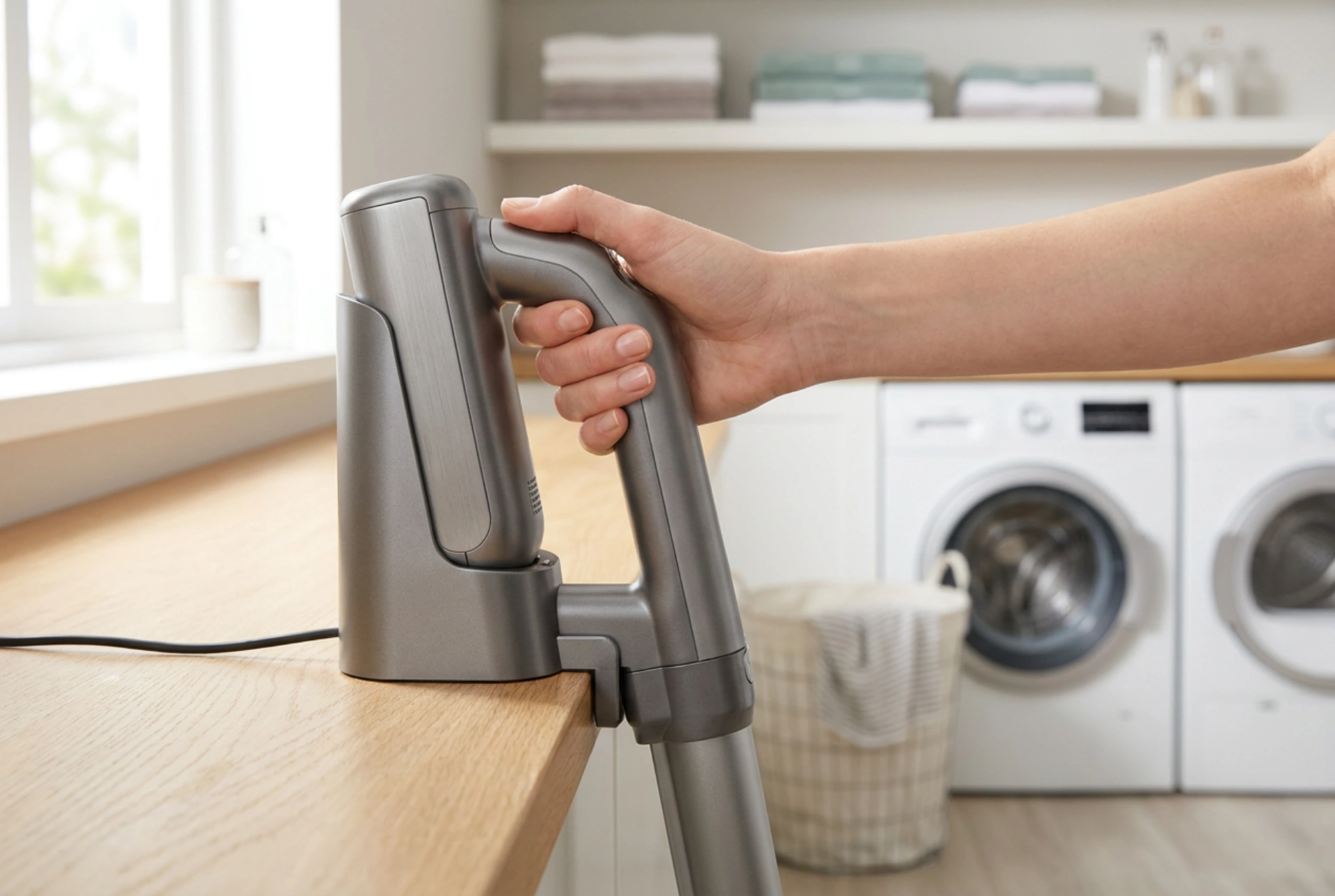
- Flexible stationing: The charging dock does not need to be mounted near a power outlet alongside the bulky vacuum body; only the compact battery dock requires a plug.
The Material Science of Battery Longevity
All battery cells experience capacity fade, a natural process where lithium ions become permanently trapped in secondary chemical reactions, reducing the charge-carrying capacity of the pack. When an integrated battery fails, the entire appliance often becomes electronic waste, despite the motor, cyclonic separators, and brush roll being in perfect working order.
A removable battery isolates the most volatile and wear-prone component of the machine. When the battery eventually reaches the end of its chemical lifespan, typically after 300 to 500 full charge-discharge cycles, it can be recycled separately and replaced with a fresh pack. This modular design aligns with circular economy principles and ensures that your initial investment in the vacuum's mechanical hardware remains protected for years.
Optimising Charge Cycles for Peak Performance
To maximise the efficiency of removable battery systems, specific handling protocols should be observed. Lithium-ion cells operate most efficiently when kept between 20% and 80% state of charge. Deep discharging, which is running the battery until the vacuum completely shuts down, places extreme physical stress on the internal copper electrodes, which can lead to microscopic short circuits over time.
With a secondary battery available, you can easily swap packs as soon as the charge indicator drops to the final bar, avoiding the damaging deep-discharge zone. Additionally, storing spare batteries in a cool, dry environment, ideally between 15 degrees Celsius and 25 degrees Celsius, prevents self-discharge and preserves the chemical stability of the electrolyte solution inside the cells.