

Vacuuming fine cold ash with a compact household vacuum cleaner often ends in clogged filters, damaged motors, and a cloud of grey dust resettling over your living space. Successfully clearing fireplace or stove residue with small-scale equipment requires understanding particulate physics, utilizing auxiliary filtration, and controlling air velocity.
The Physics of Fine Ash and Standard Filtration
Wood ash is not typical household dust; it consists of microscopic inorganic compounds, primarily calcium carbonate, potash, and silica. Many of these particles are smaller than 2.5 micrometres in diameter. When a compact vacuum draws in this ultra-fine particulate, the high velocity of the airflow forces the sharp, irregular ash structures deep into the microscopic pores of standard filters. This leads to immediate suction loss and can cause "blow-by," where fine dust escapes the seals of a basic filter and is blown directly back into the room through the exhaust port, posing an inhalation hazard.
Ensuring Absolute Thermal Inertia
Before introducing any mechanical suction, you must ensure the ash is completely cold. Smouldering embers can hide beneath a layer of insulating grey ash for over 48 hours. Because compact vacuums rely on plastic housings, synthetic filters, and rapid airflow (which introduces fresh oxygen), vacuuming even slightly warm ash can instantly melt components or trigger an internal fire. To verify thermal inertia, stir the ash pile thoroughly with a metal poker and use a metal scoop to check the deeper layers. If any warmth is detected, wait another 24 hours before proceeding.
Employing the Sacrificial Barrier Technique
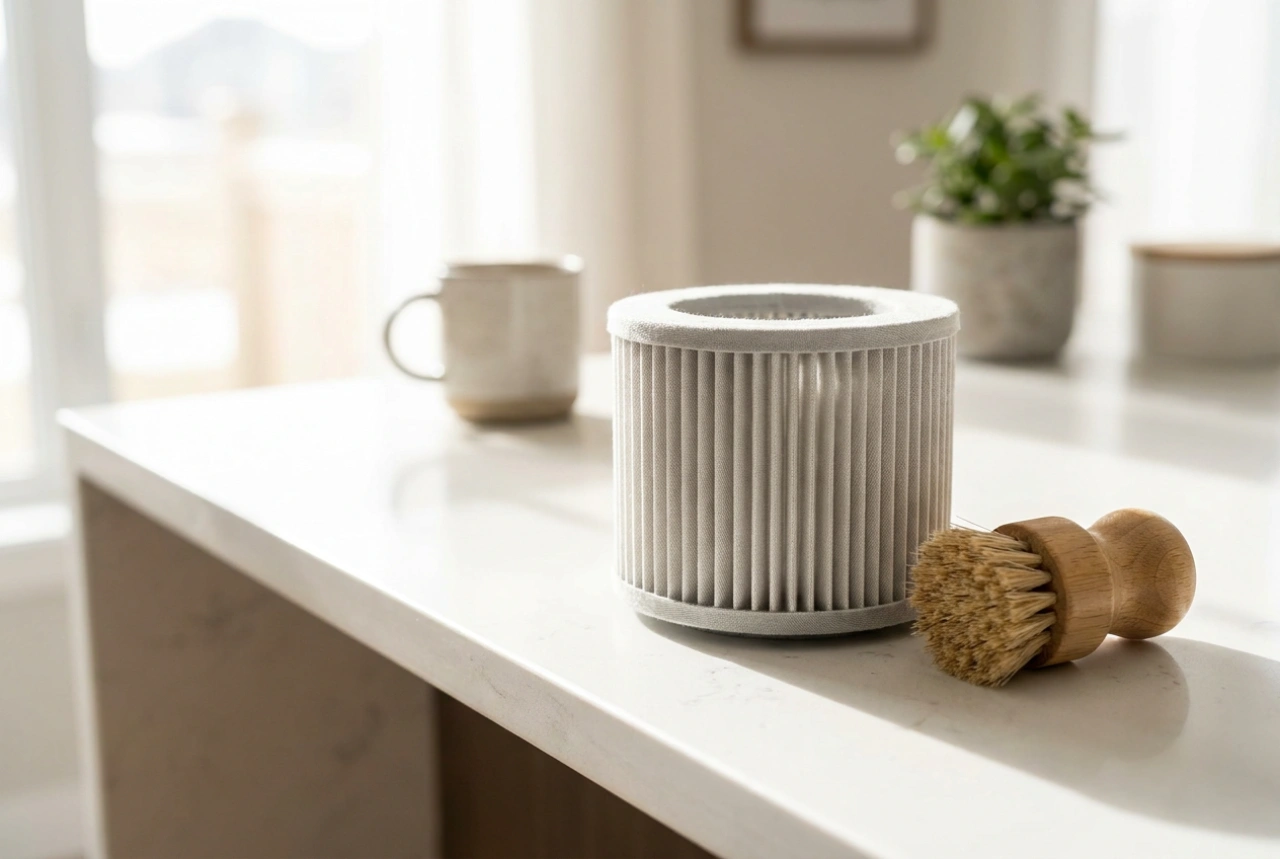
If you must use a small handheld or compact vacuum directly, you must protect its primary filter from clogging. This is achieved by creating a sacrificial pre-filter barrier. You can wrap a single layer of dry, fine-mesh material (such as a nylon stocking or a dry-wipe sheet) tightly around the pleated filter cartridge, securing it with an elastic band. This barrier intercepts the larger, static-charged ash flakes before they wedge themselves into the deep crevices of the paper or fabric filter. When the suction drops, you simply peel off and discard the outer layer, keeping the core filter clean and functional.
The Ash Separator: A Physics-Based Solution
The most efficient way to use a small vacuum cleaner for fireplace maintenance is to pair it with an ash separator. This is a sealed metal container placed between the fireplace and your vacuum cleaner. The separator utilizes cyclonic force and gravity: as the dirty air enters the metal canister at an angle, it spins rapidly. The heavier ash particles lose momentum, hit the metal walls, and fall to the bottom of the container, while only the lightweight, pre-filtered air is drawn into your compact vacuum. This completely eliminates filter clogging and protects the vacuum motor from abrasive dust.
Controlled Vacuuming Techniques and Dust-Free Emptying
When vacuuming, your physical technique determines the amount of airborne dust. Keep the nozzle close to the surface, buried slightly in the ash pile, rather than hovering above it. Moving the nozzle in slow, linear paths prevents air turbulence from kicking up dust clouds. Once finished, do not open the vacuum canister directly into an open bin. Take the unit outdoors, place the entire canister inside a large bin bag, seal the bag tightly around your wrists, and then release the dustbin latches. Let the airborne particles settle inside the sealed bag for two minutes before removing your hands.