

Standard overhead room lighting often makes floors appear perfectly clean, while a layer of fine dust, pet dander, and microscopic debris remains hidden. Integrating low-angle LED lights onto a vacuum cleaner nozzle utilizes fundamental optical physics to expose these concealed particles through contrast and shadow creation.
The Science of Raking Light and Shadow Casting
The primary reason LED lights on a vacuum nozzle reveal dust is a phenomenon known in optical science and art conservation as 'raking light' or grazing light. When light originates from overhead fixtures, it strikes the floor at a near-perpendicular angle. This perpendicular light illuminates both the floor surface and the dust particles equally from above, washing out any potential shadows. Because dust particles are exceptionally thin, they do not cast visible shadows under diffuse overhead lighting.
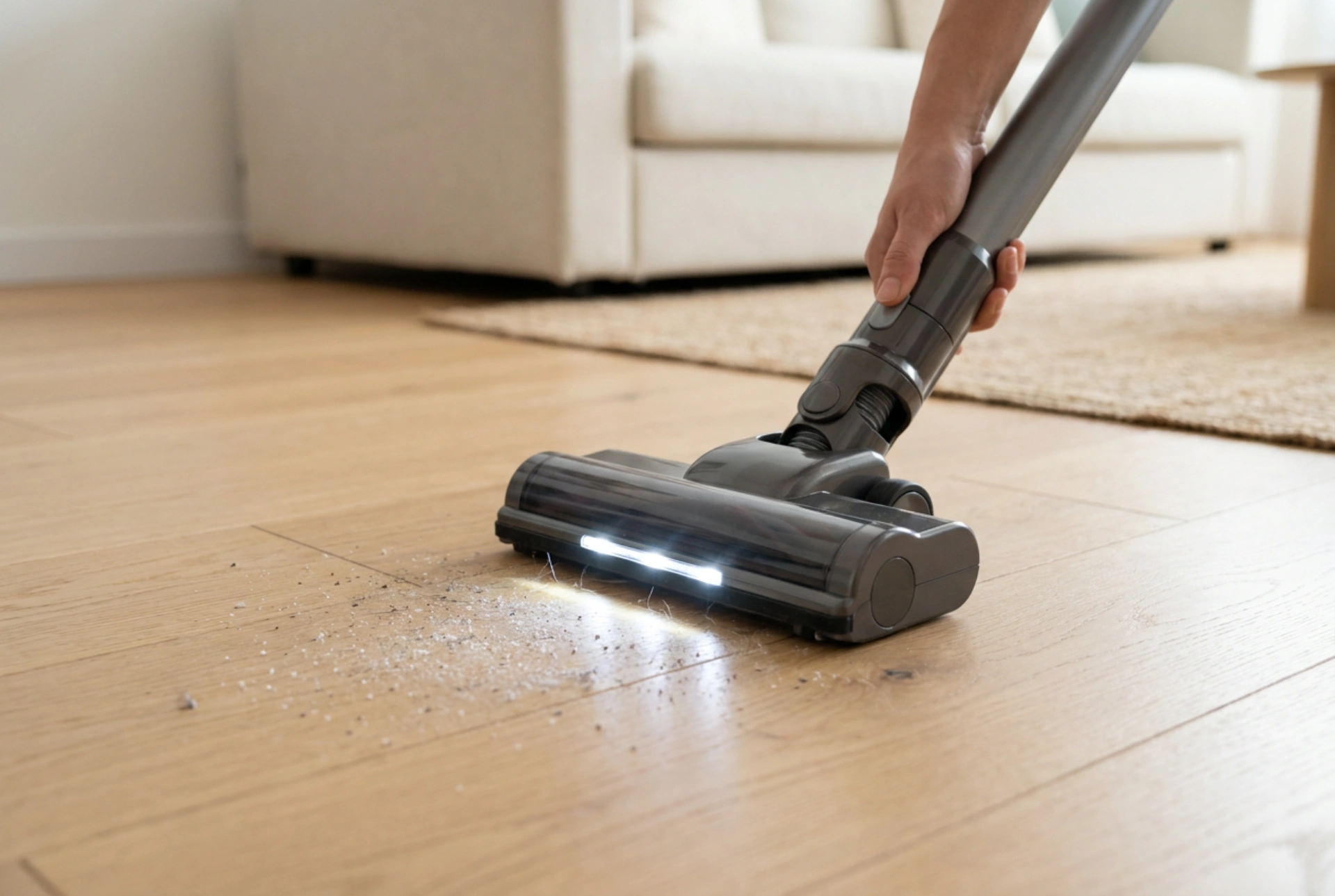
Positioning high-intensity LEDs mere millimeters above the floor surface changes the angle of incidence to nearly zero degrees. When this low-angle, parallel beam of light encounters a microscopic dust particle, hair, or salt crystal, it strikes only the side of the object. The particle blocks the light, casting a shadow behind it that is many times longer than the height of the particle itself. It is not the tiny dust particle itself that your eye easily detects, but rather the elongated, high-contrast shadow it projects against the floor surface.
Mie Scattering and Particle Visibility
The visibility of fine dust is also enhanced by a physical process called light scattering. When light waves hit small particles suspended in the air or resting on a flat surface, the light is deflected in various directions. For particles that are roughly equal to or larger than the wavelength of visible light (such as skin flakes, pollen, and fine sand), this interaction is governed by Mie scattering.
Mie scattering is highly directional, meaning the light is scattered predominantly forward and outward. By placing the light source directly in front of the nozzle and directing it forward across the cleaning path, the vacuum cleaner utilizes this forward scattering effect. The light bounces off the irregular surfaces of the dust particles directly toward your eyes, making the particles appear to glow against the darker, unlit floor ahead.
Why Cool White LED Spectra Excel
The spectral composition of the light source plays a critical role in particle detection. Most vacuum headlights utilize cool white LEDs with a color temperature ranging from 5000K to 6500K. This specific range offers several distinct advantages over warmer halogen or incandescent light:
- High Contrast: Cool white light contains a higher proportion of blue wavelengths. Since most domestic flooring materials—such as wood, laminate, and stone—possess warm yellow, red, or brown undertones, the cool blue-tinted light creates an immediate chromatic contrast, making white or grey dust particles stand out instantly.
- Luminous Efficiency: LEDs produce a highly concentrated, directional beam without generating excessive heat. This allows manufacturers to mount them close to the plastic housing without risking deformation of the nozzle materials.
- Color Rendering: The sharp, crisp output of a high-CRI ('Color Rendering Index') LED ensures that organic fibers, pet hair, and mineral dust are illuminated in their true colors, allowing the user to differentiate between harmless fibers and debris that requires thorough extraction.
Practical Techniques for LED-Assisted Vacuuming
To maximize the efficacy of your vacuum's LED headlights, adjust your cleaning methodology to leverage these physical principles. Simply turning on the vacuum is not enough; managing the environment will yield significantly better results.
Control Ambient Light Levels
The contrast ratio is the difference in luminance between the brightest and entertainment parts of your field of view. To increase this ratio, dim or turn off overhead ceiling lights and close window blinds. By reducing diffuse ambient light, you allow the highly directional LED beam to dominate the floor surface, amplifying the shadows cast by fine dust particles.
Adopt the Slow-Glide Motion
Rapid, sweeping motions can cause the human eye to miss the flickering shadows created by the moving light source. Glide the nozzle slowly and deliberately in straight, overlapping lines. This gives your visual cortex time to process the shifting shadows as the grazing light approaches and passes over the particles.
Target Low-Clearance Zones
Areas under furniture, toe-kicks, and baseboards are notorious dust reservoirs. The grazing angle of the LEDs is particularly effective here, as these areas are permanently shielded from overhead light. Keep the nozzle flush with the floor to ensure the light path remains parallel to the surface, preventing light leakage that would otherwise wash out the dust shadows.