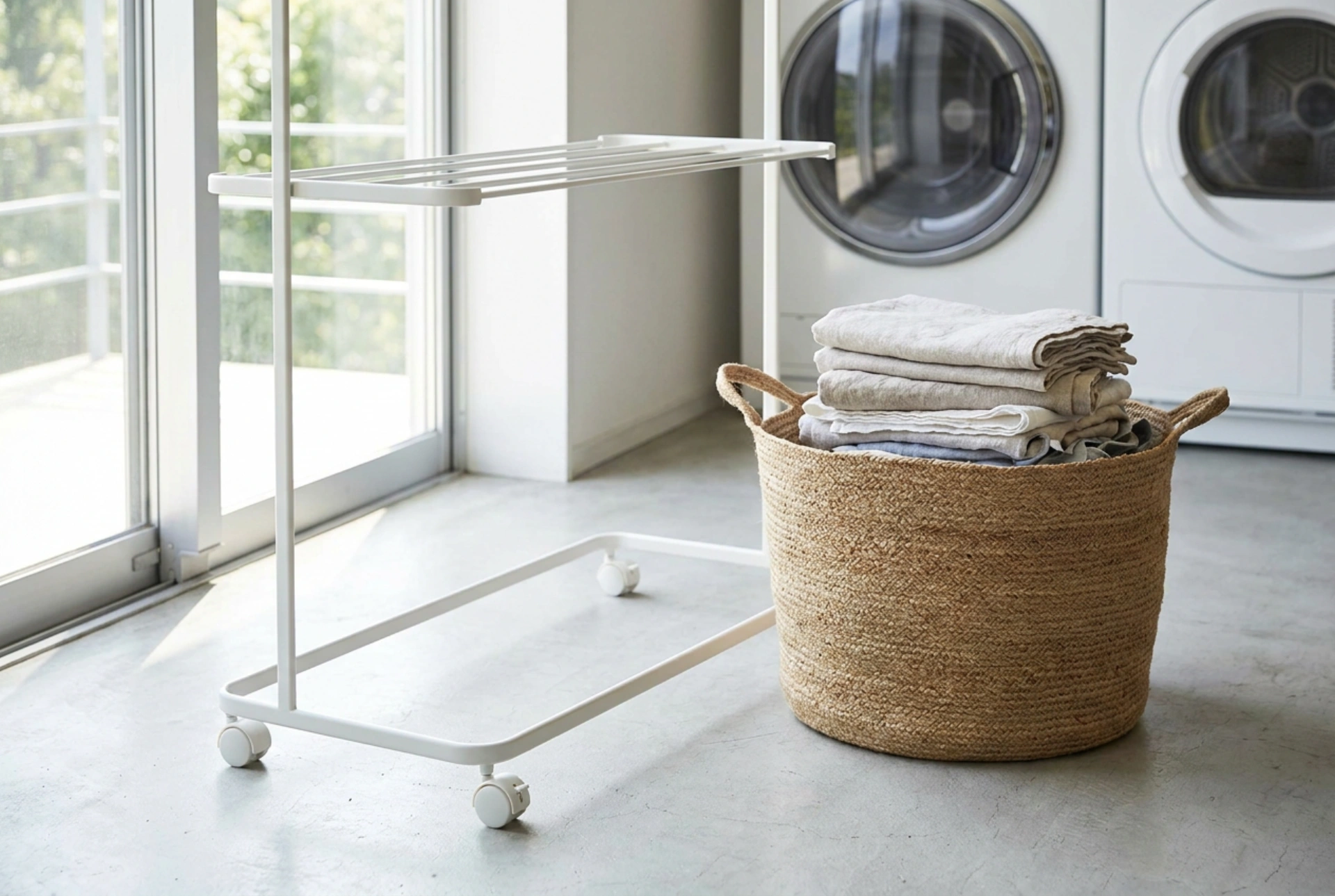


Managing the physical weight of wet laundry requires an understanding of structural stability and thermodynamics. Transitioning heavy, saturated textiles from the washing machine to an optimal drying zone can be made highly efficient by utilizing wheeled drying racks designed to exploit domestic microclimates.
The Physics of Wet Textiles and Centre of Gravity
When textile fibres absorb water, their weight increases dramatically—often by up to sixty percent of their dry mass. Hanging these heavy items on a static frame creates a high centre of gravity, making the structure prone to tipping if disturbed. A wheeled drying rack mitigates this risk through a wider wheelbase and structured load distribution. To maintain mechanical stability, always load the lowest tier of the rack first with the heaviest items, such as denim and thick cotton towels. This keeps the centre of gravity low, reducing the tipping torque when the frame is rolled across different floor surfaces.
By spreading the weight symmetrically across the horizontal rails, you prevent structural warping. Placing heavier items on one side forces the frame to bend under asymmetrical shear stress, which can permanently deform aluminum or steel tubing over time. Symmetrical loading also ensures that the downward force is distributed equally across all four castor wheels, ensuring smooth tracking and reducing localized wheel wear.
Wheel Dynamics and Floor Surface Friction
The mobility of a drying rack depends heavily on the interaction between its castor wheels and the flooring material. Most wheeled racks utilize thermoplastic elastomer or nylon castors. Nylon wheels offer low rolling resistance on high-friction surfaces like carpets but can slide or scratch polished hardwood. Conversely, softer rubber-coated castors provide excellent grip and noise dampening on tiles and wood, though they require slightly more force to initiate movement from a dead stop.
When navigating transitions between flooring types—such as moving from a tiled utility room to a carpeted hallway—the structural joints of the rack experience sudden deceleration forces. To prevent joint failure, always push the rack from its structural uprights rather than pulling it from the delicate drying rails. Pushing from the lower frame transfers your mechanical energy directly to the wheel base, reducing the bending moment applied to the upper joints.
Microclimate Optimisation and Airflow Mechanics
The primary advantage of a mobile drying rack is the ability to continuously position it within optimal drying microclimates throughout the day. Evaporation is governed by temperature, relative humidity, and boundary layer displacement. As water evaporates from wet fabric, it creates a highly humid boundary layer of air directly surrounding the cloth. If this air remains stagnant, evaporation slows down significantly.
By rolling the rack into areas with active air currents—such as near open windows, passive vents, or mechanical ventilation units—you introduce kinetic energy that strips away this humid boundary layer, replacing it with drier air. Additionally, moving the rack to follow the path of direct sunlight allows solar radiation to heat the water molecules in the fabric, increasing their kinetic energy and accelerating the transition from liquid to vapour.
Preventative Maintenance and Mechanical Longevity
Because laundry rooms are environments of high humidity, the mechanical components of a wheeled rack are susceptible to degradation. Dust, lint, and loose hair frequently wrap around the castor axles, increasing rotational friction and causing the wheels to drag rather than roll. Regularly inspecting the wheel assemblies and clearing debris with a small brush or tweezers preserves smooth mobility.
Furthermore, steel frames should be wiped down periodically to prevent moisture-induced oxidation, particularly at the welded joints where the protective powder coating may be thinnest. Checking the tension of joint screws once a season prevents the frame from developing structural play, ensuring the rack remains a rigid, stable tool for efficient moisture management.