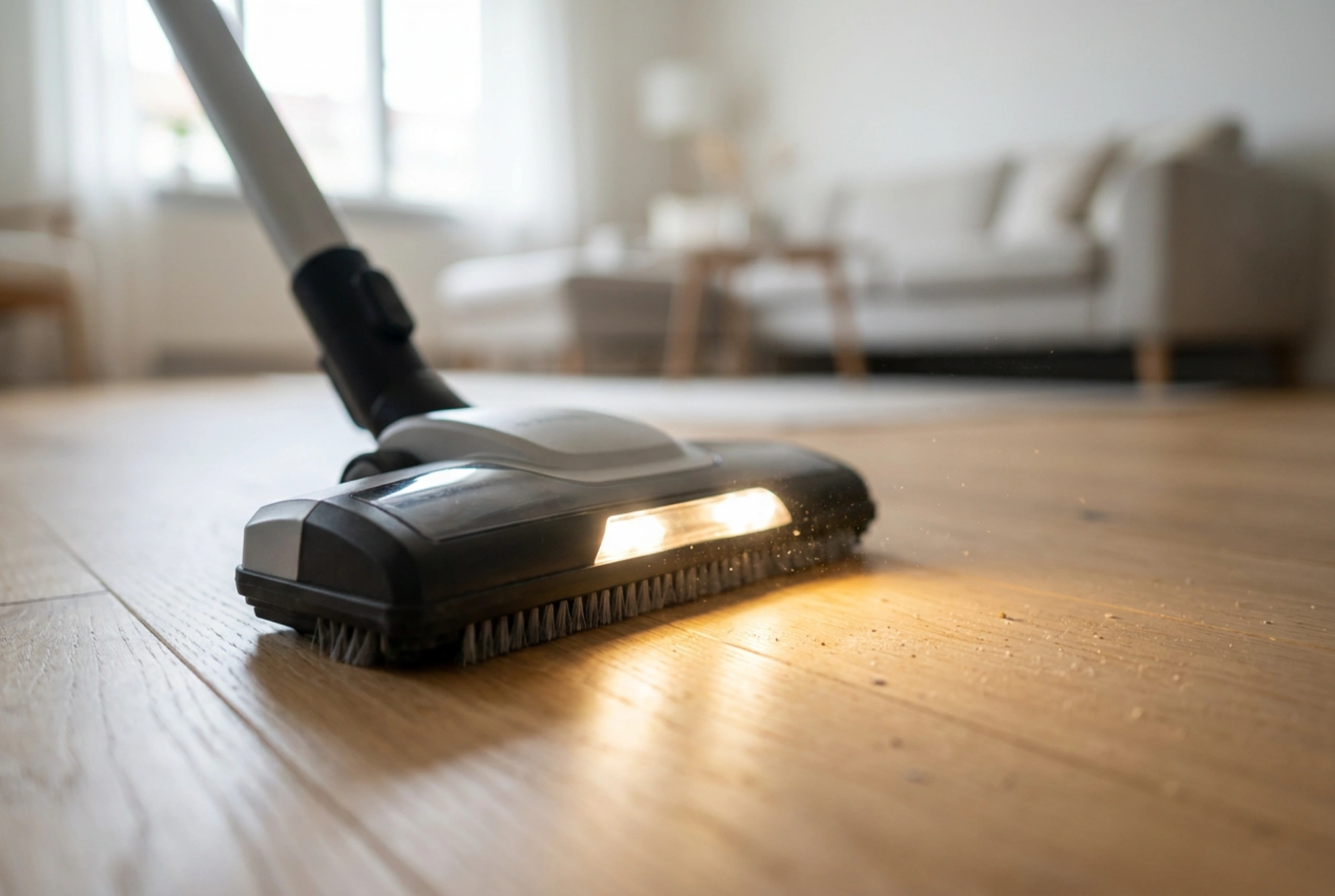


Illuminated nozzle technology on modern cordless vacuums is not an aesthetic gimmick; it relies on precise optical physics to reveal microscopic particles that remain completely invisible under standard ambient lighting. By understanding how light angles and contrast interact with household dust, you can fundamentally transform your cleaning efficiency and protect your flooring materials.
The Physics of Grazing Incidence and Shadow Casting
Under standard overhead ceiling lights, light waves hit the floor at a perpendicular or highly angled downward trajectory. Because microscopic dust particles have minimal height, they cast virtually no visible shadows when lit from above. The human eye fails to register these tiny particles because they blend seamlessly into the texture and color of the flooring material.
Integrating low-profile light sources—specifically light-emitting diodes (LEDs) positioned mere millimeters above the floor surface—introduces a phenomenon known as grazing incidence. When light is projected parallel to the floor at a very shallow angle (typically between 1 and 5 degrees), it strikes the sides of dust particles rather than their tops. This shallow angle creates two crucial optical effects:
- Elongated Shadows: Every microscopic dust speck, pet hair, and salt crystal acts as a physical barrier to the shallow light beam, casting a shadow that is multiple times longer than the height of the particle itself. This drastically increases the visual footprint of the debris.
- Light Scattering: Small particles scatter light forward and outward, making them self-illuminate against the darker, unreflective floor surface behind them.
Wavelengths and Contrast: Why Color Matters
The effectiveness of vacuum illumination is heavily dependent on the wavelength of the light emitted. While bright white LEDs are highly common and effective for general illumination, some advanced systems utilize specific green light spectra. This choice is rooted in human biology and material science.
The human eye is evolutionary optimized to detect wavelengths in the middle of the visible spectrum, peaking around 555 nanometers, which corresponds to green light. This makes human vision far more sensitive to contrast variations under green light than under red or blue light. When a green light sweeps across a wooden, laminate, or tiled floor, the contrast between the reflective organic dust (such as dead skin cells and fabric fibers) and the non-reflective floor finish is maximized, rendering even the finest microscopic layer of dust highly visible.
Protecting Flooring Materials from Micro-abrasions
Illuminated vacuuming does more than satisfy a desire for visual cleanliness; it serves as a preventative maintenance strategy for high-end flooring materials. Hardwood, engineered wood, and polished natural stone are susceptible to micro-abrasions. These tiny scratches are caused when fine, abrasive grit—such as quartz sand carried indoors on shoes—is dragged across the surface by foot traffic or heavy furniture.
By revealing this invisible abrasive grit before it can be ground into the floor finish, low-angle lighting allows for targeted, highly effective extraction. Instead of guessing where the dust has accumulated, you can systematically remove these hard minerals from high-traffic pathways, preserving the protective polyurethane or wax seal of your floors for years longer.
Surface Texture and Reflective Properties of Flooring
Different flooring materials interact uniquely with low-angle light. Highly reflective surfaces like polished porcelain tiles or high-gloss laminates can cause specular reflection, where the light bounces off the floor at the same angle it strikes. On these surfaces, dust appears as a dark silhouette interrupting the light path. Conversely, matte surfaces like oiled oak or textured stone scatter the light diffusely. Here, the illumination helps by catching the edge of dust particles, which appear as bright, glowing specks against a neutral backdrop. Adapting your viewing angle—looking slightly ahead of the vacuum head rather than directly down—will help you capture these subtle visual cues regardless of your floor's finish.
Optimizing Your Cleaning Technique
To get the most out of an illuminated vacuum cleaner, your movement and environment should adapt to maximize optical contrast. Follow these structured steps during your cleaning routine:
- Reduce Ambient Light: Draw blinds or dim overhead fixtures. The lower the ambient room light, the higher the contrast ratio created by the vacuum’s low-angle light.
- Adjust the Approach Angle: Guide the vacuum head perpendicular to the natural grain of wooden planks. This allows the light to highlight dust trapped within the micro-bevels of the wood joints.
- Maintain a Steady Velocity: Moving the vacuum head too quickly can cause you to miss areas where the light briefly catches fine particles. A slow, steady stroke ensures the air intake has sufficient dwell time to pull the revealed particles from the surface.