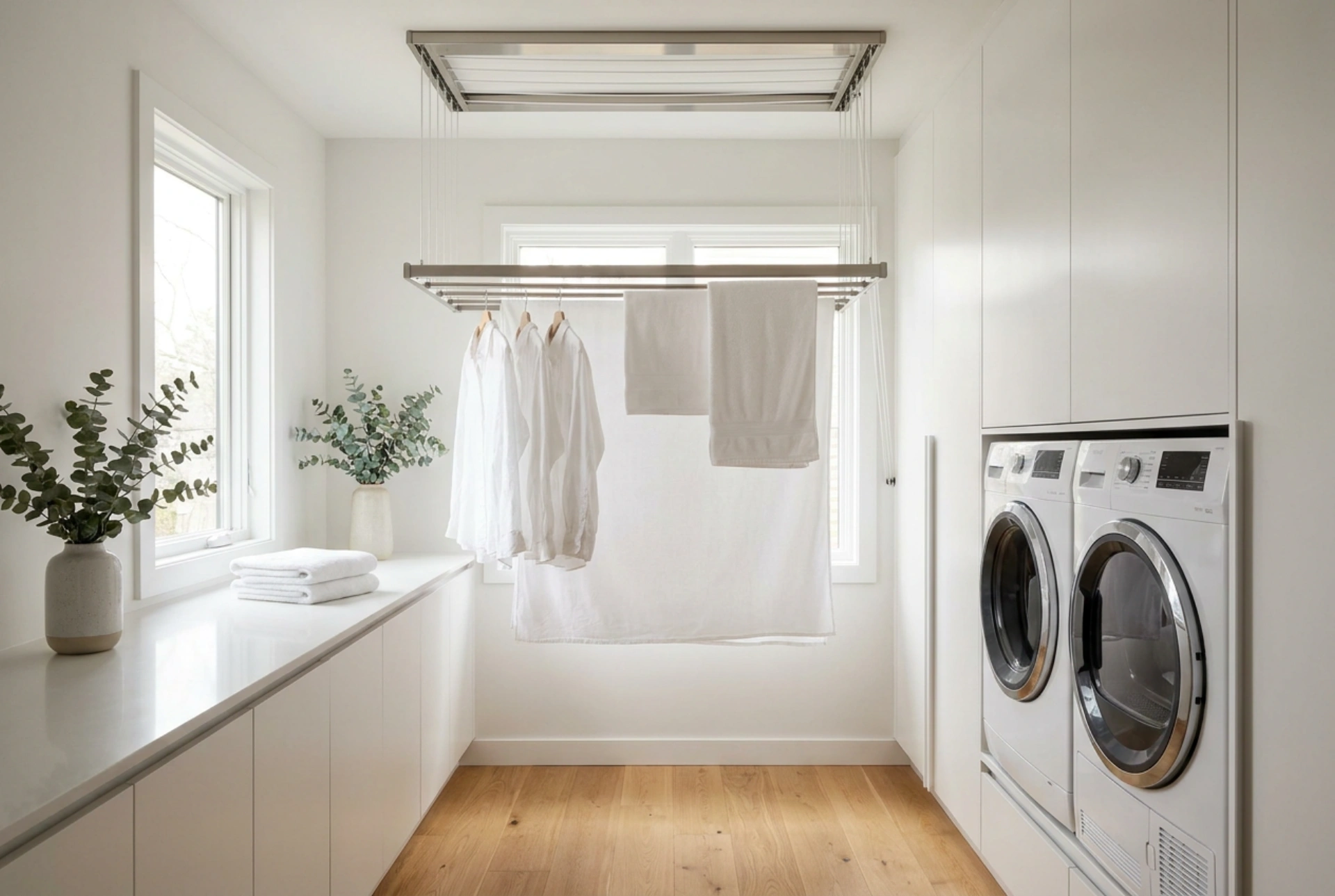


Ceiling-mounted drying racks offer an elegant solution to indoor laundry management by utilizing underused vertical space and exploiting fundamental laws of thermodynamics. By elevating wet textiles to the warmest zone of a room, these systems significantly accelerate evaporation while keeping living areas clear.
The Science of Warm Air and Evaporation
The primary thermodynamic advantage of a ceiling-mounted rack lies in air stratification. Within any indoor space, temperature gradients naturally form because warm air is less dense than cold air. This causes warmer air to rise toward the ceiling, creating a microclimate that is typically several degrees warmer than the air near the floor. Additionally, warm air has a higher moisture-carrying capacity (higher saturation vapour pressure), meaning it can absorb water molecules from wet fabrics much more efficiently.
When laundry is elevated close to the ceiling, it enters this high-energy zone. The heat energy in the ambient air transfers to the water trapped in the textile fibres, facilitating the phase transition from liquid water to water vapour. This process is significantly faster than drying clothes at floor level, where temperatures are lower and air is more stagnant.
The Role of Airflow and the Boundary Layer
Evaporation is not governed by temperature alone; airflow plays a critical role in preventing localized humidity buildup. As water evaporates from wet garments, a thin boundary layer of highly saturated, humid air forms immediately around the fabric. If this layer remains undisturbed, evaporation slows down dramatically or stops altogether, regardless of the room temperature.
Ceiling-mounted racks naturally counteract this through the chimney effect and convective currents. As warm air rises through the hanging garments, it displaces the saturated boundary layer, replacing it with drier air that can absorb more moisture. To maximize this effect, correct hanging techniques are essential: garments should be spaced at least five to ten centimetres apart to allow unhindered air passage. Heavier items, such as heavy cotton sweaters or denim, should be hung closest to the main convective pathways, while lighter synthetics can occupy peripheral positions.
Mechanical Dynamics and Load Distribution
The structural efficiency of a ceiling rack relies on a simple yet effective pulley-and-cleat system. High-tensile nylon or polyester cords run through independent pulleys anchored to the ceiling, allowing individual drying rods to be lowered and raised. This mechanical advantage reduces the physical effort required to lift heavy, wet laundry, which can weigh up to three times its dry weight due to water retention.
To ensure long-term durability and prevent structural strain, load distribution must be managed carefully. Wet textiles should be spread evenly across the length of each metal or wooden rod. Concentrating weight in the centre of a rod can cause permanent deformation or bending, especially in hollow aluminum or lightweight steel tubes. Furthermore, distributing the weight evenly across all rods prevents uneven tension on the pulley cords, which can cause slipping or accelerated wear on the locking mechanism.
Optimising Your Indoor Drying Environment
To achieve the fastest drying times without risk of musty odours, the indoor environment must be actively managed. Combining a ceiling rack with controlled ventilation is highly recommended. Opening opposing windows slightly creates cross-ventilation, which rapidly removes the humid air displaced from the ceiling zone.
- Positioning by fabric weight: Hang thick, multi-layered garments on the highest bars, where the temperature is peak, and keep lightweight fabrics below.
- Unfolding completely: Ensure sleeves, pockets, and collars are fully extended to eliminate double-layer fabric zones where moisture can linger.
- Ventilation timing: Dry laundry during hours when indoor heating is active or when external relative humidity is lowest to facilitate faster moisture exchange.