

Using a cordless vacuum with a mopping function is highly efficient, but excessive water delivery can easily ruin laminate joints and natural wood sealants. Mastering the physical mechanics of moisture control, water temperature, and stride speed ensures a streak-free, dry finish that preserves delicate floor structures.
The Science of Wood Expansion and Capillary Action
Wood and laminate are inherently hygroscopic materials, meaning they readily absorb moisture from their environment. When water sits on a floor surface, it seeks out microscopic gaps in the polyurethane sealant or the joints between laminate planks. Through capillary action, liquid is drawn downward into the porous wood fibres or the dense fibreboard core. Once absorbed, the cell walls swell, causing warping, cupping, and the irreversible lifting of plank edges. Cordless mop vacuums mitigate this risk by utilising active suction alongside water application, but only if the rate of water delivery does not exceed the vacuum's extraction capacity. Ensuring that the surface moisture evaporates within less than sixty seconds is the critical threshold for preventing structural damage.
Optimising Surface Tension and Water Temperature
To dry floors quickly, we must manipulate the physical properties of the cleaning solution. Pure water has a high surface tension, which causes it to form thick droplets that cling to surfaces and take longer to evaporate. By introducing a tiny amount of a neutral pH surfactant—such as a generic floor cleaning concentrate designed for hard surfaces—you lower the water’s surface tension. This allows the liquid to spread into a microscopic, ultra-thin film that evaporates rapidly. Additionally, using lukewarm water (approximately 30°C to 40°C) instead of cold water increases the kinetic energy of the water molecules, accelerating the rate of evaporation. However, avoid boiling water, as excessive heat can soften adhesives beneath laminate floors and damage the internal seals of your cordless appliance.
The Physics of the Forward-Back Movement Sequence
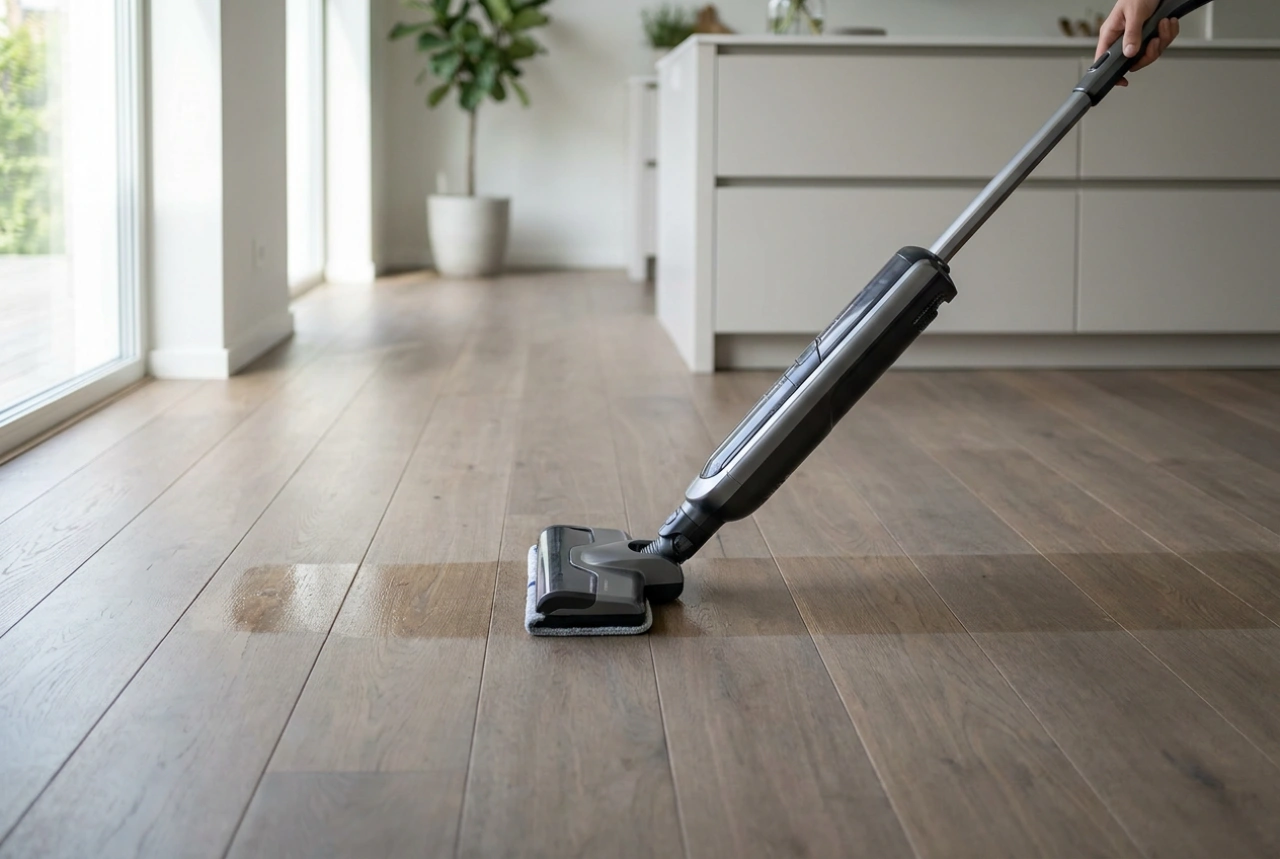
The operational technique with a wet-dry cordless vacuum differs significantly from traditional manual mopping. To prevent over-wetting, you must work in harmony with the machine’s mechanical layout, which usually places the water-dispensing roller at the front and the suction inlet directly behind it.
- The Wet Pass: Push the appliance forward slowly. This allows the damp microfibre roller to break the bond between the soil and the floor, while depositing a thin layer of water.
- The Dry Pass: Pull the appliance back along the exact same path at a slightly slower pace. This secondary movement utilises the maximum suction power of the vacuum inlet to lift the dirty water off the surface before it has time to penetrate any seams.
Avoid overlapping passes excessively. A single double-stroke (one forward, one back) is sufficient for standard maintenance cleaning. If a stubborn spot remains, spot-treat it manually rather than subjecting the surrounding seams to multiple wet passes.
Microfibre Hydration and Flow Control
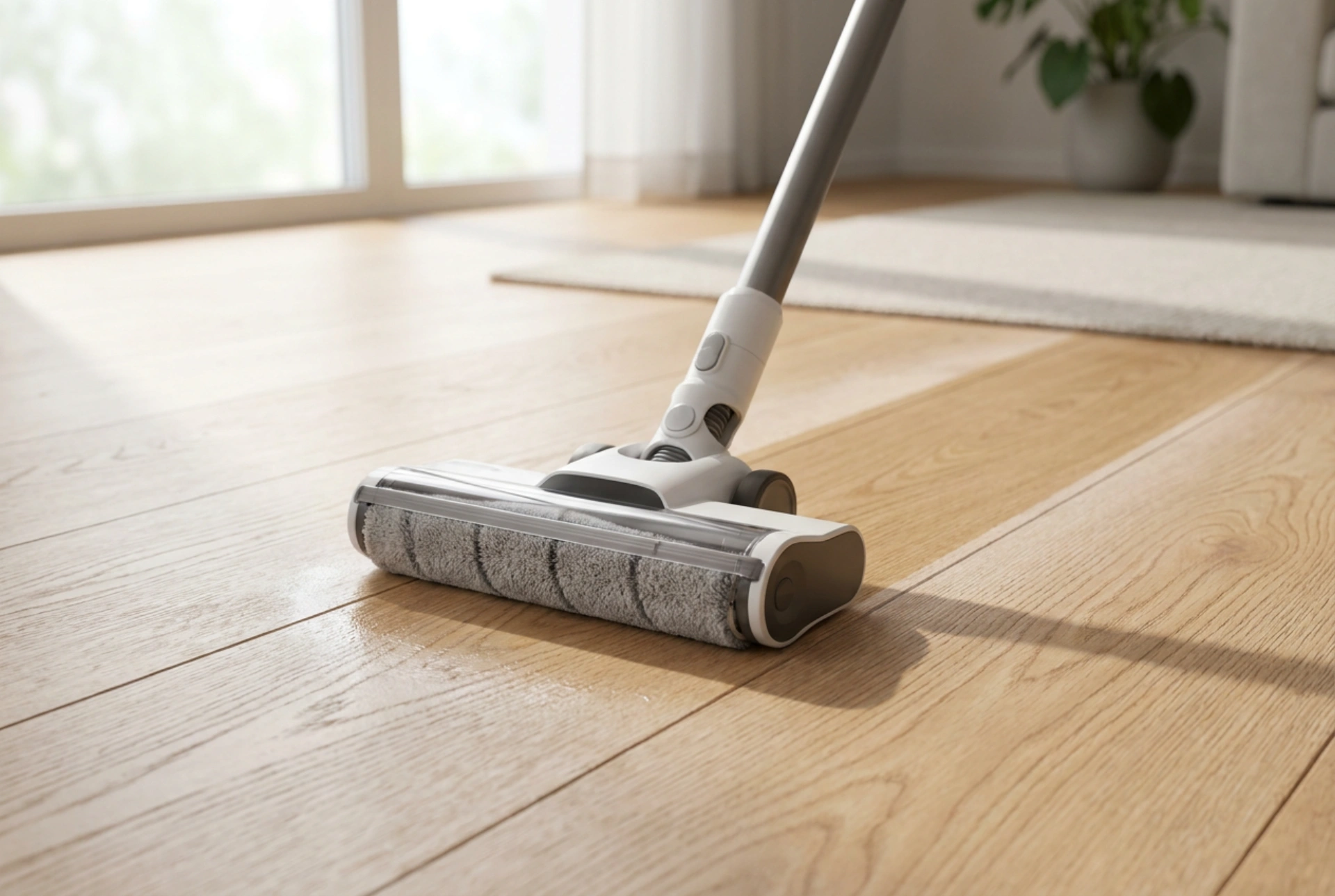
Most modern cordless mopping vacuums feature electronic water flow control. For sealed wood, engineered timber, and laminate, always select the lowest possible flow setting. The microfibre roller or pad should feel damp to the touch, not soaked. If your machine lacks electronic flow control and relies on gravity-fed reservoirs, prime the microfibre pad by spraying it lightly with water before attaching it, and keep the fresh water tank only half-filled to reduce downward gravitational pressure on the drip valves. This mechanical restriction ensures that the volume of water deposited never exceeds the immediate lift capability of the suction motor.
Essential Post-Clean Maintenance for Moisture Control
Moisture control does not end when you switch off the motor. A damp roller left resting on a wooden floor will transfer water continuously via capillary action, leaving a saturated spot that can rot wood over time. Immediately after cleaning, park the machine on its protective plastic docking tray. Empty both the clean and dirty water tanks to release internal pressure and stop any residual dripping. Remove the microfibre roller and allow it to dry in a well-ventilated area. This simple physical separation prevents musty odours, bacterial proliferation, and localized water damage to your flooring.