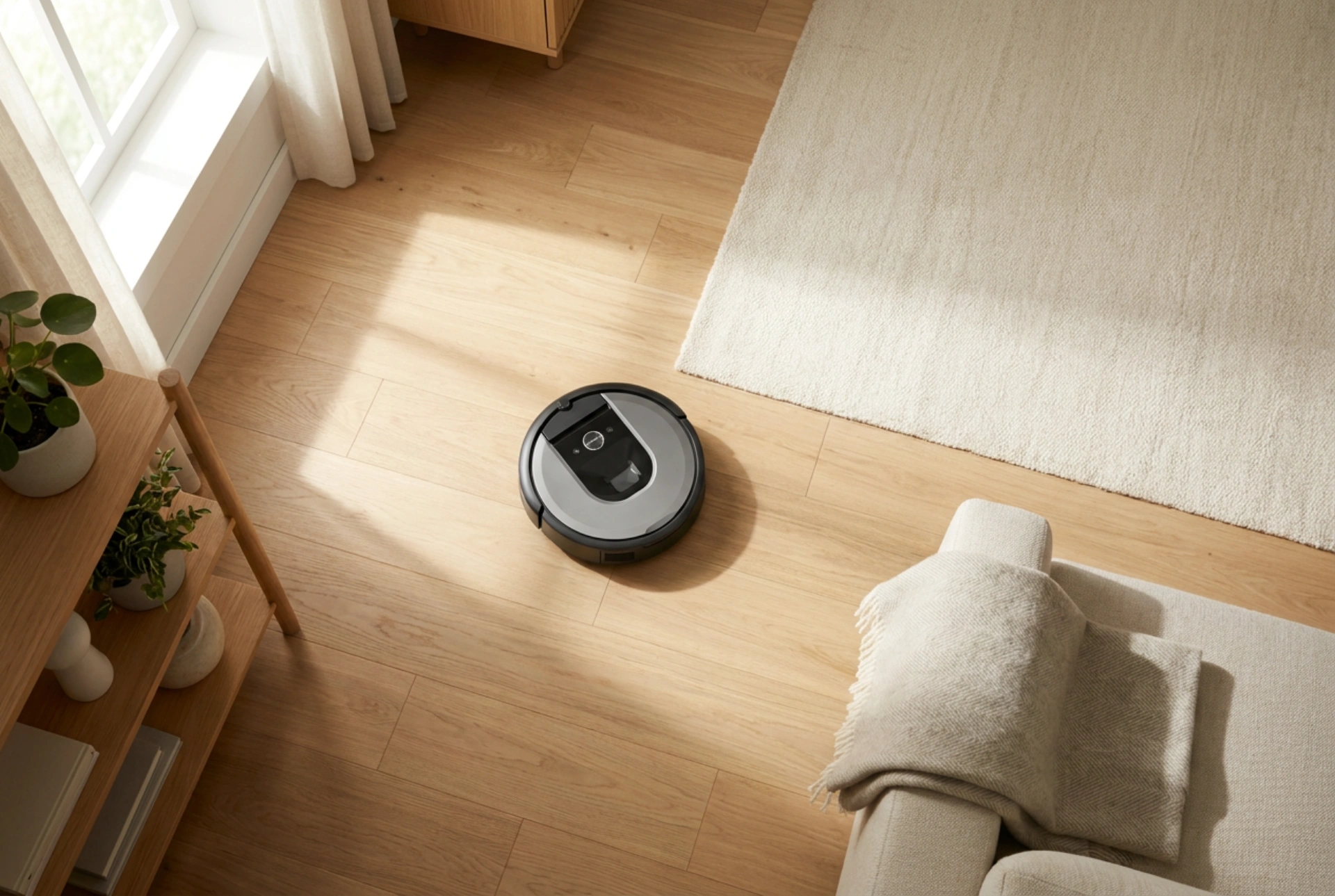


Navigating tight corners, dense furniture layouts, and limited floor areas requires a precise understanding of robot vacuum dimensions, turning circles, and sensor physics. While standard-sized robotic vacuums offer high dustbin capacities and massive batteries, compact or "mini" robot vacuums are often more thermodynamically and mechanically efficient in spaces under 45 square meters.
The Geometry of Maneuvering: Turning Radii and Clearance
The primary limitation of automated floor cleaning in small apartments is physical obstruction. Most standard robotic vacuums feature a diameter ranging between 33 and 35 centimeters. In contrast, mini models typically measure between 24 and 28 centimeters. This minor reduction in diameter exponentially improves their maneuvering capability in tight spaces.
When a robot encounters chair legs, table bases, or narrow corridors between furniture, it must execute a pivot turn. Mathematically, a circular robot rotates around its central axis. If the distance between two obstructions is less than the robot's diameter plus a safety margin for sensor tolerance (typically 2 to 3 centimeters on each side), the navigation algorithm registers a dead end. Standard robots will completely avoid these zones, leaving dust to accumulate. A mini robot, with its significantly smaller turning radius, can seamlessly navigate between furniture legs spaced just 30 centimeters apart, ensuring complete floor coverage without getting trapped in infinite error loops.
Sensor Physics and Height Constraints in Dense Layouts
In compact living areas, furniture is often multi-functional and low to the ground. The vertical clearance of sofas, bed frames, and cabinets dictates whether a robot can clean beneath them, where the majority of household dust bunnies—composed of sloughed skin cells, fabric fibers, and pet dander—tend to settle due to stagnant air currents.
The sensor technology used for navigation directly impacts the overall height of the machine:
- LiDAR (Light Detection and Ranging): Utilizes a spinning laser turret mounted on top of the unit. While highly accurate for mapping, this turret adds 1.5 to 2.5 centimeters to the robot's height, often pushing the total profile above 9.5 centimeters. This prevents entry under low-clearance furniture.
- Optical and Gyroscopic Navigation: Mini robots often rely on downward-facing infrared sensors, front-facing optical cameras, or internal gyroscopes. Lacking a protruding turret, these machines can maintain a ultra-low profile of under 7.5 centimeters. This allows them to glide easily beneath low-slung furniture, utilizing the venturi effect of their intake ports to pull dust out of tight crevices.
Battery Chemistry, Mass, and Suction Efficiency
A common misconception is that a larger battery always equates to better cleaning. In a small space, a massive lithium-ion battery (often 5200 mAh in standard units) is mechanically redundant and structurally detrimental. Large batteries add significant weight, increasing the wheel load on the flooring material.
This increased mass causes higher rolling resistance, demanding more torque from the drive motors and accelerating tire wear. On delicate wood or laminate floors, heavier units can leave microscopic track marks over time. A mini robot vacuum utilizes a smaller battery pack (typically 2000 to 2600 mAh). Because the cleaning area is small, the run time of 50 to 70 minutes is more than sufficient to cover the entire space on a single charge. The reduced weight lowers friction, maximizes energy efficiency, and allows the brush roll to maintain optimal contact with the floor surface without dampening the suspension system.
Fluid Dynamics: Dustbin Design and Airflow
To maintain suction, a robot vacuum relies on continuous airflow. As the dustbin fills, the resistance to air passing through the high-efficiency particulate air (HEPA) filter increases, causing a drop in static pressure. In a small home, the volume of daily debris is naturally limited by the physical footprint of the inhabitants.
A mini robot's smaller dustbin (usually around 250 to 300 milliliters) is optimized for this lower volume. Because the path from the suction inlet to the bin is shorter than in larger models, there is less friction loss inside the air duct. This means a smaller, less power-hungry motor can generate equivalent static pressure (suction) at the floor interface compared to a larger machine with a convoluted air pathway. To maximize this efficiency, users should empty the bin after every cycle, ensuring the filter remains free of fine particulate blockages that restrict air velocity.
Brush Mechanics and Debris Handling in Small Spaces
In small apartments, hair (human and pet) and long fibers are concentrated in a smaller surface area, leading to rapid brush entanglement. Mini robots often utilize specialized suction ports instead of traditional rotating bristle brushes, or they use short, high-frequency rubber extractors.
Bristle brushes work by mechanically lifting particles from carpet fibers. However, in compact spaces dominated by hard flooring like tiles, vinyl, or hardwood, bristles are less effective and highly prone to hair wrapping. A brushless suction intake relies purely on negative pressure. Without a rotating brush roll to wrap around, maintenance is drastically reduced, and the risk of motor stalling due to hair binding is eliminated. For small spaces with minimal low-pile rugs, a brushless mini robot provides consistent pickup without the mechanical failures associated with complex drive assemblies.
Optimizing the Deployment Zone for Compact Units
To ensure a mini robot operates at peak efficiency, the physical layout of the charging dock must be carefully managed. The dock emits an infrared homing signal that the robot detects when its battery voltage drops below a specific threshold (usually 15%).
- Positioning: Place the dock on a hard, level surface with at least 0.5 meters of clear space on either side and 1.2 meters in front. In small apartments, this can be achieved under a raised TV console or inside a hallway recess.
- Cable Management: Because mini robots have a lower ground clearance, loose cables from chargers or floor lamps can easily foul the wheels or intake. Bound cables increase electrical resistance in the drive motors, triggering automatic thermal shutdowns. Bundling cables at least 10 centimeters off the floor prevents these mechanical interruptions.