

Drying laundry on a ceiling-mounted rack utilises rising warm air to accelerate evaporation, but without active moisture management, this process can quickly saturate your indoor environment. Understanding the relationship between thermal stratification, vapour pressure, and air movement allows you to dry clothes rapidly while maintaining a balanced, mould-free household.
The Thermodynamics of Ceiling-Level Drying
In any indoor space, temperature layers naturally establish themselves through thermal stratification. Because warm air is less dense than cold air, it rises toward the ceiling. By suspending your laundry in this upper zone, you place it in the warmest part of the room, which naturally increases the kinetic energy of the water molecules trapped in the fabric fibres. This thermal energy accelerates the transition of liquid water into gaseous water vapour.
However, as water evaporates, it absorbs latent heat from the surrounding air, a process known as evaporative cooling. This means the air immediately surrounding the wet clothes cools down and becomes dense, sinking toward the floor. To prevent this cold, damp air pocket from stalling your drying process, there must be continuous air movement to break the boundary layer—the thin, stagnant layer of saturated air that clings to the wet fabric surface.
The Moisture Equation: Volume and Saturation
A standard five-kilogram load of spun laundry holds approximately two to three litres of water. When you hang this load to dry, that entire volume of water must be absorbed by the indoor air. If a room has a volume of 40 cubic metres, releasing three litres of water vapour into it can raise the relative humidity from a comfortable 45% to a saturated 80% or higher within a few hours.
When relative humidity rises, the air reaches its drying capacity. The rate of evaporation drops because the vapour pressure differential between the wet fabric and the surrounding air shrinks. Furthermore, if this highly humid air contacts cold surfaces, such as window panes or external walls, it cools below its dew point, leading to condensation. Over time, this localised dampness can degrade wall finishes and encourage mould growth.
Optimising Air Exchange and Ventilation
To successfully dry laundry under the ceiling without raising indoor humidity to hazardous levels, you must facilitate efficient air exchange. This does not require complex mechanical systems; instead, it relies on basic physics and pressure differentials.
- Controlled Cross-Ventilation: Open two windows slightly on opposite sides of the house to create a pressure differential. This forces humid air out while drawing in fresher, drier air.
- The Winter Air Exchange Strategy: In colder months, outdoor air has low absolute humidity, even if its relative humidity is high. Opening a window near the drying rack for just ten minutes replaces the warm, damp indoor air with cold, dry outdoor air. Once this fresh air heats up inside, its relative humidity drops significantly, turning it into a highly effective sponge for moisture.
- Exploiting Natural Convection: Ensure the ceiling rack is positioned in a room with an active exhaust vent or near a door that remains ajar, allowing the rising damp air to escape the room's microclimate naturally.
Strategic Hanging Techniques for Efficient Evaporation
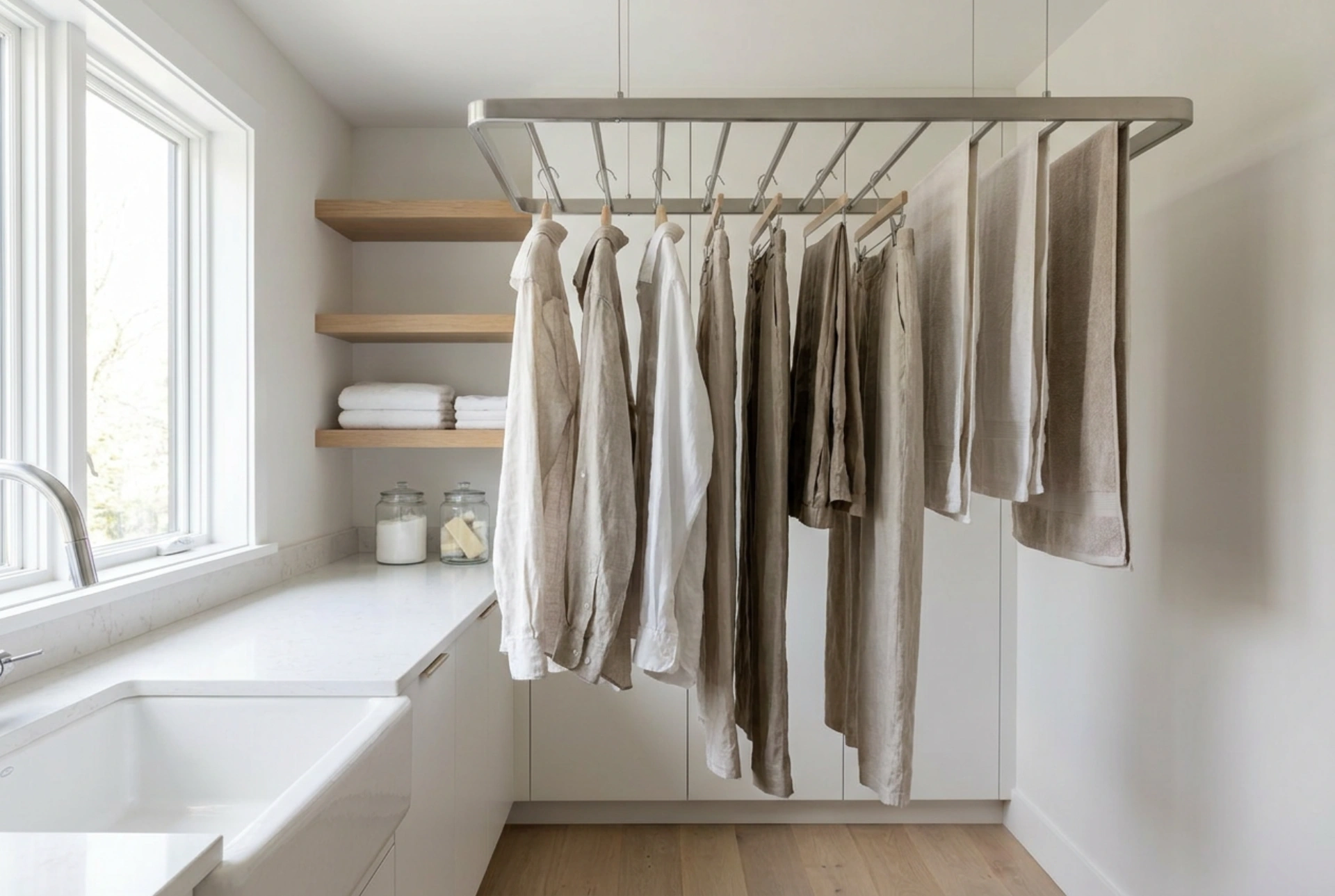
The arrangement of garments on your ceiling-mounted rack plays a critical role in how quickly moisture is released into the air and carried away. Poorly spaced clothes trap pockets of cold, humid air, significantly extending drying times.
Begin by sorting garments by material density and thickness. Heavy fabrics, such as denim, wool, and thick cotton sweaters, should be placed on the outer bars of the rack. The outer edges experience greater air velocity and turbulence, which helps strip away the boundary layer of moisture. Lightweight synthetics and thin cottons can be hung on the inner rails, as they require less thermal energy to dry.
Maintain a minimum gap of five to eight centimetres between each hanging item. This gap allows the rising warm air to pass vertically through the rack, creating a chimney effect that carries away water vapour. Additionally, hanging clothes on hangers rather than draping them directly over the bars increases the exposed surface area, doubling the interface where evaporation can occur.