

Spot cleaning fabric upholstery requires a precise balance of mechanical agitation, temperature, and chemical reaction to dissolve stains without damaging delicate fibers. Using a portable spot cleaner allows for targeted extraction, lifting soils permanently out of the weave rather than spreading them deeper into the cushion backing.
The Physics of Spot Extraction: Why Blotting Is Not Enough
When a liquid spill occurs on fabric, it immediately begins to migrate through capillary action. The microscopic spaces between the woven threads act like tiny channels, drawing the liquid deeper into both the yarn and the underlying foam padding. Standard manual blotting with a cloth can only absorb surface-level liquid. In fact, applying excessive downward pressure during blotting often forces the contaminant deeper into the textile core, making subsequent removal far more difficult.
A portable spot cleaner solves this through a localized pressure differential. The machine operates on a dual-action mechanism: a fluid pump and a high-vacuum extraction motor. First, the machine deposits a fine, controlled mist of cleaning solution onto the targeted area to act as a carrier agent. Immediately following the wet application, the extraction nozzle is pressed firmly against the textile. The vacuum motor creates a low-pressure zone at the nozzle head. Because fluids naturally migrate from high-pressure to low-pressure environments, the dirty solution—now carrying the suspended soils—is drawn vertically out of the fiber matrix and into the recovery tank.
The Chemistry of Stain Breakdown on Fibers
Successfully removing a spot depends heavily on matching the chemical agent to the specific molecular makeup of the stain. Soil-to-fiber bonds are typically held together by electrostatic forces, hydrogen bonding, or physical entrapment. To break these bonds, the cleaning solution must lower the surface tension of the water, allowing it to penetrate the fibers thoroughly. This is achieved through surfactants, which contain both hydrophilic (water-loving) and hydrophobic (water-repelling) ends. The hydrophobic ends attach to grease and oil, while the hydrophilic ends pull toward the water molecules, lifting the soil into suspension.
- Organic Stains: Spills containing proteins and lipids require enzymatic formulas. Enzymes act as biocatalysts, physically slicing complex organic chains into smaller, water-soluble fragments that the spot cleaner can easily extract.
- Tannins and Dyes: Coffee, tea, and fruit juices contain complex pigments. These require mild acidic solutions or oxygen-based bleaching agents that alter the chemical structure of the pigment molecule, neutralizing its color without degrading the textile fibers.
- Synthetic Stains: Petroleum-based grease or cosmetics require non-ionic surfactants that dissolve oils without leaving a high-pH residue that could attract future dirt.
Temperature and Material Sensitivity
Thermal energy is a powerful catalyst in cleaning chemistry. Heat increases the kinetic energy of the molecules, accelerating chemical reactions and softening hardened fats or waxes. For synthetic fibers such as polyester, nylon, and acrylic, using warm water (around 40 degrees Celsius) significantly boosts the efficiency of the surfactant. The heat relaxes the synthetic polymer chains slightly, allowing trapped dirt to be released easily.
However, natural fibers like cotton, linen, and wool require strict temperature control. High temperatures can cause natural fibers to swell, distort, shrink, or lose their structural integrity. Furthermore, excess moisture on natural fibers can lead to cellulosic browning, where lignin in the cotton or linen migrates to the surface as it dries, leaving unsightly brown rings. For these delicate materials, keep water lukewarm or cold, and focus heavily on maximizing extraction passes to leave the fabric as dry as possible.
The Order of Operations for Spot Cleaning
Achieving optimal results with a portable spot cleaner requires a disciplined, step-by-step process. Skipping any phase can lead to permanent fiber damage or recurring stains.
1. Dry Soil Extraction
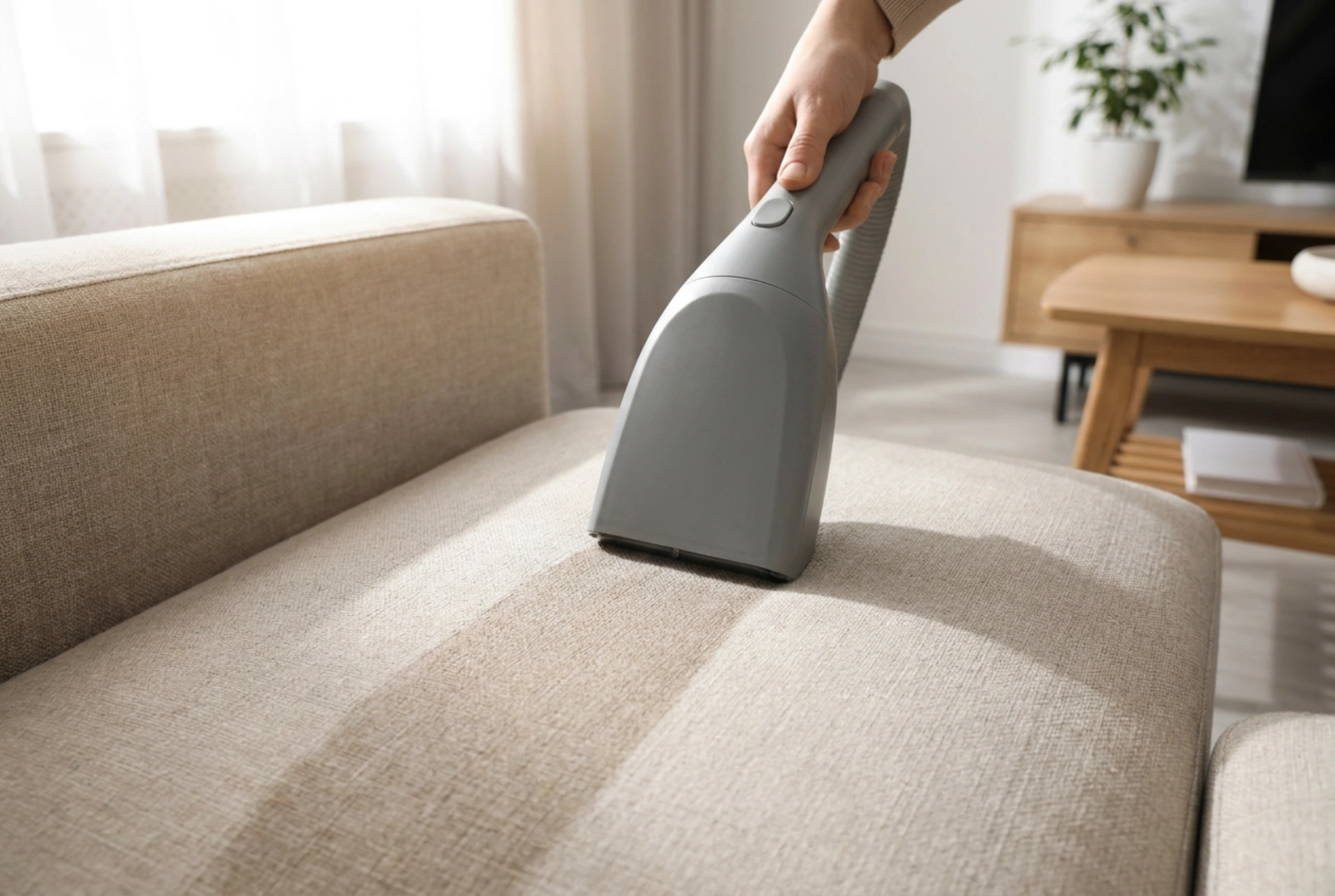
Never apply liquid to a dusty or dry-soiled stain. Always thoroughly vacuum the entire cushion first with a dry upholstery tool. If you spray liquid onto loose surface dust, you create mud, which will be forced deep into the weave during the extraction phase.
2. Pre-Treatment and Dwell Time
Spray the cleaning solution lightly over the spot, extending about two centimeters beyond the visible boundary of the stain. Allow the solution a dwell time of three to five minutes. This allows the surfactants and enzymes to actively break the chemical bonds holding the stain to the fiber before mechanical forces are introduced.
3. Controlled Mechanical Agitation
Using the brush attachment on the spot cleaner nozzle, gently agitate the pre-treated area. Always work in circular motions from the outer edges of the stain toward the center. This technique prevents the stain from expanding outward into clean fabric zones. Apply minimal downward pressure; let the bristle tips do the work.
4. Wet Extraction and Drying Passes
Press the extraction tool firmly against the fabric and pull it slowly backward in straight, overlapping lines. For the first pass, pull the trigger to release clean rinse water to flush out the emulsified dirt. Follow this with several dry passes where you pull the tool over the damp area without pulling the trigger. Continue making dry passes until you no longer see water droplets being drawn into the machine.