

Achieving a showroom-grade finish inside a vehicle requires more than high suction power; it demands an understanding of textile physics, surface tension, and systematic movement. Using a professional vacuum cleaner correctly allows you to extract deeply embedded grit, dust, and allergens that degrade cabin air quality and wear down upholstery over time.
The Physics of Embedded Grit in Automotive Carpets
Car carpets are typically made of dense, needle-punched synthetic fibres designed to withstand heavy wear. However, this structure acts as a physical trap for fine silica particles, sand, and dried mud. When feet press down on the carpet, these sharp particles are driven deep into the backing. Standard suction alone cannot overcome the mechanical friction holding these particles in place.
To dislodge them, you must apply mechanical agitation alongside high airflow. Professional vacuuming relies on opening the carpet pile. By brushing the fibres in the opposite direction of their natural lay, you release the mechanical grip on the dirt. Without this step, the sand remains at the base of the fibres, slowly cutting away at the synthetic strands every time pressure is applied, leading to premature wear and bald spots.
The Correct Order of Operations: Top to Bottom
To prevent recontaminating cleaned surfaces, a strict top-to-bottom workflow is essential. Gravity dictates the movement of dust; any particulate dislodged from the upper trim will inevitably settle on the floor. Begin by clearing large debris by hand, then use compressed air or a soft-bristled detailing brush to sweep dust out of ventilation grilles, seat seams, and dashboard crevices directly onto the floorboards.
Crucially, dry vacuuming must always be completed before applying any liquid cleaners or upholstery shampoos. Introducing moisture to dry, dusty fibres creates a fine mud slurry. This liquid mixture travels deeper into the fabric backing via capillary action, making it significantly harder to extract and leaving stubborn tide marks as the material dries.
Nozzle Dynamics and Airflow Optimisation
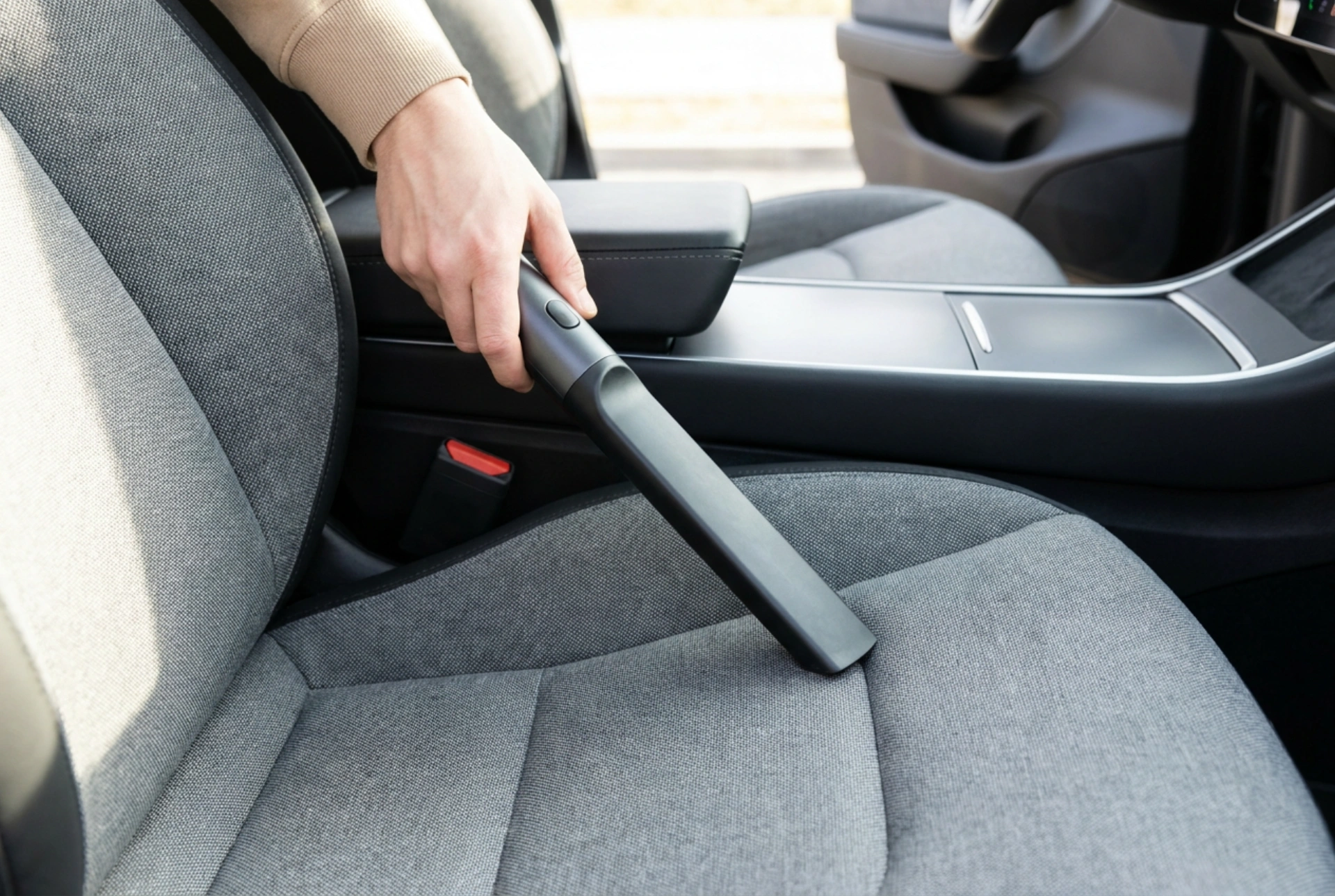
Vacuuming efficiency is governed by the relationship between static lift (suction) and airflow (measured in cubic feet per minute). A professional vacuum cleaner provides high values of both, but you must direct this energy correctly using the right attachments. The narrow crevice tool is not just for tight gaps; its restricted opening increases air velocity dramatically according to Bernoulli's principle. This high-velocity air shears dust away from plastic surfaces and tight seams.
When vacuuming flat carpeted areas, use a claw nozzle or utility nozzle. Keep the nozzle angled at roughly 45 degrees to the surface rather than flat. A flat seal restricts airflow completely, stalling the vacuum’s ability to carry away debris. A slight angle allows a high-velocity stream of air to rush under the nozzle lip, lifting the dirt and carrying it into the recovery tank. Move the tool in a deliberate cross-hatch pattern—first vertically, then horizontally—to ensure the carpet fibres are cleaned from all angles.
Overcoming Electrostatic Forces and Pet Hair
Pet hair and synthetic clothing fibres pose a unique challenge because they carry an electrostatic charge that binds them to seat fabrics. Additionally, animal hair has microscopic barbs that lock into the woven structure of car upholstery. Relying solely on vacuum suction to remove hair is highly inefficient and can overheat the motor due to restricted airflow.
To solve this, use a rubber-edged detailing tool or a silicone brush prior to vacuuming. Friction between the rubber and the synthetic fabric generates a localized static charge that neutralises the bond, while the mechanical grip of the rubber pulls the barbed hairs out of the weave. Once gathered into neat clumps, they can be easily lifted away by the vacuum nozzle.