

Using a spray extraction cleaner on upholstery is the most effective way to remove deep-seated dirt, but improper technique often leads to unsightly water marks as the fabric dries. Preventing these stains requires an understanding of capillary action, detergent chemistry, and moisture control during the extraction process.
The Science of Water Marks: Why Rings Form
Water marks, or drying rings, are not caused by clean water itself, but by the migration of dissolved soils. When fabric remains wet for too long, water moves outward toward the dry areas of the upholstery through capillary action. As the water evaporates at the dry boundary, it leaves behind a concentrated ring of suspended dust, oils, and detergent residues. To prevent this, you must achieve uniform wetting and, more importantly, maximum moisture extraction so that the drying boundary never has the time or volume of water to transport these particles.
Step 1: Thorough Dry Preparation
Never apply liquid to a dusty sofa. Any loose particles present in the weave will instantly dissolve into mud once wet, making them much harder to extract and increasing the risk of staining. Use a vacuum cleaner equipped with an upholstery nozzle to thoroughly clean the fabric. Pay special attention to seams, crevices, and the undersides of cushions. Use overlapping, slow strokes to allow the airflow to pull dust from deep within the foam backing.
Step 2: Chemical Pre-Spray and Activation
Instead of filling your extraction machine's tank with a heavy detergent solution, use a two-step chemical process. Mix a low-foaming, neutral pH upholstery pre-spray in a separate hand pump sprayer. Spraying the detergent independently allows you to control the exact amount of moisture applied. The surfactants in the pre-spray lower the surface tension of water, allowing it to penetrate the fibers and emulsify greasy soils. Let the solution dwell for five to ten minutes, but do not let it dry. During this time, gently agitate the fabric with a soft-bristled horsehair brush in circular motions to break physical bonds between dirt and fibers.
Step 3: The Extraction and the Critical Dry Pass
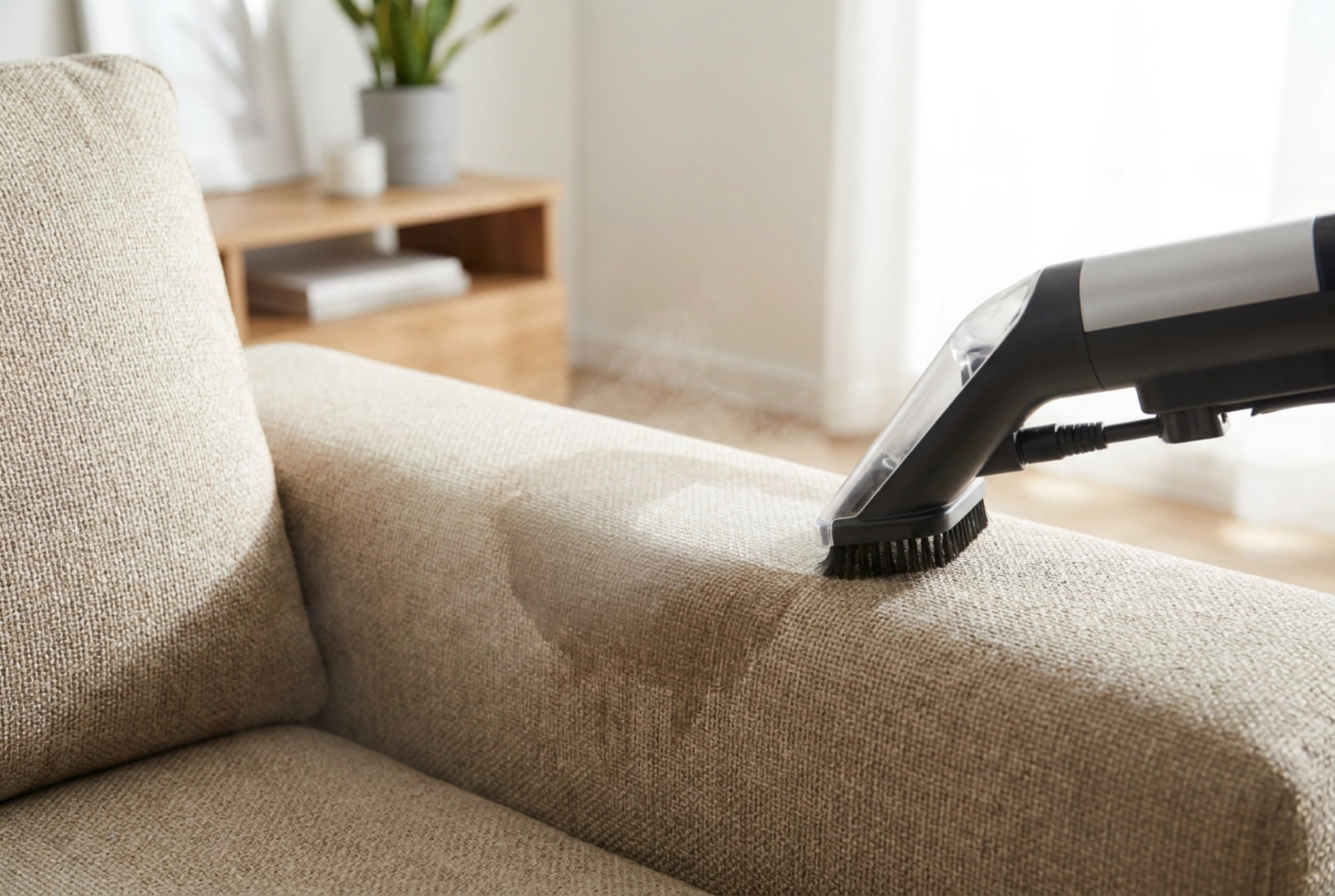
Fill your extraction cleaner's clean-water tank with warm water (not exceeding forty degrees Celsius to prevent shrinking or weakening synthetic fibers). Do not add more detergent to this water; instead, use it strictly as a rinse to flush out the emulsified dirt and pre-spray residue. Pull the extraction nozzle slowly across the fabric while pulling the trigger to inject the water. The vacuum nozzle must sit flat against the fabric to maintain a tight seal, which maximizes suction. Immediately follow every wet stroke with two or three dry passes without squeezing the trigger. Press down firmly and move slowly. These dry passes are the most critical step, as they remove the bound moisture from the deep layers of the foam and fabric, reducing drying time from days to hours.
Step 4: Ensuring Uniform Drying
To eliminate any chance of localized water rings, the entire piece of furniture must dry at a uniform rate. Once the extraction is complete, use a clean, dry microfiber cloth to wipe down any wooden or plastic trim, and gently buff the fabric in the direction of the nap. Increase ventilation in the room by opening windows or using a carpet dryer fan directed toward the sofa. Keep the room temperature moderate (around twenty degrees Celsius) and avoid high humidity. Do not sit on the sofa or place cushions back onto the frame until the material is completely dry to the touch, which typically takes between six and twelve hours.