

Maintaining the battery life of a cordless vacuum cleaner depends heavily on how you manage its charging cycles and operating temperature. Understanding the physical principles of lithium-ion cells prevents premature capacity loss and ensures safe, reliable operation in the home.
The Chemistry of Lithium-Ion Batteries
Modern cordless vacuums rely on lithium-ion (Li-ion) battery packs to deliver high suction power in a lightweight form. Inside these batteries, lithium ions move between the cathode and the anode through an organic liquid electrolyte. When charging, these ions are forced back into the anode, a process that requires precise voltage control. If a battery is exposed to extreme states of charge—such as remaining at 100% capacity continuously while connected to a power source—the structural stability of the cathode degrades, leading to permanent capacity loss. Most devices feature an integrated Battery Management System (BMS) that stops active charging once maximum voltage is reached. However, keeping the cell under constant high voltage still promotes chemical degradation of the internal components.
Thermal Management and the Cooling Phase
Heat is the primary enemy of lithium-ion chemistry. During vacuum operation, high electrical current discharge generates internal thermal energy. Plugging the device into the charger immediately after use is a common mistake that accelerates battery aging. Charging an already warm battery causes the internal temperature to quickly exceed safe thresholds (typically 45°C), which speeds up the decomposition of the electrolyte layer. To prevent this, always allow the vacuum cleaner to cool down at room temperature for 15 to 30 minutes before initiating the charge cycle. Conversely, charging in extremely cold environments (below 10°C) should also be avoided. Low temperatures slow down the chemical reaction, causing lithium ions to accumulate on the anode surface as metallic lithium—a process known as lithium plating, which can cause internal short circuits.
The Safe Order of Operations
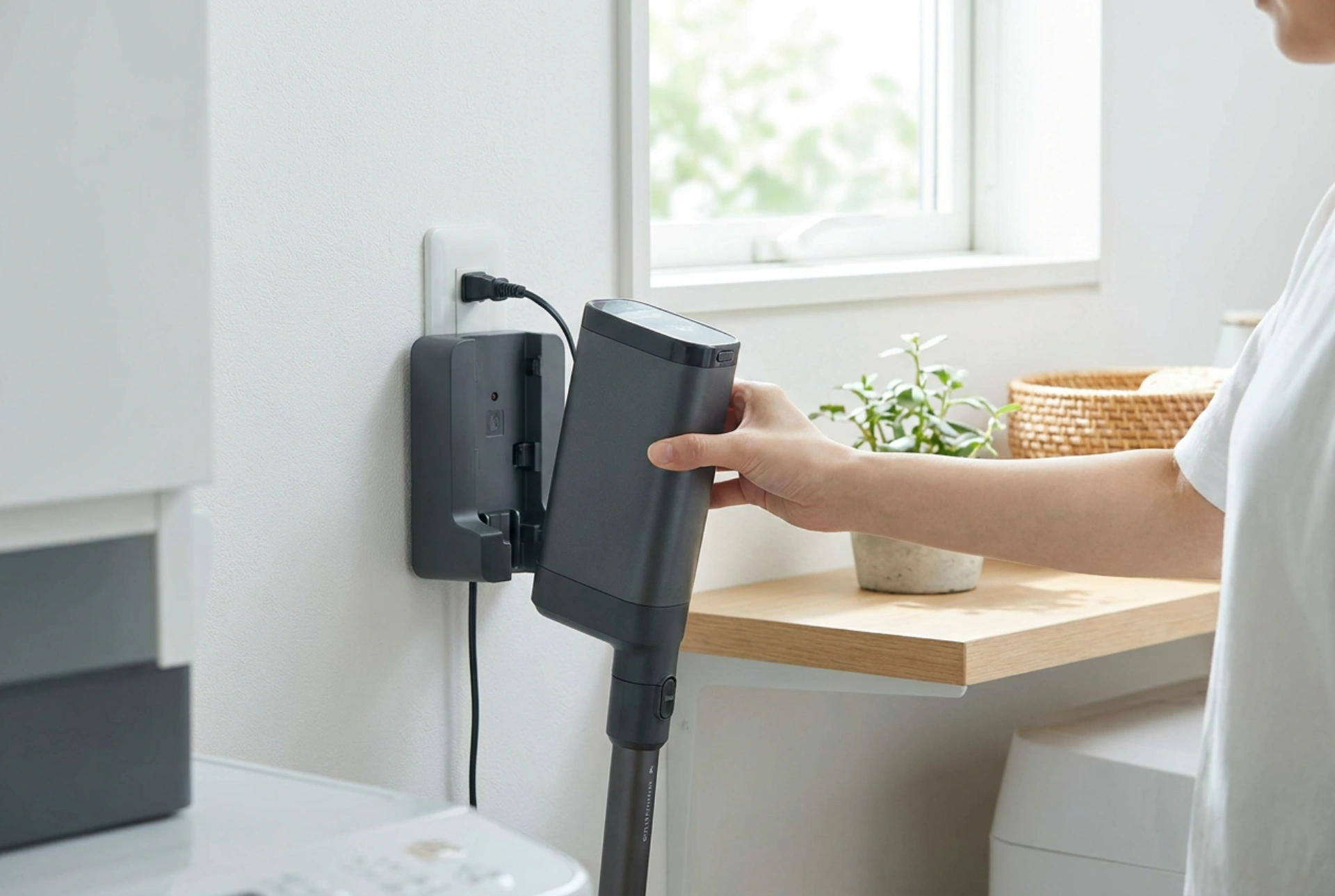
To shield the internal electronics from transient voltage spikes, establish a consistent routine when connecting the charger. Always connect the charging jack to the vacuum cleaner’s battery port or place the unit securely in its wall dock before inserting the power adapter into the wall outlet. This sequence ensures that the initial surge of electrical current is absorbed and regulated by the transformer brick rather than hitting the sensitive control boards of the vacuum directly. Ensure that the wall charger is plugged directly into a stable wall outlet rather than overloaded extension leads, which can suffer from voltage drops and increased electrical resistance.
Optimising Storage and Charge Levels
To extend the lifespan of your appliance, avoid deep discharges where the battery drains completely to 0%. Modern batteries experience the least amount of mechanical and chemical stress when maintained between 20% and 80% charge. If you plan to store the cordless vacuum unused for an extended period, such as during a holiday, do not store it completely empty or fully charged. The optimal storage state is approximately 50% capacity, kept in a cool, dry environment between 15°C and 20°C. This level minimises the self-discharge rate while preventing the cells from falling into a deep-discharge state, which can disable the battery permanently.
Preventative Maintenance Checklist
- Check the charger cord regularly for physical wear, kinks, or exposed wires.
- Keep the charging contact pins free of dust and debris by wiping them with a dry microfibre cloth; never use damp cloth or chemical solvents on active contacts.
- Position the charging station away from direct sunlight, radiators, or other heat sources.
- Ensure the charging area is well-ventilated to allow natural heat dissipation from the transformer.