

Sanding plaster creates ultra-fine gypsum particles that easily bypass standard vacuum systems and suspend in the air for hours. Controlling this airborne nuisance requires a systematic approach based on filtration mechanics, pressure differentials, and proper tool aerodynamics.
Understanding Gypsum Dust and Filtration Classifications
Gypsum plaster dust consists of particles ranging from over 50 micrometers down to sub-micron sizes. Standard vacuum filters rely on simple surface sieving, which quickly fails when exposed to plaster. The ultra-fine particles lodge deep within the filter fibers, a phenomenon known as blinding, which rapidly drops airflow and leads to motor overheating.
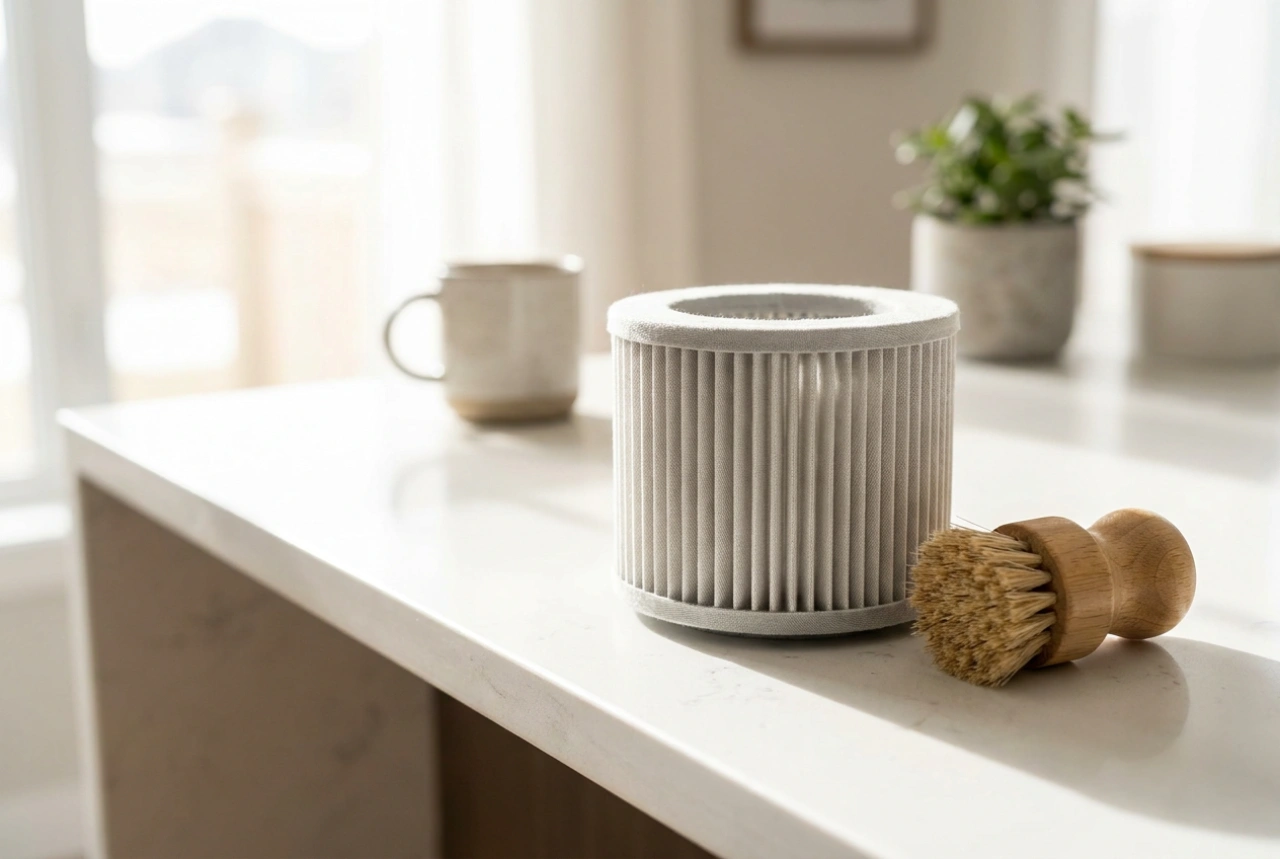
To capture these particles effectively, you must utilise high-efficiency particulate air (HEPA) filters or M-class certified filtration systems. These filters operate on three physical principles: inertial impaction, interception, and diffusion. For plaster dust, diffusion is critical as thermal molecular movement causes the smallest particles to wander erratically and collide with the filter fibers, where they are trapped. To prevent rapid clogging, choose a filter made from or coated with polytetrafluoroethylene (PTFE). This material has an extremely low coefficient of friction, allowing dust cakes to release easily during cleaning cycles rather than embedding in the substrate.
The Role of Airflow and Suction Regulation
A common mistake is assuming that maximum suction power is ideal for dust extraction. In reality, successful dust collection relies on high volume flow (measured in cubic meters per hour) rather than high static vacuum pressure. If the static pressure is too high, the sanding head will seal hermetically against the plaster surface. This creates a suction lock, stalling the orbital rotation of the sander, damaging the soft plaster finish, and starving the vacuum motor of cooling air.
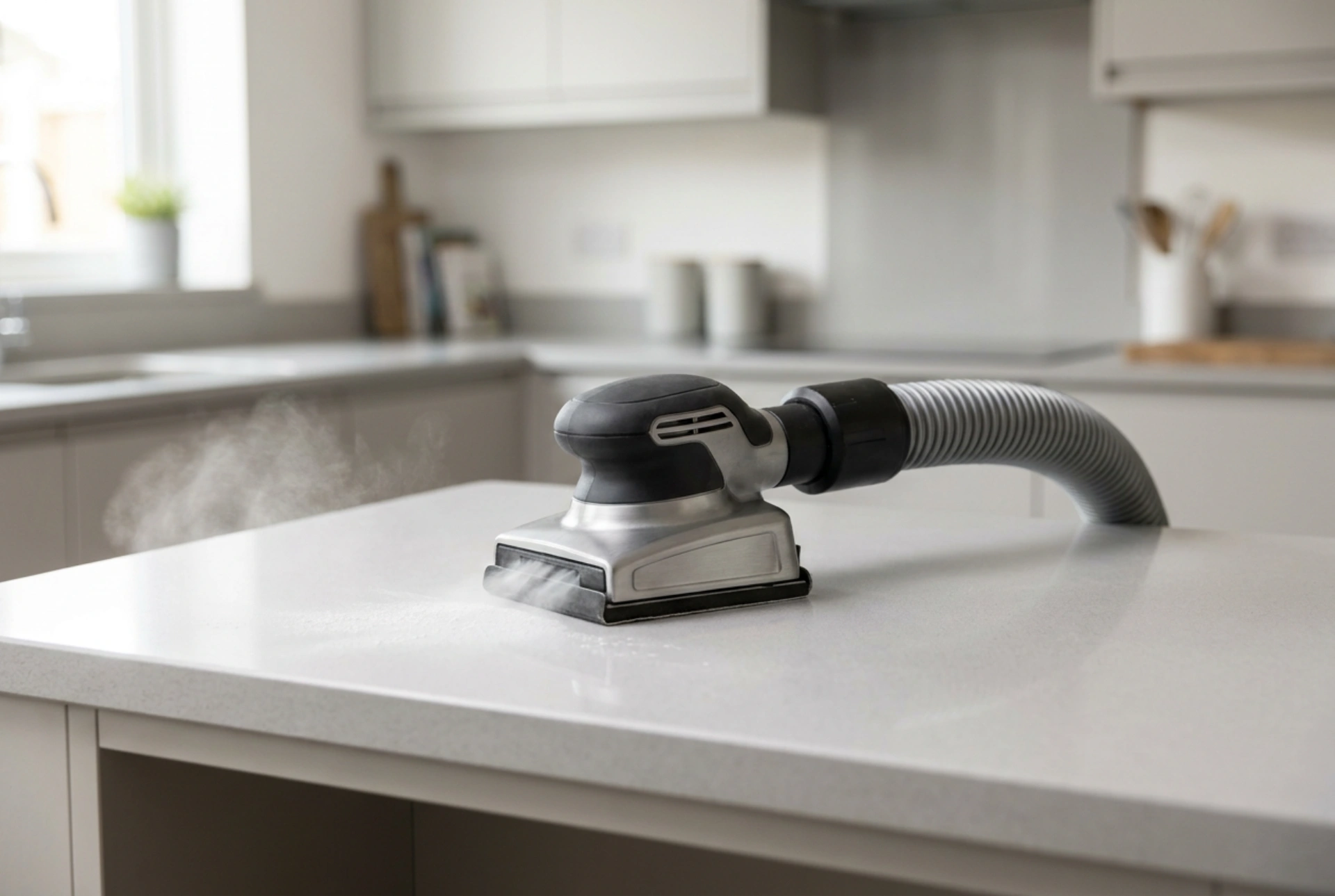
To prevent suction lock while capturing all airborne dust, utilise the bypass valve (bleed valve) located on the vacuum hose connector. Adjusting this valve introduces a controlled ambient air stream, reducing the vacuum hold on the wall while maintaining a high-velocity airflow through the extraction shroud. The shroud must float just a millimeter above the surface, utilising the Venturi effect to accelerate air across the sanding pad perimeter, pulling the dust into the vacuum stream before it can escape into the room.
Utilising Cyclonic Pre-Separation
When sanding large areas of plaster, the sheer volume of dust can overwhelm even the best self-cleaning filters. Integrating a cyclonic pre-separator between the sander and the vacuum is a highly effective way to manage this volume. A cyclone separator works on the principle of centrifugal force.
As the dust-laden air enters the cyclone chamber tangentially, it is forced into a rapid downward spiral. Because gypsum dust is denser than air, the centrifugal force flings the heavy particles outward against the chamber walls. Gravity then pulls these separated particles down into a collection bin below, while the cleaned air spirals upward through the center of the vortex into the vacuum. A properly sized cyclone can remove up to 99% of gypsum dust before it ever reaches the vacuum filter, maintaining consistent airflow and dramatically extending filter life.
Sanding Techniques and Hose Management
Your physical technique plays a major role in dust containment. Always activate the vacuum extraction system several seconds before bringing the sanding pad into contact with the wall. This establishes the necessary negative pressure zone inside the shroud. When sanding, keep the tool perfectly flat against the wall, moving in steady, overlapping sweeping motions. Raising one edge of the pad breaks the vacuum seal, instantly releasing a cloud of fine dust into the air.
Additionally, pay attention to the electrostatic properties of your setup. The friction of gypsum dust travelling through a plastic hose generates significant static electricity. This static charge causes dust to cling to the outside of the hose and the sander casing. Using an anti-static hose made with conductive carbon fibres dissipates this charge, ensuring that dust flows smoothly through the system and does not accumulate on your equipment or hands.