

Maintaining the filtration system of a bagless vacuum cleaner is essential for preserving suction power, extending motor life, and ensuring high indoor air quality. Understanding the physical mechanisms of dust accumulation and the correct thermal limits during cleaning prevents irreversible damage to delicate filter media.
Understanding Filter Materials and Clogging Mechanics
Bagless vacuum cleaners typically rely on a multi-stage filtration system. This usually includes a coarse mesh separator, a high-density foam pre-motor filter, and a pleated post-motor filter (often a HEPA or high-efficiency particulate air filter). Each material interacts with dust differently, requiring specific care.
Foam filters work via depth filtration. They trap larger debris within a complex, three-dimensional maze of open-cell polyurethane. Over time, fine particles accumulate in these chambers, restricting airflow. Pleated filters, conversely, use surface filtration. Made from synthetic polymer fibres (such as polyester or polypropylene) or fiberglass, they capture microscopic particles through interception, inertial impaction, and diffusion. When dust coats these fibers, it forms a "filter cake" that restricts air passage, forcing the vacuum motor to work harder, run hotter, and lose efficiency.
Indicators That Your Filter Needs Washing
While manufacturers often suggest washing filters every three to six months, real-world usage dictates a more observation-based approach. Key physical indicators that your filter is saturated include:
- Reduced Suction Power: If the vacuum fails to lift standard debris, the airflow is likely choked at the filter interface.
- A High-Pitched Motor Whistle: This sound occurs when the motor struggles to pull air through a dense barrier, creating high vacuum pressure inside the housing.
- Musty Odours: Organic particles like pet dander and skin flakes trapped in a slightly damp filter begin to decay, releasing volatile organic compounds (VOCs).
- Visible Dust Cake: A grey, compacted layer covering the pleats of a HEPA filter or discoloration of the foam indicates maximum holding capacity.
The Correct Washing Protocol
Improper washing techniques can destroy the microscopic structure of the filter fibers. Follow this systematic approach to clean washables safely:
1. Dry De-dusting
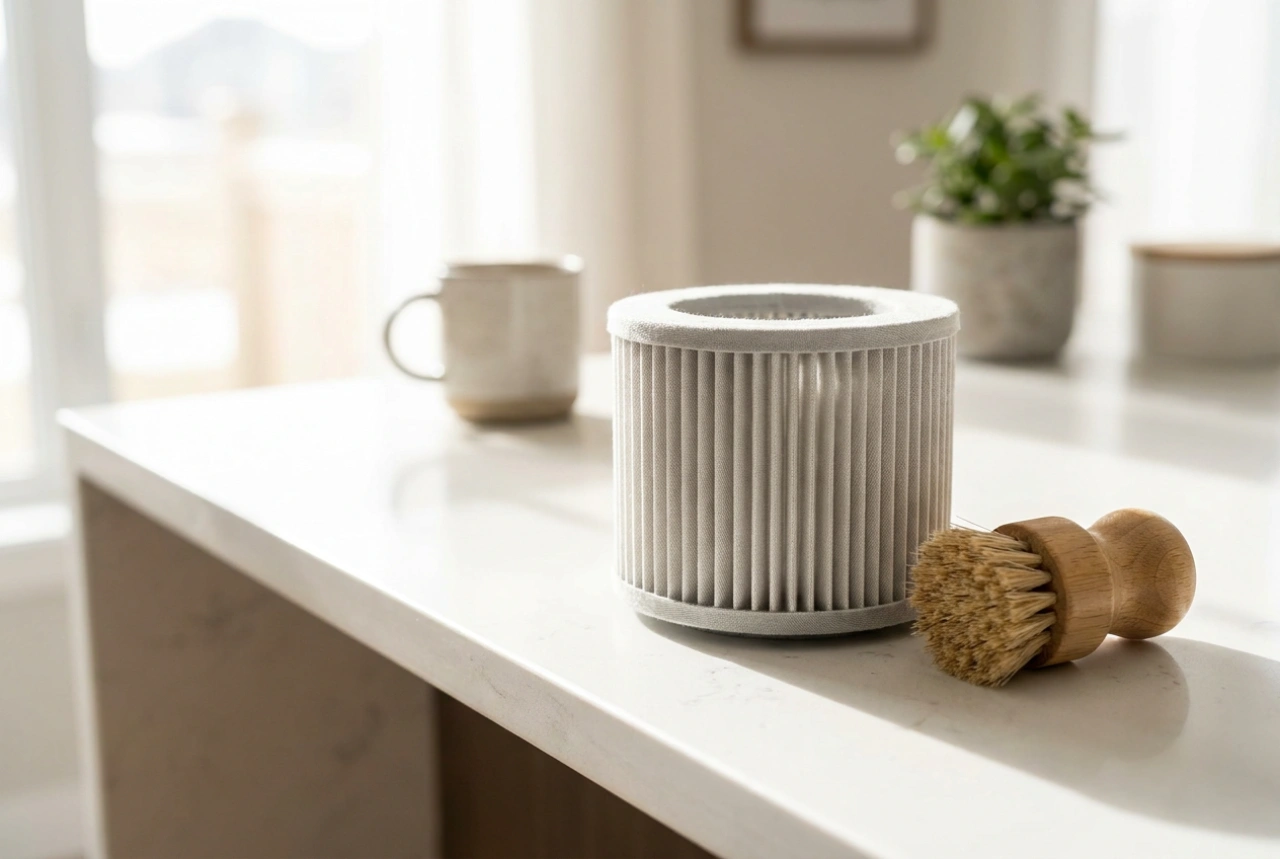
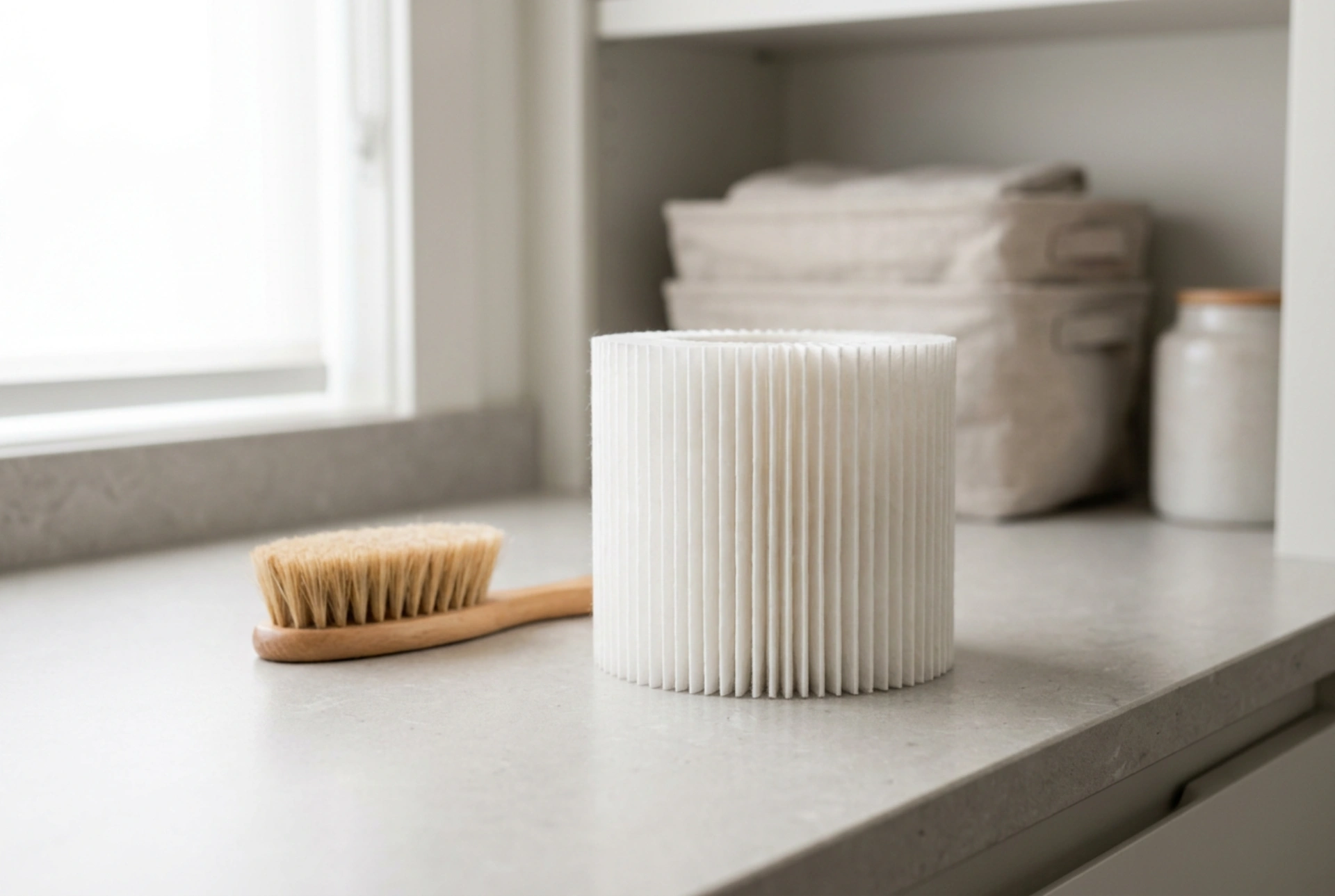
Before introducing water, gently tap the filter frame against the inside of a waste bin to dislodge loose dust. You can use a soft-bristled brush to sweep away the surface cake from pleated channels. Never tap the delicate paper-like pleats directly.
2. Reverse-Flow Rinsing
Always run lukewarm water (under 30°C) through the clean side of the filter so that it pushes the dust out the way it came in. Directing water onto the dirty side forces fine particles deeper into the fiber matrix, locking them in permanently. Avoid using boiling water, which can melt hot-melt adhesives holding the pleats together or warp plastic frames.
3. Chemical Caution
Do not use dishwashing liquids, laundry detergents, or bleaching agents. These chemicals can degrade synthetic polymers and leave behind surfactant residues that attract dust even faster once dry. Plain, running water is usually sufficient. For stubborn odors, a mild solution of white vinegar (acetic acid) can be used briefly to neutralise alkaline organic compounds.
The Critical Drying Phase: Why Time and Airflow Matter
Reinserting a damp filter into a vacuum cleaner is disastrous. The moisture acts as a binder, turning incoming dust into an impermeable mud layer that immediately ruins the filter. Furthermore, the warm, dark interior of a vacuum housing provides the perfect environment for mould spores to colonise the damp fibers within hours.
The standard rule for drying is a minimum of 24 to 48 hours in a well-ventilated space. However, the method of drying is just as important as the duration:
- Do Not Use Direct Heat: Never place filters on radiators, inside ovens, or under hair dryers. High temperatures shrink synthetic fibers, altering the pore size and destroying the filter's rated efficiency. It can also warp the rubber seals, leading to dirty air bypassing the filter entirely.
- Positioning: Place pleated filters on their side, pleats facing downwards, on a clean towel. This allows gravity to pull water out of the deep crevices. Shake foam filters gently to remove excess water before laying them flat; do not wring or twist them, as this tears the delicate polyurethane cells.
- Passive Airflow: Keep the drying filter in a room with active air circulation or near an open window, away from direct, harsh sunlight which can cause UV degradation of plastic casings.