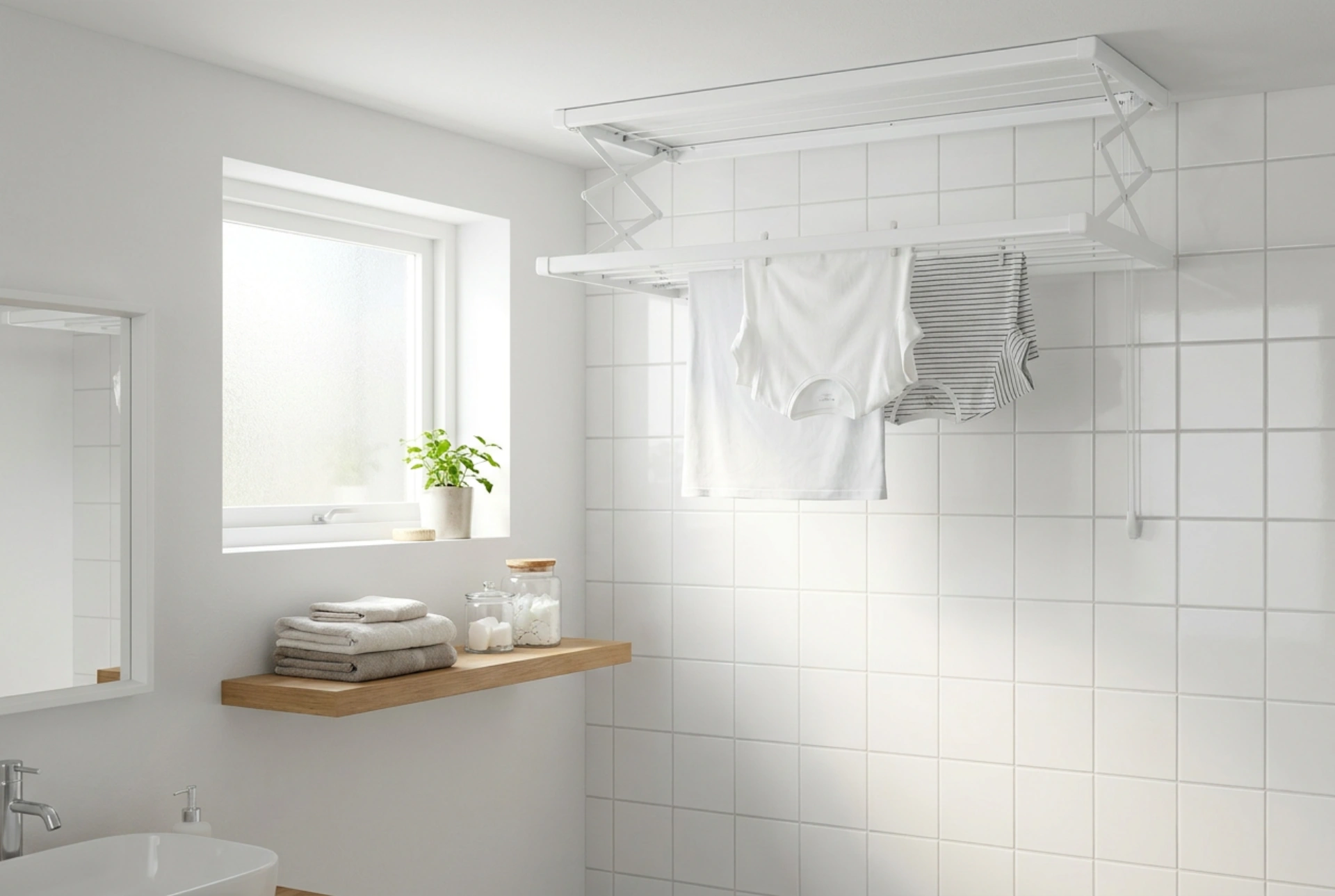


Hanging laundry high up exploits the natural accumulation of warm air near the ceiling, but without strategic planning, this process can trap moisture and cause condensation. Understanding the physics of airflow and humidity is key to installing a ceiling clothes airer that dries clothes rapidly while keeping your bathroom dry and mold-free.
The Thermodynamics of Ceiling-Level Drying
In any indoor space, warm air rises due to its lower density—a process known as natural convection. This makes the zone closest to your ceiling the warmest part of the bathroom, providing an ideal environment for accelerating water evaporation from wet fabrics. However, as water evaporates, it raises the relative humidity of this warm air layer. If this moisture-laden air cools down rapidly—for instance, by coming into contact with a cold external wall or an uninsulated ceiling—it reaches its dew point, and water transitions from a gaseous state back into liquid droplets. To prevent this condensation, the ceiling airer must be positioned where air does not stagnate, and the boundary layer of air is constantly renewed.
Mapping Bathroom Airflow Paths
For effective drying without dampness, your ceiling airer must intersect the bathroom's active ventilation pathway. Air enters the room through an inlet—typically a gap under the door (undercut) or a window trickle vent—and exits through the mechanical extraction fan or passive ventilation grille.
- Avoid Dead Zones: Corners and alcoves have minimal air movement. Placing an airer here creates a pocket of high humidity that slows drying and damages paint.
- Align with the Draft: Position the airer parallel to the direction of airflow from the door to the extractor. This ensures that dry incoming air continuously sweeps across the wet garments, absorbing moisture and carrying it directly out of the building.
- Proximity to Extraction: While placing the rack near the extractor fan is beneficial, ensure it does not physically block the intake grille, which would restrict the fan’s volumetric flow rate.
Structural Integrity and Mounting Mechanics
A loaded ceiling airer can weigh upwards of 15 to 20 kilograms when wet fabrics are distributed across its rails. Safely suspending this weight requires understanding the physics of load distribution.
- Solid Ceilings: In concrete ceilings, mechanical expansion anchors or nylon wall plugs designed for solid masonry ensure a high pull-out strength.
- Plasterboard Ceilings: If mounting to a suspended plasterboard ceiling, you must locate the timber joists using a stud finder. Fastening directly into plasterboard with plasterboard anchors is unsafe for dynamic, heavy loads. Use heavy-duty wood screws aligned with the center of the timber joists to transfer the load directly to the building's structural frame.
- Pulley Alignment: Ensure the pulley system is aligned to minimize friction. High friction increases the physical effort required to raise the rack and puts unnecessary lateral stress on the ceiling mounts.
Optimal Hanging Techniques for Air Circulation
The speed of evaporation is directly proportional to the exposed surface area of the wet fabric. Efficient drying relies on maximizing this surface area and maintaining space between garments.
- The Chimney Effect: Hang thicker, heavier items (like towels or denim) on the outer rails of the airer, and lighter, thinner items in the center. This creates a natural chimney effect, allowing air to rise freely through the middle of the rack.
- Spacing: Leave at least 5 to 8 centimeters of space between individual garments. When clothes touch, they create microclimates of high humidity, significantly extending drying times.
- Hanger Utilization: Whenever possible, hang shirts and delicates on plastic hangers suspended from the airer. This keeps the fabric open and maximizes the boundary layer air exchange, accelerating evaporation.
Controlling the Indoor Climate
Even with perfect placement, you must manage the room's temperature and relative humidity during the drying cycle.
- Temperature Control: Keep the bathroom heated to at least 18 to 20 degrees Celsius. Warm air can hold significantly more moisture than cold air before reaching saturation.
- Extraction Timing: Run the mechanical extraction fan throughout the drying process and for at least 30 minutes after the clothes feel dry to remove the final residual vapor from the room's surfaces.