

Achieving a streak-free finish with a cordless vacuum-mop hybrid requires an understanding of fluid dynamics, surface tension, and material science. To prevent damage to sensitive floorings like hardwood or laminate, you must balance water volume, mechanical agitation, and detergent chemistry rather than relying on brute force.
The Physics of Vacuum-Mopping: How Hybrid Systems Work
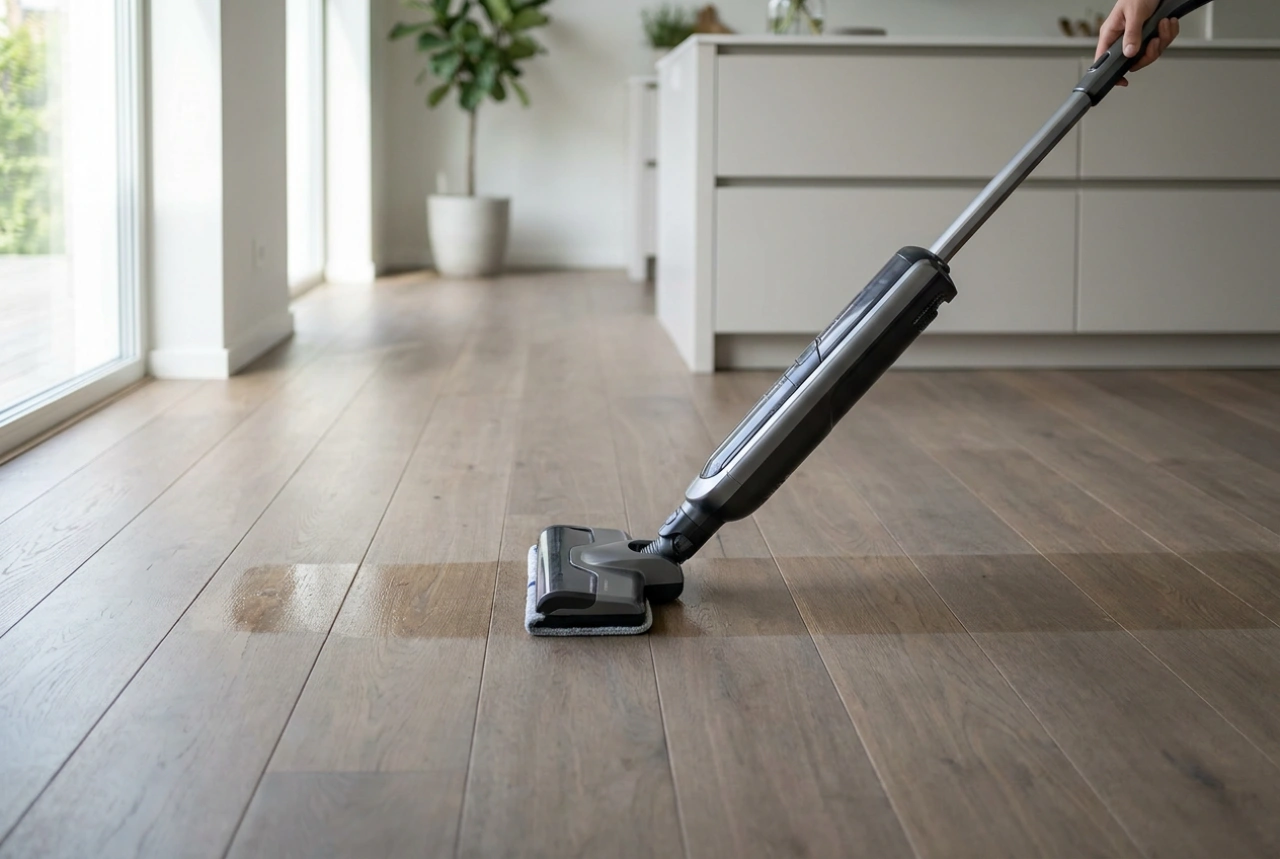
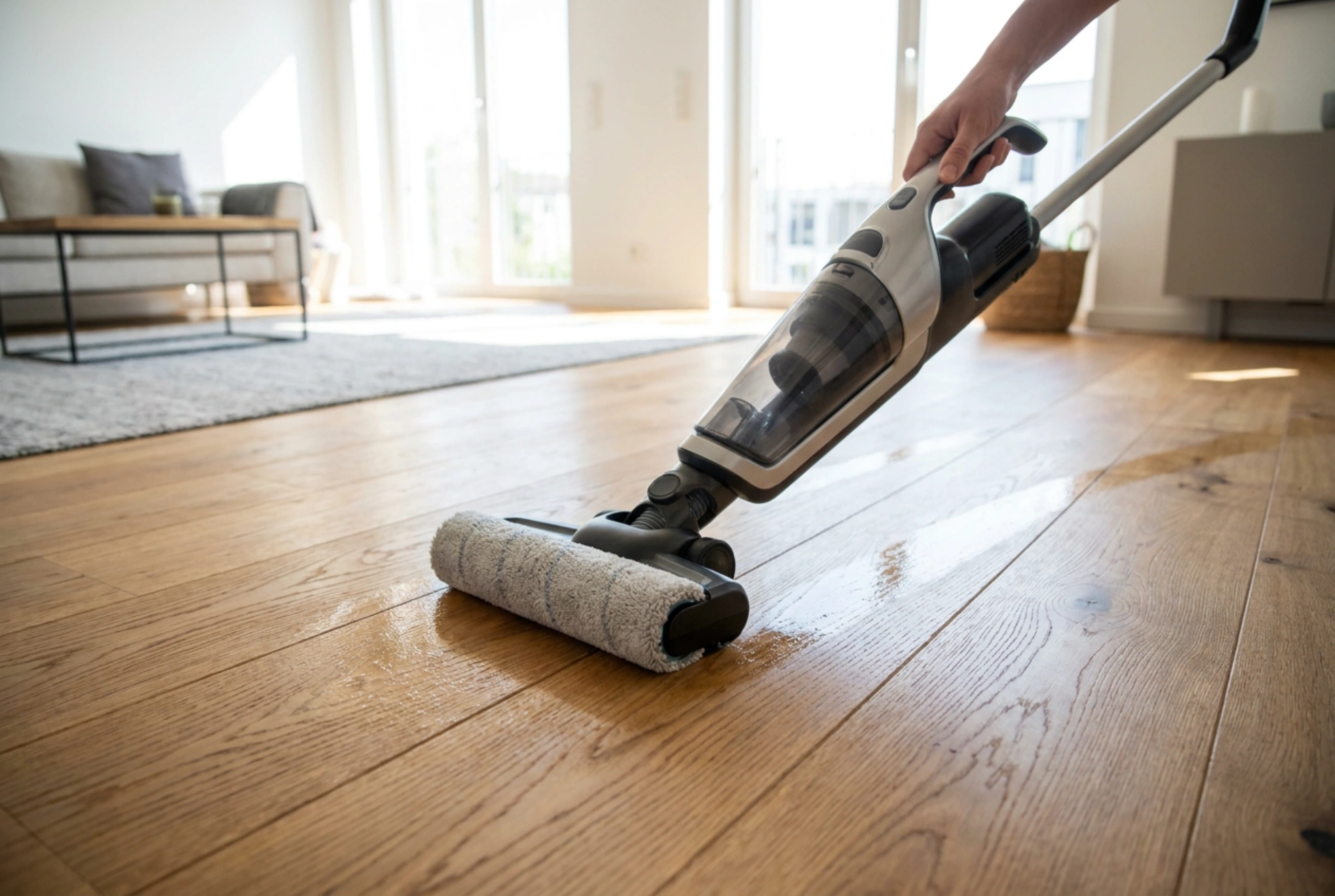
Traditional mopping often redistributes dissolved dirt across the floor, leaving a thin film of grime when the water evaporates. A cordless wet-and-dry vacuum solves this by using a continuous-flow system. Clean water and detergent are fed onto a rotating microfiber roller, which loosens dirt through high-speed mechanical agitation. Simultaneously, a high-velocity suction channel behind the roller immediately lifts the dirty slurry into a separate recovery tank.
For this process to work efficiently, the rate of water deposition must match the rate of extraction. Moving the machine too quickly breaks the seal between the squeegee lip and the floor, leaving behind excess moisture. A slow, steady forward pass applies the moisture, while a slightly slower backward pass ensures the vacuum suction can reclaim nearly one hundred percent of the liquid before it can penetrate floor joints.
Water Temperature and Surfactant Chemistry
It is a common misconception that boiling hot water is best for floor cleaning. In sealed hybrid vacuums, hot water can warp plastic components and weaken rubber seals. More importantly, hot water evaporates too rapidly on the floor surface, leaving behind surfactant residues before the suction nozzle can extract them. This results in unsightly streaks and sticky surfaces that quickly attract new dirt. Use lukewarm water (around thirty degrees Celsius) to keep the surfactants active without accelerating evaporation.
The choice of cleaning agent is critical. Standard floor cleaners or dish soaps contain high-foaming ionic surfactants. When agitated by a roller spinning at thousands of revolutions per minute, these agents create dense foam. This foam fills the dirty water tank rapidly, bypassing the float valve and entering the vacuum motor, which can cause electrical failure. Always use low-foaming, non-ionic surfactants designed specifically for extraction machines. These break the surface tension of water to release oily grime without generating foam bubbles.
Mastering the Motion: Grid Technique and Overlap
To avoid leaving wet tracks and uncleaned stripes, adopt a systematic grid pattern. Always start at the furthest corner of the room and work toward the exit to avoid stepping on freshly damp surfaces.
- The 30% Overlap Rule: Each pass should overlap the previous one by approximately thirty percent. This ensures that the edges of the roller, which receive slightly less downward pressure, do not leave uncleaned gaps.
- Two-Phase Stroke: Push the machine forward slowly to allow the wet roller to dissolve dried-on stains. Pull the machine backward along the same path at half the speed; this secondary pass relies on the squeegee blade to scrape up the remaining water layer into the vacuum stream.
- Handling Corners: Because circular rollers cannot reach the absolute apex of ninety-degree corners, pull the machine perpendicular to the wall first, then sweep parallel to capture edge dust.
Adjusting for Wood vs. Tile Flooring
Different materials require different moisture levels. Hardwood and laminate floors are highly susceptible to moisture ingress through capillary action at the joints. Excessive water can cause the wood fibres to swell and the edges to warp. When cleaning wood, set the water flow to the lowest setting and ensure the roller is only damp, not saturated. Immediately follow with a dry suction pass if any dampness remains visible for more than two minutes.
In contrast, ceramic or porcelain tiles are non-porous but feature recessed grout lines. These recessed areas act as dirt traps. For tiles, increase the water flow rate to allow the liquid to pool slightly in the grout lines, softening the accumulated grime. The mechanical action of the spinning roller, combined with the high-airflow suction, will then pull the dirty water out of these crevices.
Preventing Odours: The Science of Post-Clean Maintenance
The moist, dark environment inside a dirty water tank is a perfect breeding ground for anaerobic bacteria, which produce volatile organic compounds responsible for sour, damp odours. To prevent this, empty and rinse both the dirty water tank and the solid waste separator immediately after every cleaning session. Wash the microfiber roller with a mild, chlorine-free disinfectant and leave it to air-dry in a well-ventilated area for at least twenty-four hours before reassembling. Never leave a damp roller inside a closed charging dock, as this encourages mildew growth on the fibers.