

Choosing a robust laundry drying rack and loading its arms correctly prevents structural bending, balances weight distribution, and accelerates the natural evaporation of water from fabrics.
The Physics of Drying Rack Stability
Every laundry drying rack is a mechanical structure subjected to gravitational pull and leverage. When wet clothes are hung, their weight increases significantly due to absorbed water. For instance, a heavy cotton towel can hold more than its dry weight in water, exerting concentrated downward force. Understanding the center of gravity is key to preventing your drying rack from tipping or warping over time.
High-quality drying racks utilize tubular steel or thick aluminum frames. Steel offers excellent rigidity and weight, which lowers the overall center of gravity, while aluminum provides corrosion resistance. The joints, often made of reinforced polymer compounds, act as the primary load-bearing pivot points. If these pivots are subjected to uneven torque, they gradually deform, leading to a permanently wobbly structure.
The Golden Rules of Weight Distribution
To preserve the structural integrity of your drying rack and ensure even drying, you must apply basic principles of physics when hanging your laundry.
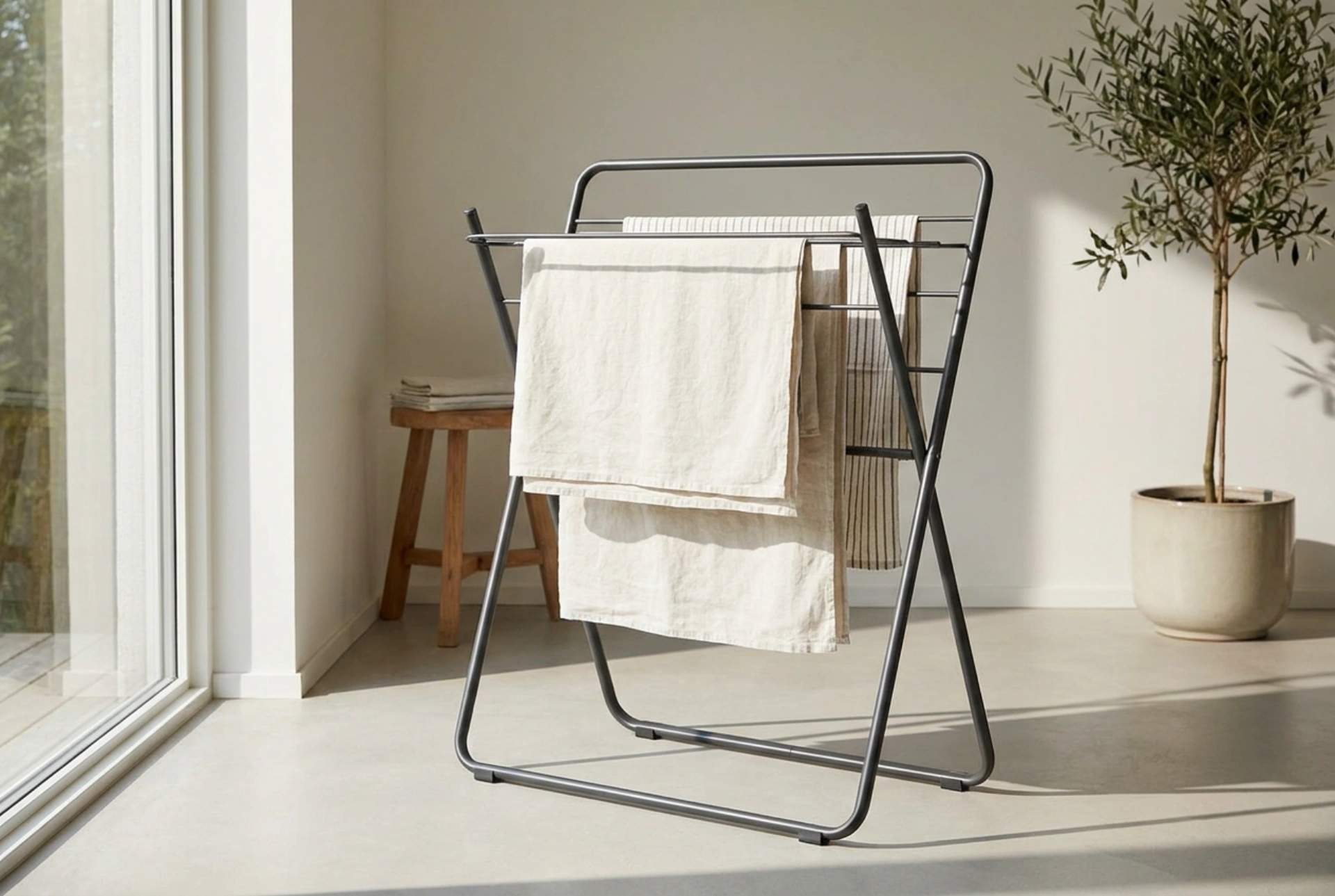
- Load from the Inside Out: Always place the heaviest items, such as denim jeans, thick sweaters, and bath towels, on the center rods directly over the main support legs. This keeps the center of gravity low and aligned with the strongest vertical supports.
- Symmetrical Balancing on Wing Racks: If your rack has extendable wings, never load one wing completely while leaving the other empty. This creates a lever arm effect, placing immense shear stress on the plastic joints and causing the rack to tip. Distribute garments symmetrically across both wings.
- Airflow and Spacing: Water evaporates when dry air circulates around wet fibers, carrying moisture away. Hanging items too close together creates a localized zone of high humidity, slowing down the drying process and risking musty odors. Leave at least one empty rod between heavy garments to facilitate convective airflow.
How Material Science Affects Garment Drying
Different textiles interact with water and air in unique ways, which dictates how and where they should be positioned on the drying rack. Capillary action draws water downward through gravity. Consequently, the bottom edges of hanging garments remain wet the longest.
Synthetic fibers like polyester and nylon are hydrophobic; they absorb very little water within their fibers, meaning water mostly clings to the surface and evaporates rapidly. These lightweight items can be placed on the outer wings. Conversely, hydrophilic natural fibers like cotton, wool, and linen absorb water deep within their cellular structure. These heavy items must be positioned on the sturdiest central rods of the frame, ideally laid flat across multiple lines if they are prone to stretching.
Proper Tensioning and Maintenance for Longevity
Over time, even the sturdiest metal racks can suffer from wear. To maximize their lifespan, periodically wipe down the metal rods with a dry cloth to prevent moisture build-up in the joints, which can lead to microscopic oxidation. When folding the rack, avoid forcing the hinges; if a joint resists, check for alignment issues rather than applying brute force, which can crack the plastic connectors or bend the metal tubing.