

Vacuuming fine construction dust like plaster, drywall residue, or concrete powder can instantly clog standard filters, drastically reducing suction and risking motor burn-out. Understanding the physics of filtration and particle separation is key to maintaining continuous airflow and protecting your equipment during heavy-duty cleanup.
The physics of fine dust and filter clogging
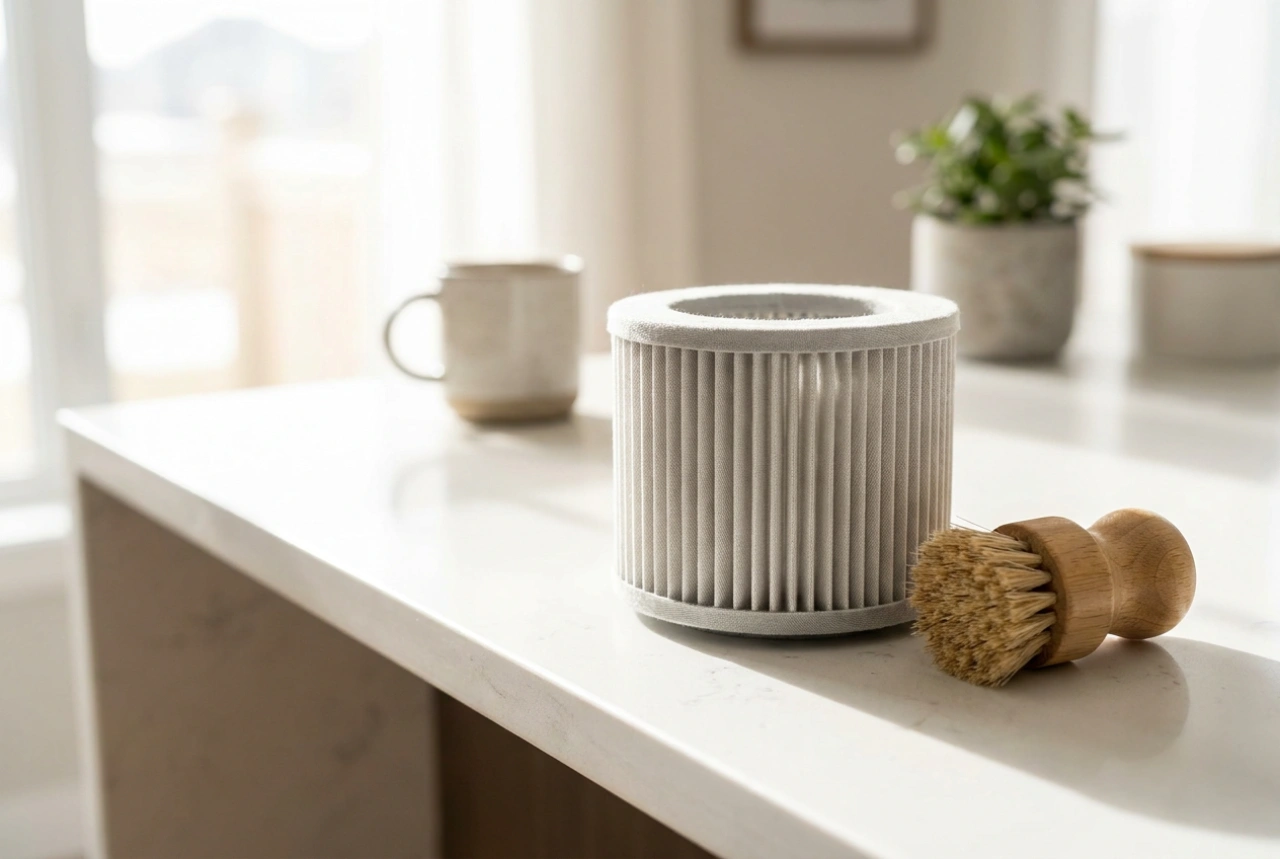
Fine dust particles are exceptionally small, often measuring under 5 micrometres in diameter. When suction pulls these particles into a standard vacuum, they do not simply settle at the bottom of the container. Instead, the high velocity of the airflow carries them directly onto the surface of the main pleated filter. Because these particles are so minute, they quickly lodge deep within the pores of the filter media, creating a dense, impermeable barrier known as a dust cake. This barrier restricts air passage, causing the motor to overheat as it struggles to pull air through the clogged obstruction.
The power of cyclone separators
The most effective way to prevent fine dust from reaching and clogging your vacuum filter is to intercept it using a mechanical pre-separator, commonly known as a cyclone. A cyclone separator is placed inline between the vacuum hose and the suction inlet of the vacuum container.
- Centrifugal force: As dust-laden air enters the conical chamber of the cyclone at a tangent, it is forced into a rapid downward spiral.
- Inertia: Because the heavy dust particles have more mass and inertia than the air molecules, they are slung outward against the walls of the cyclone.
- Gravity: The particles slide down the walls and fall into a separate collection vessel below, while the clean air is drawn upward through the center and into the vacuum.
By employing a cyclone pre-separator, up to 99% of fine dust is captured before it ever touches the main vacuum filter, ensuring consistent suction power throughout the entire project.
Selecting and using the correct filter bags
If a cyclone separator is not an option, you must use specialized filter bags designed specifically for fine dust. Standard paper bags tear easily under the pressure of sharp plaster particles and quickly clog. Instead, opt for multi-layer synthetic fleece filter bags. Fleece bags consist of several layers of microfiber with varying pore sizes. The outer layers trap larger debris, while the inner, denser layers capture the microscopic dust. This gradient filtration prevents the surface of the bag from sealing shut instantly, allowing air to pass through freely even when the bag is nearly full.
Active filter cleaning mechanisms
Many professional construction vacuums feature built-in filter cleaning systems, which are essential when tackling fine masonry dust. These systems operate on two distinct principles:
- Manual pulse cleaning: The user temporarily blocks the suction hose, directing a blast of reverse airflow through the filter to knock the dust cake loose into the collection tub.
- Automatic electromagnetic pulse: Sensors detect the drop in air pressure when the filter begins to clog, automatically triggering rapid mechanical vibrations or reverse air pulses to clean the filter element during operation.
When working with fine dust, always ensure these systems are switched to the highest frequency setting to continuously clear the filter pores before they become permanently compacted.
Optimizing airflow and technique
How you operate the vacuum also influences how quickly the system clogs. Moving the nozzle too quickly into a large pile of dust starves the system of air, drawing a dense plug of concentrated particles straight onto the filter. Instead, hold the nozzle slightly above the surface, allowing a high volume of air to mix with the dust. This high air-to-dust ratio keeps the particles suspended in the airflow, preventing them from settling and compacting prematurely inside the hose or against the filter pleats.