

Coffee stains are among the most common household mishaps, yet attempting to remove them without understanding the underlying material science often leads to permanent setting. Coffee contains tannins—water-soluble polyphenolic compounds—along with lipids and proteins from milk. Successful removal relies on a precise sequence of physical and chemical steps designed to release these molecules from the fabric weave before they oxidise and bond permanently with the fibres.
Understanding the Coffee Stain: Tannins and Fibres
To effectively neutralise a coffee stain, one must understand its chemical composition. Black coffee is primarily an aqueous solution of organic acids, caffeine, and tannins. Tannins are natural dyeing agents that form strong hydrogen bonds with polar groups in natural fibres like cotton, linen, and wool. When coffee penetrates a fabric, these pigments wrap around the polymer chains of the yarns.
If the coffee contains milk or cream, the stain becomes a complex mixture of organic pigments, lipids (fats), and proteins. Introducing high heat at the beginning of the cleaning process will coagulate these proteins, locking them into the matrix of the fabric. Therefore, the temperature of the water used during the initial treatment must be carefully regulated based on the specific composition of the beverage.
Step 1: Capillary Action and Immediate Dilution
The first rule of coffee stain emergency response is to exploit capillary action through blotting, never rubbing. Rubbing applies lateral mechanical force, pushing the pigment molecules deeper into the interstitial spaces of the yarn and spreading the stain horizontally.
- Blotting: Place a clean, dry, white cotton or linen cloth directly over the spill. Apply firm, vertical pressure. This coaxes the liquid to migrate from the damp garment into the dry substrate via capillary action.
- Reverse Flushing: Turn the garment inside out. Align the stained area under a cold, running tap so that the water enters from the back of the fabric and pushes the coffee particles out the way they came. Flushing from the front only drives the pigments deeper into the weave.
Step 2: Breaking the Bonds with Surfactants
Once the excess liquid is removed, the remaining pigment must be chemically detached from the fibres. This is achieved using surfactants (surface-active agents). Anionic surfactants, commonly found in liquid laundry detergents, possess a hydrophilic (water-attracting) head and a hydrophobic (water-repelling) tail.
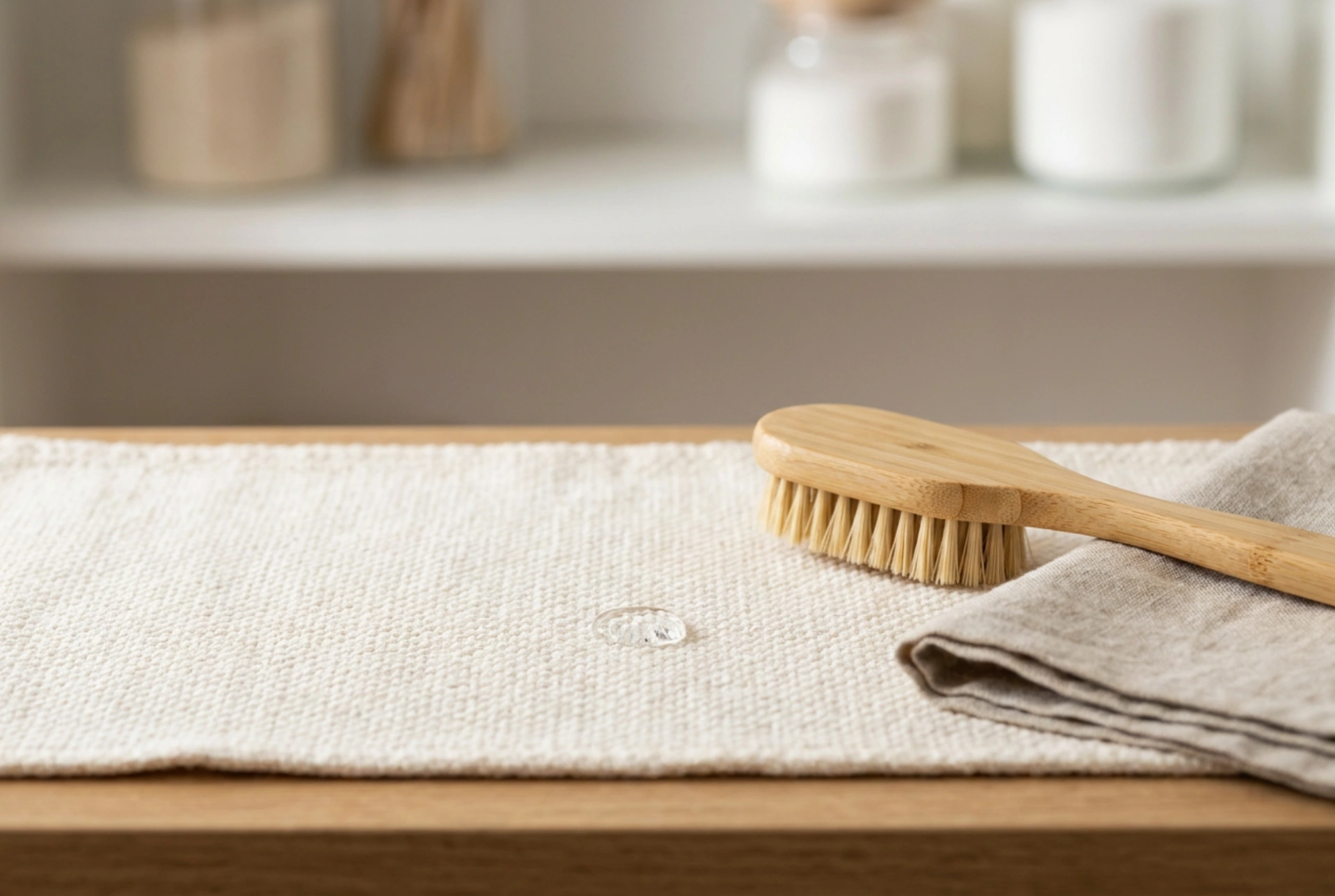
Apply a small amount of neutral liquid detergent directly to the damp stain. Using a soft-bristled brush or the pad of your finger, gently work the detergent into the fabric using circular, inward-spiralling motions to prevent the stain from spreading. The hydrophobic tails of the surfactant molecules attach to the organic compounds of the coffee, while the hydrophilic heads pull them into the rinsing water.
Step 3: Addressing Oxidation with Oxygen Bleach
For dried or particularly stubborn coffee stains, simple surfactants may not suffice. The tannins may have already begun to oxidise, turning into yellow-brown compounds that are highly resistant to water. In this scenario, an oxidising agent such as sodium percarbonate (oxygen bleach) is required.
Dissolve a small amount of oxygen bleach in warm water (approximately 40°C, provided the fabric care label permits). This reaction releases hydrogen peroxide, which breaks down the double bonds in the tannin molecules through oxidation, rendering them colourless and water-soluble. Submerge the stained area in this solution for 30 to 60 minutes before proceeding to the final wash cycle.
Step 4: The Final Thermal Cycle
The final stage is a standard laundering cycle, where temperature and mechanical action work in tandem to remove any remaining microscopic residues. For synthetic fabrics like polyester or nylon, a moderate temperature of 30°C to 40°C is ideal to prevent thermal setting of synthetic polymers. For robust natural fibres like cotton or linen, a higher temperature of up to 60°C can be utilised to maximise the solubility of the remaining lipids and surfactants, ensuring a completely clear weave.