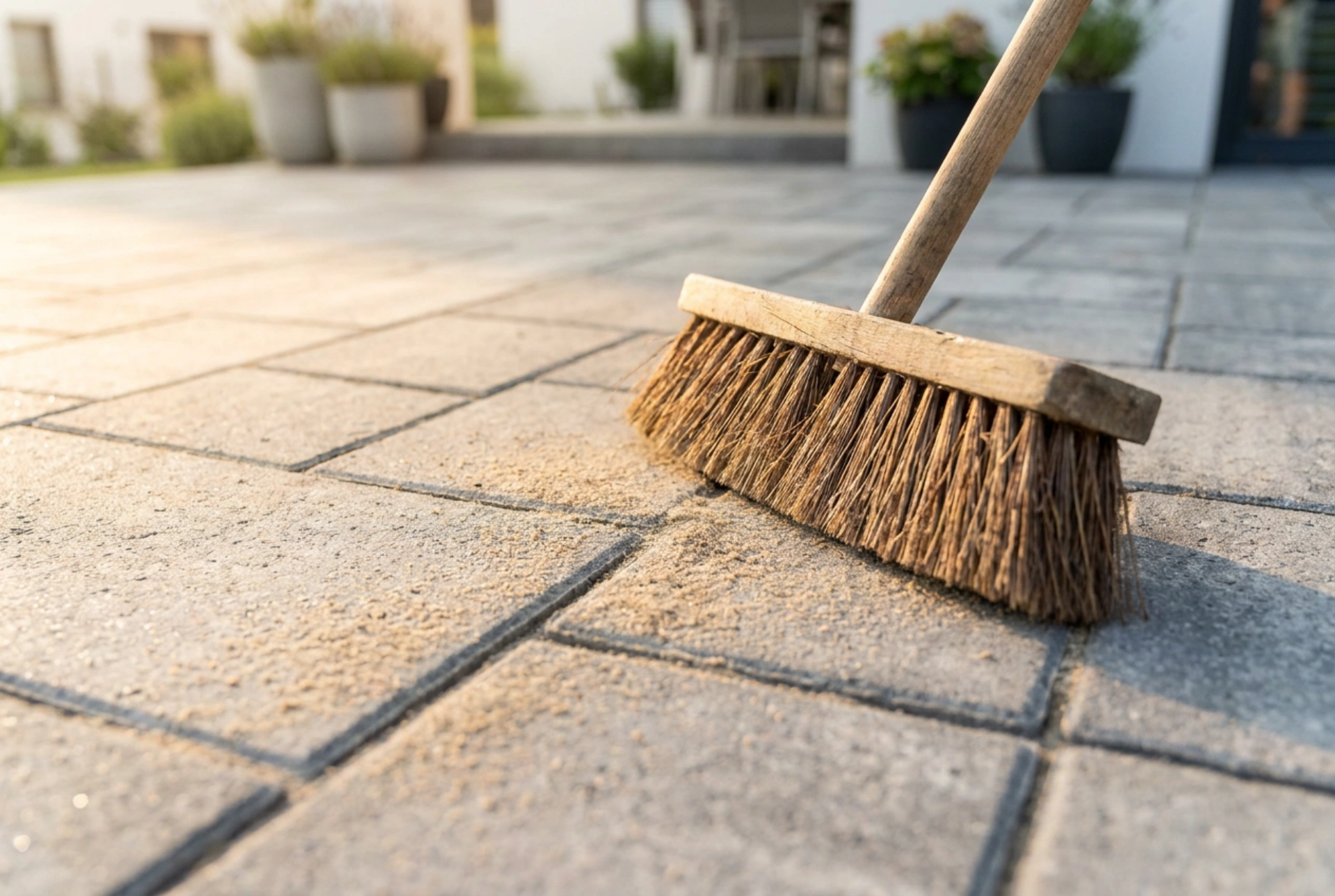


Clearing excess, loose, or contaminated sand from block paving joints is a precise mechanical task that directly influences the structural integrity of your outdoor surfaces. Employing the correct sweeping technique ensures you remove only loose debris and surface-level particles without undermining the interlocking stability of the pavers below.
The Physics of Joint Sand and Structural Integrity
Block paving relies on a principle known as interlocking friction. The sand filled between the individual blocks does not act merely as a visual filler; it distributes lateral loads across the entire paved surface. When vehicles or heavy foot traffic traverse the paving, the shear force is transferred from block to block through the compacted sand. However, when surface sand becomes contaminated with organic matter, weed seeds, or simply drifts across the surface as loose grains, it must be cleared. The objective is to sweep away this loose upper layer—often down to a depth of 2 to 3 millimetres to allow for fresh jointing compound or sealer—without vacuuming or digging out the structural sand beneath.
The Mechanics of Bristle Selection
The physical properties of your broom's bristles dictate how energy is transferred to the sand particles. Broadly, bristles fall into three categories: natural fibres (such as coco or bassine), synthetic polymers (such as polypropylene), and wire. For clearing loose surface sand, a medium-stiff synthetic or natural-bristle broom is ideal. Highly rigid wire brushes should be avoided for general sweeping, as their high modulus of elasticity can scratch concrete or natural stone faces and gouge too deeply into the joint, destabilising the compacted lower layers. Conversely, overly soft bristles lack the kinetic energy transfer required to dislodge particles wedged slightly between the blocks. A medium-stiff bristle provides the necessary spring-back action, flicking loose grains upward and outward from the joint surface.
The 45-Degree Angular Sweeping Technique
The direction of your sweeping stroke determines the vector of force applied to the joint. If you sweep parallel to the joint lines, the bristles drop directly into the crevices, acting like small shovels that scoop out the essential jointing sand. If you sweep perpendicular to the lines, the broom bounces over the edges, failing to clear the loose debris sitting just below the paver chamfer. The optimal path is a diagonal angle—specifically 45 degrees to the grid of the paving. This angle allows the bristles to glide smoothly across the surface of the blocks while the outer tips of the bristles gently skim the top of the joint, lifting only the uncompacted, loose particles. Use short, controlled strokes rather than long, sweeping arcs to maintain consistent pressure and prevent the broom from lifting too early.
The Influence of Capillary Action and Moisture
Surface chemistry and moisture levels play a critical role in how sand behaves during sweeping. When sand is damp, capillary action creates liquid bridges between the individual quartz grains. This surface tension binds the particles together, making them highly resistant to the mechanical action of dry sweeping. Attempting to sweep damp sand will only smear it across the paving faces, leaving unsightly stains and failing to clear the joints. Always ensure the paving is completely dry. Under dry conditions, the cohesive forces between the sand grains are broken, allowing the mechanical energy of the broom to easily overcome gravity and friction, cleanly separating the loose grains from the compacted matrix below.
An Operational Protocol for Surface Clearing
To achieve a professional finish, follow this systematic order of operations:
- Clear the Area: Remove all larger debris, leaves, and twigs first using a soft-bristled broom to prevent them from grinding into the sand joints.
- Assess Dryness: Ensure the paving has had at least 24 hours of dry, warm weather to eliminate sub-surface moisture.
- Execute the Diagonal Sweep: Position yourself at a 45-degree angle to the primary joint pattern. Use firm, short pulling motions rather than pushing, as pulling gives you greater control over bristle penetration depth.
- Collect the Spoil: Sweep the accumulated sand into central piles on the face of the blocks, avoiding sweeping them back into adjacent joints. Use a dustpan to remove the piles entirely.