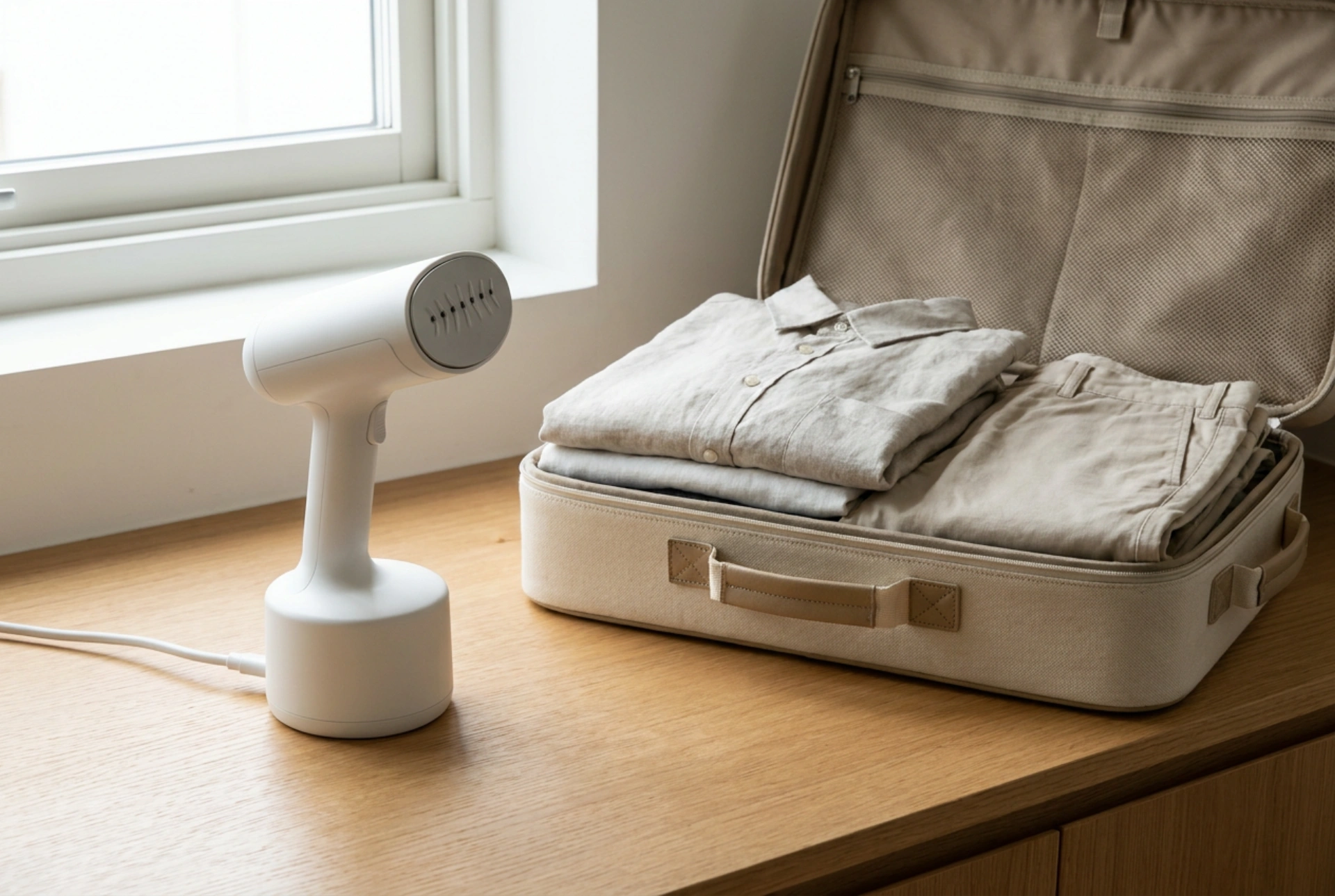


Packing clothes into a suitcase inevitably subjects fabrics to compression, friction, and shifting humidity, which disrupts the hydrogen bonds holding textile fibres in place and results in deep wrinkles. Handheld travel garment steamers solve this by using high-temperature water vapour to relax these molecular bonds, allowing fibres to return to their natural, flat state without the physical weight of an iron.
The Science of Steaming: How Vapour Relaxes Fabrics
To understand why steaming is highly effective for travel-worn clothes, we must look at polymer chemistry. Natural fibres like cotton, linen, and wool contain intermolecular hydrogen bonds that give the fabric its shape. When clothes are packed tightly in a suitcase, pressure and ambient humidity force these bonds to break and reform in bent, compressed positions, creating stubborn creases. Steaming introduces heat and moisture simultaneously. The thermal energy from the vapour increases molecular motion, while water molecules penetrate the polymer chains, breaking the temporary hydrogen bonds. As you gently pull the fabric taut, the fibres align, and as they cool and dry, the hydrogen bonds reform in a smooth, unwrinkled alignment.
The Proper Technique: Tension, Angle, and Movement
Achieving professional results in a hotel room requires a systematic approach based on tension and steam flow rather than just waving the device near the garment:
- Hang and Secure: Suspend the garment on a sturdy hanger from a door frame or wardrobe hook, allowing you full access to both sides. Ensure the garment hangs free without touching the wall.
- Apply Tension: Hold the hem of the garment taut with one hand. This physical tension is crucial; steam relaxes the fibres, but gravity or manual tension is what actually pulls the wrinkles straight.
- Bottom-to-Top Motion: Start steaming from the bottom of the garment and work your way up. Because steam naturally rises, this pre-heats and slightly dampens the upper sections of the fabric, making them highly receptive when the steamer head reaches them.
- Steam from the Inside: For heavy fabrics like cotton shirts or structured linen jackets, insert the steamer head inside the garment. This pushes the steam outward through the fibres, relaxing the deep wrinkles from the inside out and preventing any fabric glazing on the exterior.
Adjusting for Fabric Chemistry and Sensitivity
Different materials respond uniquely to heat and moisture. Applying the same steaming technique to silk and heavy cotton can damage delicate items or fail to de-crease tougher ones:
Natural Plant Fibres (Cotton and Linen)
Cotton and linen have highly crystalline structures, meaning they require maximum heat and close contact. You can press the metal plate of the steamer directly against these fabrics while applying firm tension to release stubborn creases.
Protein Fibres (Silk and Wool)
Wool and silk are highly sensitive to moisture and localized heat. Keep the steamer head at least 2 to 5 centimetres away from the fabric to prevent water-spotting and thermal damage. For wool, the steam will plump up the natural scales of the fibre, restoring its loft and elasticity without flattening the texture.
Synthetic Fibres (Polyester, Nylon, Acrylic)
Synthetics are thermoplastics, meaning they soften and melt at specific temperatures. Direct contact with a hot steamer head can cause permanent glazing, melting, or puckering. Always steam synthetics from a safe distance of 5 centimetres and move the steamer constantly to prevent heat build-up in a single spot.
Preventing Scale and Water Spitting on Travel
A common issue with portable steamers is "spitting"—where hot droplets of water shoot out instead of clean vapour, leaving wet rings or mineral stains on clean garments. This is caused by scale buildup. Tap water contains dissolved minerals like calcium and magnesium. When heated, these minerals form calcium carbonate scale inside the heating element, obstructing steam flow. To prevent this during travel, always use distilled or demineralised water. If you must use local tap water, empty the steamer chamber completely after every use to prevent mineral deposition as the remaining water evaporates.