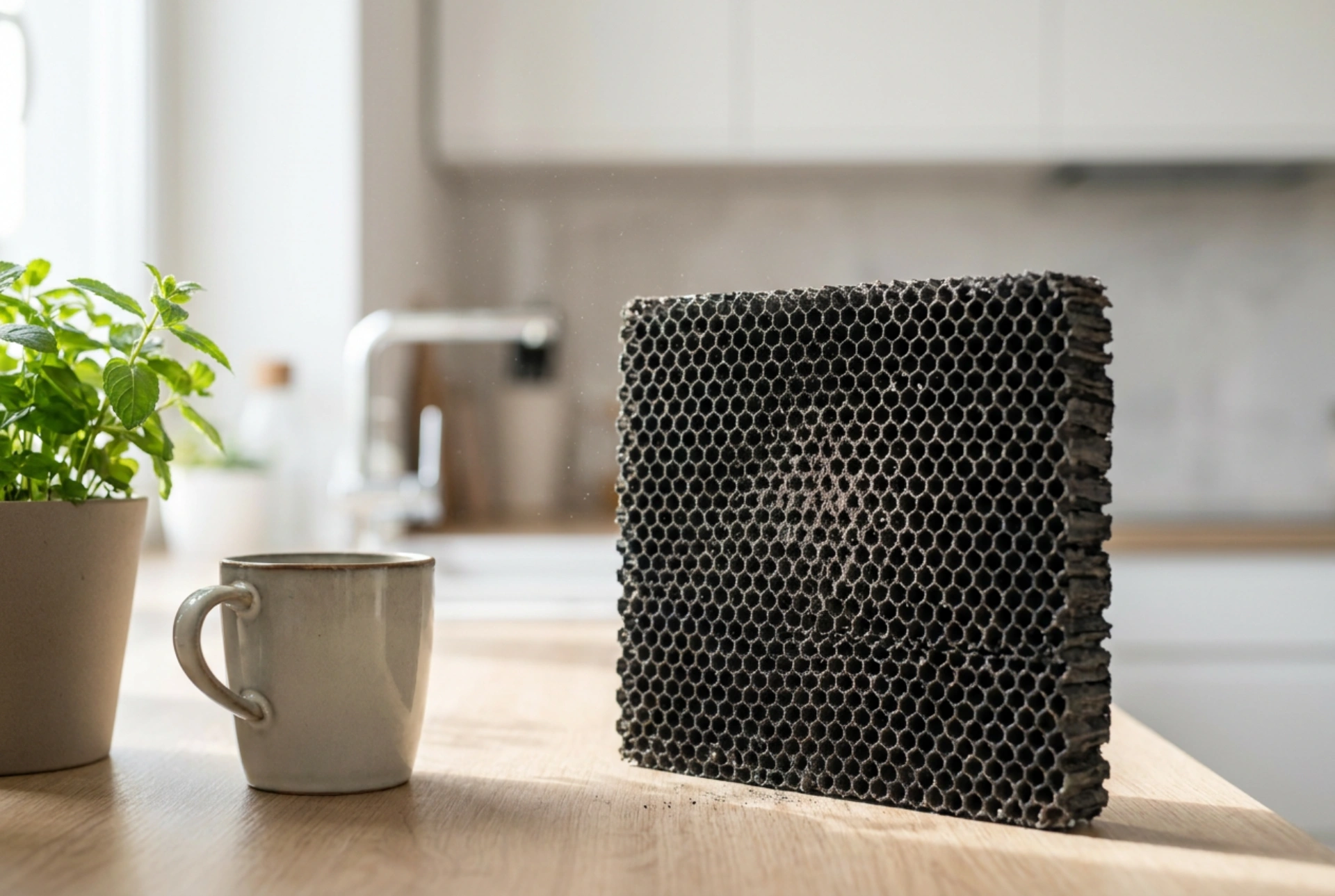


Activated carbon filters are the primary line of defence against gaseous pollutants, volatile organic compounds (VOCs), and persistent household odours. While mechanical filters trap airborne particulates, carbon filters rely on molecular physics and surface chemistry to capture invisible gases that easily pass through physical barriers.
The Science of Activation: Creating a Molecular Sponge
To understand how activated carbon functions, we must look at its structural anatomy on a microscopic scale. Regular charcoal is highly carbonaceous, but it lacks the internal architecture required for high-efficiency filtration. The carbon used in air purifiers undergoes an activation process, typically involving exposure to superheated steam, carbon dioxide, or oxygen at temperatures exceeding 800 degrees Celsius.
This thermal treatment burns away non-carbon impurities and carves out an intricate, highly fractured network of internal pores. The result is an incredibly high surface-area-to-mass ratio. A single gram of high-grade activated carbon can possess an internal surface area of over 1,000 square metres, equivalent to the floor space of several tennis courts. This vast surface area is packed into a compact honeycomb grid or a porous pellet bed inside the filter cartridge, providing millions of potential binding sites for passing gas molecules.
Adsorption versus Absorption: The Surface Phenomenon
The core mechanism of a carbon filter is adsorption, a term that must not be confused with absorption. In absorption, a substance penetrates the bulk volume of a liquid or solid, much like water filling a cellular sponge. Adsorption, conversely, is an entirely surface-based chemical and physical phenomenon.
As contaminated air passes through the filter, gas molecules collide with the carbon pore walls. When these molecules come into close contact with the carbon atoms, weak intermolecular forces known as Van der Waals forces draw them together. The gas molecules lose kinetic energy and adhere to the carbon surfaces, becoming trapped in the microscopic crevices. This attraction is purely physical, meaning the chemical structure of the pollutant remains unchanged, but it is effectively immobilised and removed from the room's atmosphere.
Pore Size Distribution and Target Pollutants
The effectiveness of an activated carbon filter depends heavily on its pore size distribution, categorised into three distinct levels:
- Micropores (less than 2 nanometres): These match the dimensions of small gas molecules and are highly effective at trapping low-molecular-weight volatile organic compounds, such as benzene and formaldehyde.
- Mesopores (2 to 50 nanometres): These act as transport channels and capture larger organic molecules, including complex household odours and smoke particulates.
- Macropores (greater than 50 nanometres): These serve as entry pathways, allowing air to quickly penetrate into the deeper, smaller pore networks without causing significant pressure drops.
Because carbon filters target molecular gases, they cannot capture microscopic dust, pollen, or pet dander. Conversely, mechanical HEPA filters cannot stop gases. Therefore, an effective air purifier always combines a mechanical particle filter with an activated carbon stage to address both physical and molecular indoor pollution.
Optimising Lifespan and Maintaining Efficiency
Unlike particulate filters that can sometimes be lightly vacuumed, carbon filters have a finite chemical capacity. Once every microscopic pore is saturated with gas molecules, the filter reaches its equilibrium point and can no longer capture new pollutants. In some cases, a fully saturated carbon filter can begin releasing previously trapped VOCs back into the room if temperature or humidity levels rise sharply.
To maximise efficiency, manage air velocity and humidity. High air velocity reduces the dwell time, which is the duration the air molecule spends in contact with the carbon, lowering the chance of adsorption. Furthermore, relative humidity above 60 percent can degrade performance, as water vapour molecules compete with VOCs for the limited binding sites on the carbon surface. Regular replacement, typically every six to twelve months depending on air quality, is essential to ensure the molecular sponge remains active.