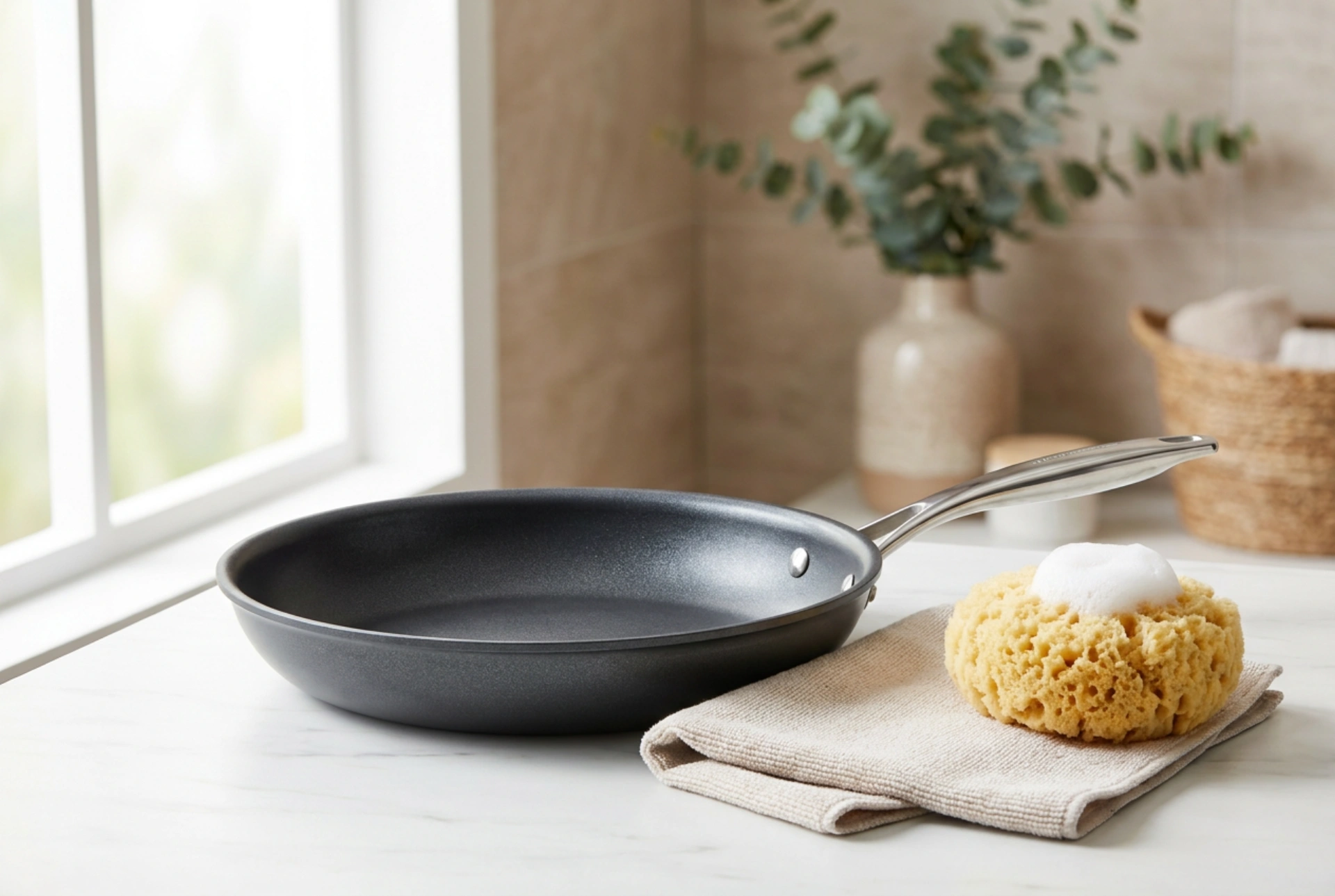


Maintaining the structural integrity of a non-stick frying pan requires a precise understanding of how polymer coatings react to thermal, chemical, and mechanical stress. Proper cleaning techniques preserve the non-stick properties of polytetrafluoroethylene (PTFE) and ceramic surfaces, preventing micro-scratches and chemical degradation that lead to premature wear.
The Physics of Thermal Shock and Coating Delamination
One of the most common causes of premature non-stick coating failure is thermal shock. Frying pans are typically constructed with an aluminum core for rapid heat distribution, coated with a delicate layer of PTFE or ceramic. These materials have vastly different thermal expansion coefficients. When a hot pan is suddenly submerged in cold water, the aluminum base contracts at a much faster rate than the non-stick coating. This rapid temperature differential creates high shear stress at the interface between the metal and the polymer, leading to micro-fractures, warping, and eventual delamination of the coating.
To prevent this mechanical stress, always allow the cookware to cool down gradually to room temperature before introducing any water. This allows the metal matrix and the surface coating to contract uniformly, maintaining the molecular bond between the layers.
Chemical Breakdown of Burnt-on Grease
When cooking oils are heated past their smoke points, they undergo polymerisation, creating a sticky, stubborn brown residue that bonds tightly to the pan. Traditional dishwashing soaps are highly surfactant-based but often lack the specific pH balance required to break down polymerised lipids without damaging the surface. Avoid harsh chemical degreasers, bleach, or highly alkaline oven cleaners, as these chemicals can oxidise the exposed metal edges and chemically degrade the structural integrity of non-stick polymers.
Instead, leverage the mild chemistry of sodium bicarbonate (baking soda). Sodium bicarbonate acts as a weak base (pH of approximately 8.3) and a highly gentle abrasive. To dissolve stubborn carbon deposits:
- Create a paste by mixing three parts sodium bicarbonate with one part warm water.
- Apply the paste directly to the affected areas and let it sit for 15 to 20 minutes. The mild alkalinity gently cleaves the ester bonds of the polymerised grease.
- Wipe the surface in circular motions using a soft cellulose sponge. The mechanical action, combined with the microscopic structure of the dissolved baking soda crystals, lifts the residue without scratching the underlying coating.
The Danger of Abrasive Tools and High Shear Forces
Mechanical abrasion is the primary cause of physical wear on non-stick surfaces. Steel wool, copper scourers, and even the abrasive green backing on standard kitchen sponges have a hardness rating high enough to gouge PTFE and ceramic coatings. Once a scratch occurs, moisture and fats penetrate beneath the coating, causing it to flake off from the inside out during subsequent heating cycles.
Always opt for cleaning implements with low Mohs hardness values, such as soft microfiber cloths, cellulose sponges, or natural bamboo brushes. When applying pressure, distribute the force evenly across the flat surface of the sponge rather than concentrating it on a single fingertip. This reduces the localized shear force applied to the delicate surface polymer.
Preventative Care: Conditioning and Storage
To maintain the hydrophobic properties of your pan after cleaning, periodic reconditioning is beneficial. After washing and drying the pan thoroughly with a soft cloth, apply a single drop of a high-smoke-point neutral oil (such as refined rapeseed or sunflower oil) to the surface. Use a clean paper towel to buff the oil into the microscopic pores of the coating. This creates a temporary barrier that shields the surface from moisture and atmospheric oxygen during storage.
When storing non-stick cookware, avoid nesting pans directly on top of each other. The hard metal undersides of other pans can easily scratch the delicate interior coatings. If space constraints require stacking, always place a thick felt protector or a soft microfiber cloth between each piece of cookware to absorb mechanical shocks and prevent friction damage.