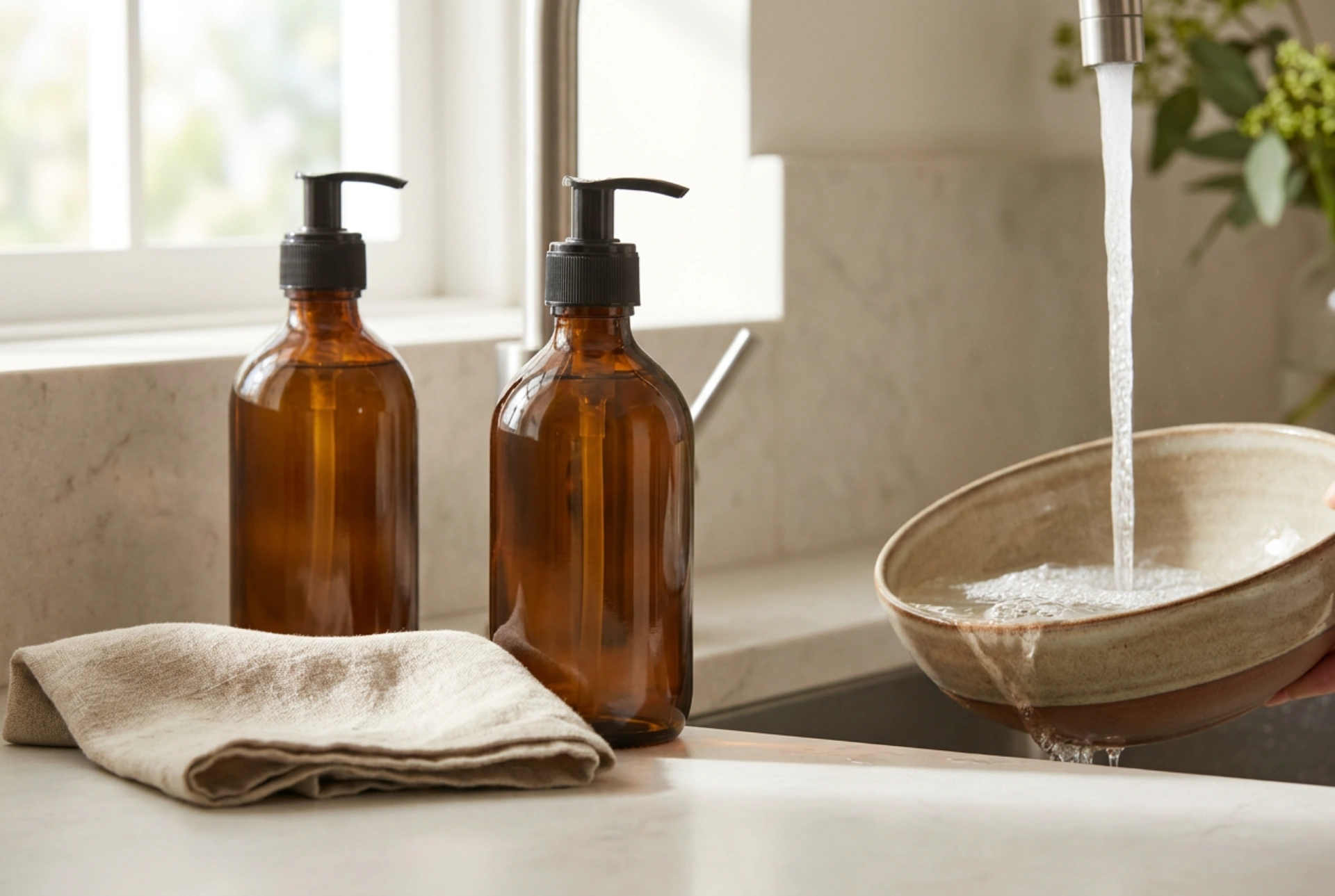


Selecting an eco-friendly dishwashing liquid that successfully cuts through heavy grease requires understanding how plant-derived surfactants interact with lipids at a molecular level.
The Science of Grease Removal: How Surfactants Work
To understand how an ecological formulation tackles fat, we must look at the physical chemistry of washing. Grease and water do not mix naturally due to differing polarities; water is highly polar, while lipids (fats and oils) are non-polar. Traditional dishwashing liquids use synthetic, petroleum-derived surfactants to bridge this gap. An eco-friendly alternative relies on plant-derived surfactants to achieve the exact same thermodynamic effect.
Surfactant molecules possess a dual nature: a hydrophilic (water-loving) polar head and a lipophilic (fat-loving) non-polar tail. When introduced to greasy dishes, the lipophilic tails embed themselves into the grease layer. The hydrophilic heads remain facing the water. As you agitate the water, these molecules organize into spherical structures called micelles, trapping the grease particles inside the sphere and suspending them in the water. This process, known as emulsification, allows the grease to be washed down the drain rather than redepositing onto your plates.
Decoding Eco-Friendly Ingredients on the Label
When evaluating ecological dishwashing liquids, ignore generic marketing terms and examine the actual chemical composition. Look for non-ionic and anionic surfactants derived from renewable agricultural sources, such as coconut oil, corn starch, or sugar beets. Common high-performance green surfactants include:
- Alkyl Polyglucosides (APGs): Listed as coco-glucoside, lauryl glucoside, or decyl glucoside. These are highly biodegradable, extremely mild on skin, and exceptionally effective at breaking down fats.
- Sodium Coco-Sulfate (SCS): A plant-derived anionic surfactant that provides rich foaming action and strong degreasing power without the severe aquatic toxicity associated with synthetic ethoxylated surfactants.
- Cocamidopropyl Betaine: An amphoteric surfactant derived from coconut oil that stabilizes foam and boosts the overall efficiency of the main cleaning agents.
Avoid products containing phosphates, which cause eutrophication in aquatic ecosystems, and synthetic preservatives like methylisothiazolinone (MIT), which are highly toxic to marine life and common contact allergens.
The Physics of Temperature and Mechanical Action
No matter how advanced an ecological formulation is, its performance is highly dependent on physical parameters, specifically temperature. Lipids exist in different states depending on their melting point. Animal fats, for example, solidify at room temperature. Trying to wash a pan covered in solid beef fat with cold water and eco-liquid will result in a smeared, sticky mess.
For efficient grease emulsification, wash water must be at least 40°C, and ideally around 45°C to 50°C. At this temperature, solid fats undergo a phase transition into liquid oils. Once liquefied, the plant-derived surfactants can easily surround, emulsify, and lift the lipid molecules. Combined with moderate mechanical friction from a natural-fiber brush or cellulose sponge, this physical transition ensures complete removal with minimal chemical consumption.
Overcoming Hard Water Barriers
Water hardness—the concentration of dissolved calcium and magnesium ions—directly impacts the efficacy of eco-friendly surfactants. These minerals bind to surfactant molecules, neutralizing their charge and preventing them from forming micelles. While conventional detergents use synthetic chelating agents like EDTA to bind these minerals, ecological liquids use biodegradable alternatives like sodium citrate or lactic acid.
If you live in a hard water area, you can optimize your eco-liquid's performance by adding a teaspoon of sodium carbonate (washing soda) directly to the basin water. Sodium carbonate precipitates the calcium and magnesium ions, effectively softening the water and allowing the plant-based surfactants to work at peak degreasing capacity without requiring you to double the dosage of your soap.
The Correct Protocol for Greaseless Results
To maximize the efficiency of your eco-friendly dishwashing liquid, follow a structured washing order of operations:
- Scrape thoroughly: Remove all solid food particles and excess oils into the compost before the dishes touch water. This prevents saturating the wash water with free lipids prematurely.
- Pre-soak: For heavily baked-on grease, soak the item in hot water with a single drop of concentrated eco-liquid for ten minutes to allow the surfactants time to penetrate the lipid matrix.
- Wash systematically: Begin with the cleanest items (glassware and cups), progress to cutlery and plates, and save greasy pots and pans for last. This ensures that the micelle-forming capacity of your wash water is not exhausted on the first few items.