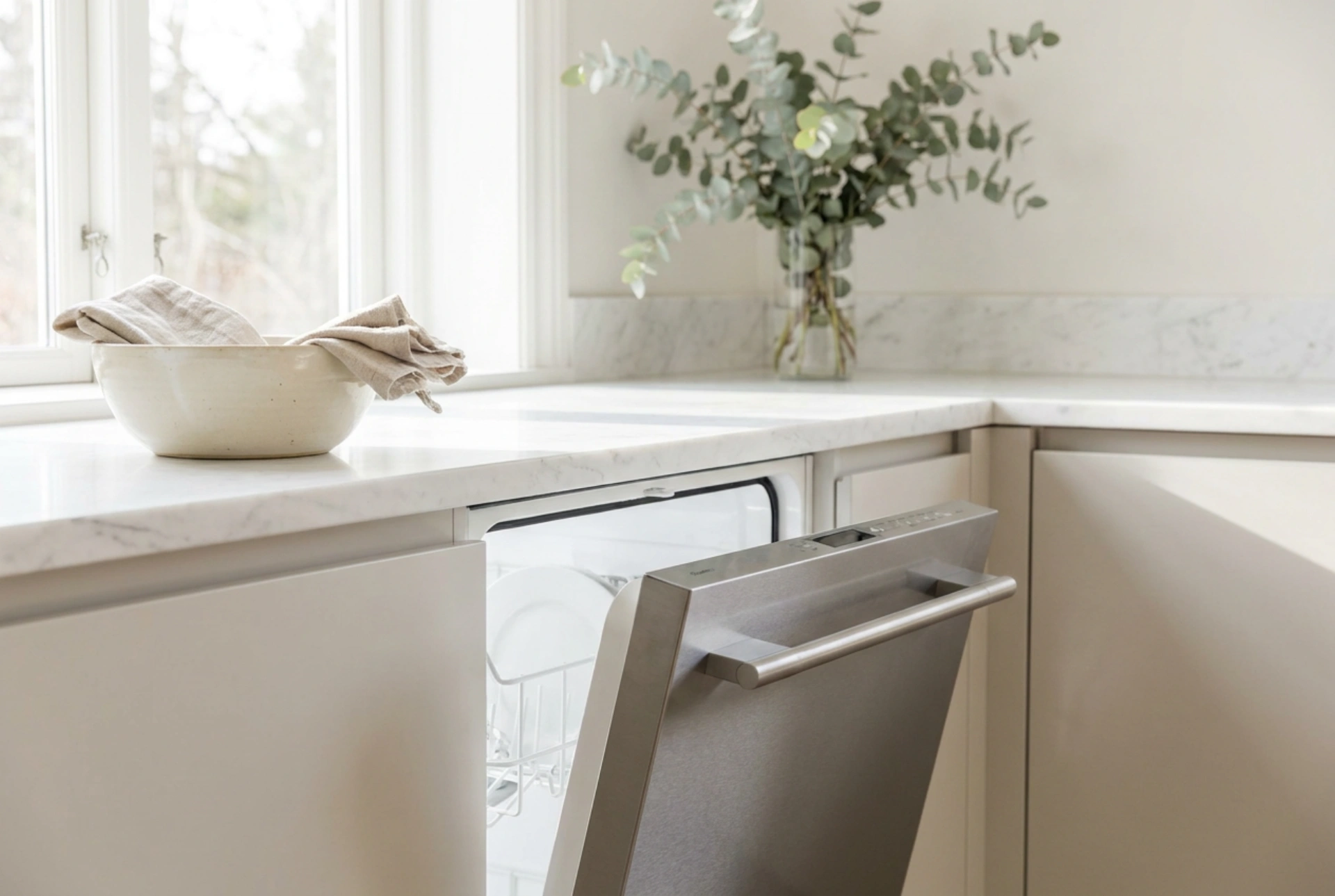


Cloudy glassware and greasy residues on plates are rarely signs of a broken appliance; instead, they indicate a system choked by grease, limescale, and organic debris. Restoring your dishwasher’s cleaning efficiency requires a methodical approach that targets different types of contamination using basic household chemistry and physical clearing.
Understanding the Chemistry of Dishwasher Grime
Every dishwashing cycle introduces two main types of waste: organic compounds (fats, proteins, and starches) and inorganic minerals (mostly calcium and magnesium carbonates from hard water). Over time, these substances combine to form a resilient, water-resistant film. Fat particles solidify in cooler areas of the machine, while minerals precipitate when water is heated, coating the heating elements and spray nozzles.
To break this cycle, you must address both components sequentially. Attempting to wash away grease with acidic agents, or dissolve limescale with alkaline ones, is ineffective. A two-phase chemical strategy—using acids to dissolve mineral scale and mild alkalis to saponify fats—is the scientifically proven way to restore pristine conditions inside the tub.
Step 1: Deep Mechanical Clearing of Filters and Spray Arms
Before introducing chemical cleaners, you must manually clear the physical barriers that restrict water circulation. Reduced water pressure prevents detergents from dissolving properly and stops food particles from being flushed away.
- The Filter Assembly: Locate the cylindrical filter at the bottom of the tub. Rotate it counterclockwise to release it. Separate the fine mesh screen from the coarse plastic sleeve. Wash both components under warm running water, using a nylon brush and a standard degreasing washing-up liquid to break down trapped fats.
- The Spray Arms: Gently unscrew or unclip the upper and lower spray arms. Inspect the tiny jet nozzles along their length. If water minerals or small food seeds have clogged these holes, use a wooden toothpick to push the debris free. Rinse the arms under a tap, shaking them to ensure no loose particles remain inside to clog the jets again.
- The Door Seals: Wipe the black rubber gasket around the door with a damp microfibre cloth. This area remains cold during cycles, meaning grease and mould easily accumulate here without being washed away by the machine's internal heat.
Step 2: Dissolving Limescale with Food-Grade Acids
Once the physical blockages are gone, you can tackle the mineral build-up. Calcium carbonate is highly insoluble in neutral or alkaline water, but it reacts readily with weak acids to form highly soluble salts that wash away easily.
Pour approximately 100 grams of citric acid powder directly onto the floor of the empty dishwasher, or place a wide-mouthed cup filled with white vinegar (acetic acid) on the top rack. Select the hottest cycle available—ideally a cycle running at 60°C or 65°C. The heat accelerates the chemical reaction, allowing the acid to rapidly break down the scale on the heating element. This improves the machine’s thermal efficiency, meaning the water will heat faster and clean more effectively in future standard cycles.
Step 3: Degreasing and Saponification with Sodium Bicarbonate
After the acidic descaling cycle is complete, you must address the remaining fat deposits. Never mix acids and bases in the same cycle, as they will neutralise each other, rendering both useless. Instead, run a separate cycle for degreasing.
Sprinkle 100 grams of sodium bicarbonate (baking soda) evenly across the bottom of the dry dishwasher. Sodium bicarbonate is a mild alkali. When combined with hot water, it undergoes a process called saponification, turning insoluble fats and oils into soluble soaps that are easily rinsed away. Run a short, hot cycle. This phase will also neutralise volatile organic compounds, completely eliminating any lingering musty odours.
Preventive Habits for Continuous Performance
To prevent rapid re-soiling, ensure the dishwasher's built-in water softener is functioning. This system uses an ion-exchange resin to swap calcium and magnesium ions for sodium ions, preventing scale from forming in the first place. Keep the salt reservoir filled with pure coarse dishwasher salt (sodium chloride). Additionally, keep the rinse aid chamber filled; rinse aid lowers the surface tension of water, allowing it to sheet off glass surfaces smoothly rather than evaporating in droplets that leave unsightly mineral spots.