

Cleaning manual salt and pepper mills requires strict dry methods because moisture corrodes metal burrs, causes salt to clump, and swells wooden casings. Restoring the precision of your grinding mechanism relies on dry mechanical action and oil-absorbing materials rather than water and soap.
The Science of Spice Residue and the Danger of Water
Pepper and salt present entirely different cleaning challenges due to their chemical compositions. Peppercorns contain piperine and volatile essential oils that leave a sticky, hydrophobic residue on the grinding burrs over time. This oily film attracts dust and spice particles, which eventually go rancid and impair the flavor of freshly ground pepper. Conversely, salt is highly hygroscopic, meaning it readily absorbs water from the environment. When moisture enters a salt mill, it partially dissolves the salt crystals, forming a highly corrosive brine. If your mill features carbon steel grinding components, this brine accelerates oxidation, leading to rust and permanent damage to the burrs.
Furthermore, many premium manual grinders are encased in seasoned wood. Wood is a porous, hygroscopic material that undergoes dimensional changes when exposed to liquid water. Introducing moisture to a wooden mill casing causes the wood fibers to swell, which can misalign the drive shaft, warp the housing, and cause the grinding mechanism to bind or seize completely. Therefore, water must be entirely excluded from the cleaning process.
The Mechanical Clearing Technique Using Dry Starch
To strip away sticky pepper oils without moisture, you can utilise the physical properties of uncooked, dry white rice. White rice is highly starch-rich and has a dry, porous surface that acts as a natural sponge for lipid-based residues. This method is highly effective for ceramic and high-grade stainless steel mechanisms, though it should be used with caution in light-duty plastic grinders.
- Load the Mill: Empty the remaining peppercorns from the mill reservoir and pour in approximately two tablespoons of dry, uncooked white rice. Do not use instant or parboiled rice, as these lack the structural density required.
- Grind: Adjust the mill to a medium-coarse grind setting and operate the mechanism. As the rice passes through the burrs, the dry grains scrape away the clinging pepper oils, absorbing the hydrophobic lipids directly into the starch matrix.
- Purge: Continue grinding until all the rice has passed through. The output will transition from a discoloured, oily powder to clean white grinds, indicating that the rancid oils have been successfully bound and ejected.
Disassembly and Manual Brushing
For a thorough de-clogging, physical disassembly remains the most reliable method. Most manual mills feature a top adjustment nut, a central spindle, and a lower burr assembly held in place by a retaining ring or screw. Carefully disassemble these components over a clean, dry surface, keeping track of the washers and springs.
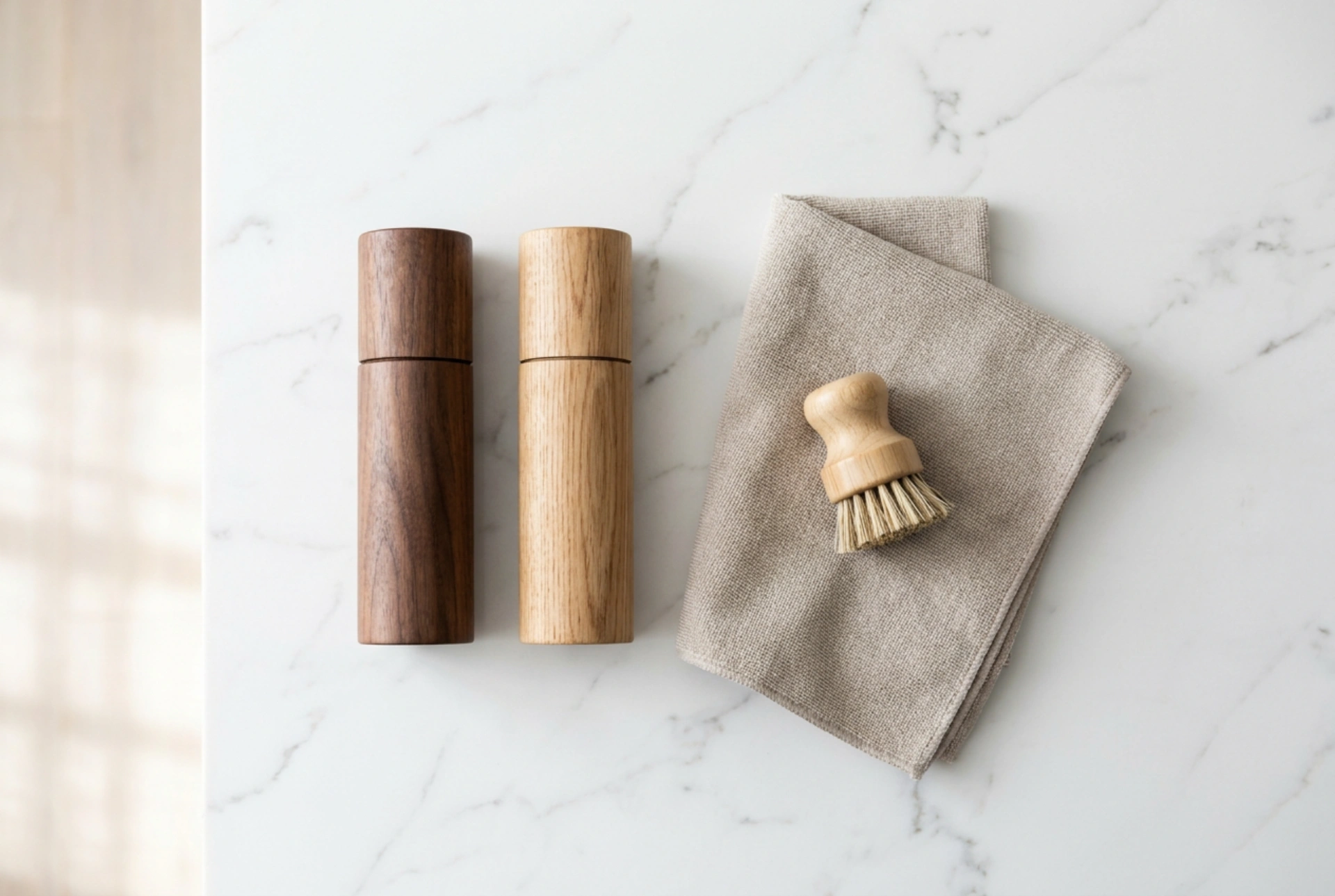
Once the grinding mechanism is exposed, use a stiff, dry utility brush or an unused toothbrush with natural bristles. Static electricity and mechanical friction are your primary tools here. Brush vigorously along the channels and grooves of both the inner and outer burrs. This action dislodges packed salt dust and impacted pepper fragments from the cutting teeth. Avoid using synthetic cloths that can snag on sharp burr edges; instead, use a high-density, dry microfiber cloth to wipe down the central steel spindle and the interior of the casing, as microfiber naturally attracts fine particulate matter through electrostatic forces.
Neutralising Odours with Sodium Bicarbonate
If the mill has developed a persistent stale smell from oxidized oils, dry sodium bicarbonate (baking soda) can be deployed as an odour neutraliser. Sodium bicarbonate is a mild alkaline compound that chemically neutralises acidic organic compounds responsible for rancid odours. Sprinkle a tablespoon of dry baking soda into the empty grinder body, seal the openings, and shake it thoroughly to coat the internal walls. Leave it to sit for thirty minutes to absorb volatile organic compounds. Afterward, turn the mill upside down and use your dry brush to sweep out every trace of the white powder. Because no water is introduced, the baking soda remains dry and easy to remove, leaving no chemical residue behind.