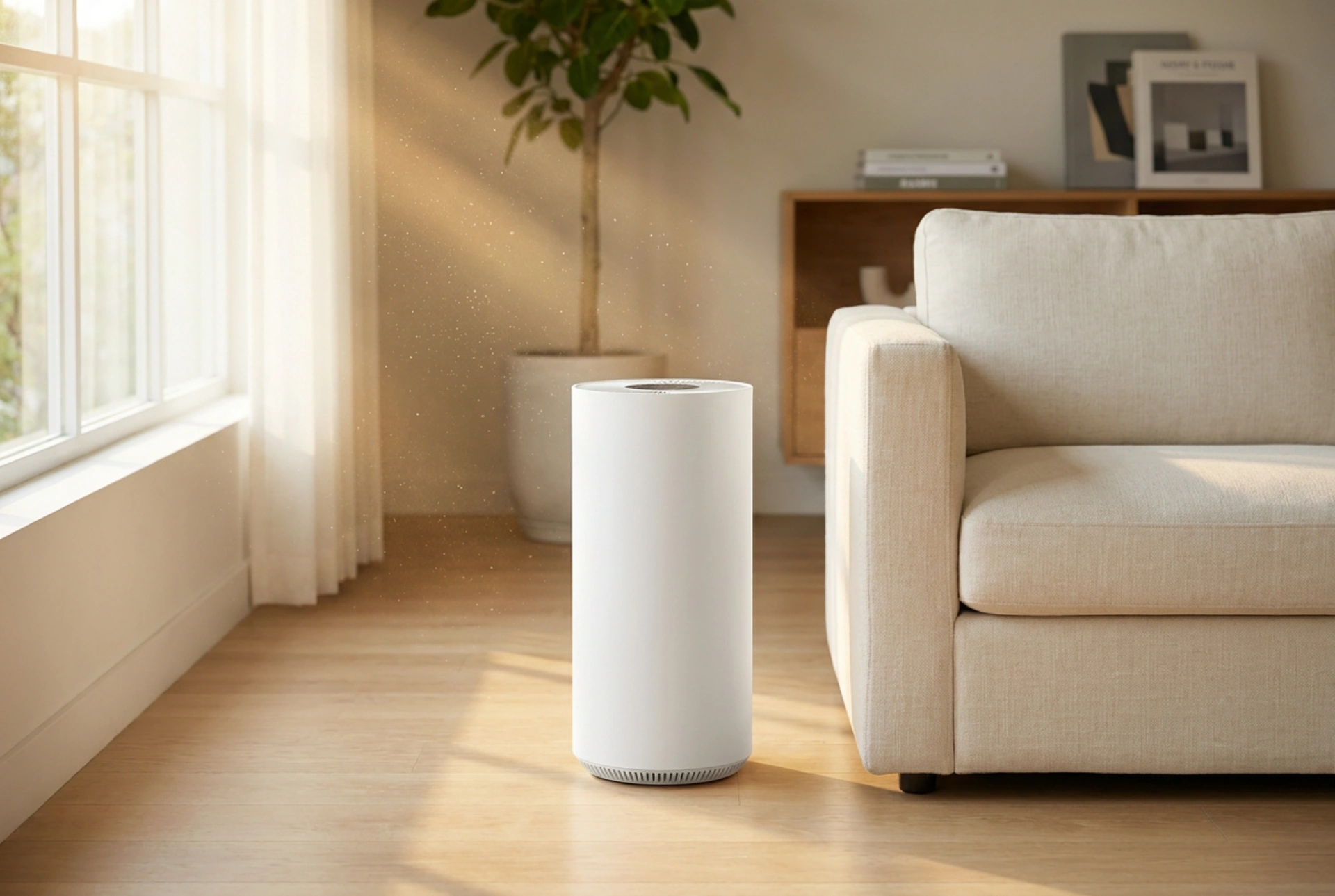


Suspended dust motes, pollen, and pet dander do not just settle on furniture; they remain trapped in a continuous cycle of suspension and inhalation due to indoor thermal currents. Understanding the physical mechanisms of air filtration allows you to strategically deploy an air purifier to intercept these microscopic particles before they land on household surfaces.
The Aerodynamics of Indoor Dust and Pollen
Indoor air is a complex fluid dynamic system. Dust is not a single material, but a shifting mixture of dead skin cells, textile fibres, soil particles, and insect debris. Pollen, on the other hand, consists of microscopic grains released by plants, entering through windows and doors or hitchhiking on clothing. Because of their differing masses and aerodynamic diameters, these particles behave uniquely in the air.
Large particles (greater than 10 micrometers) tend to settle relatively quickly due to gravity, landing on carpets, upholstery, and tables. However, smaller particulates (PM2.5 and PM10) remain suspended in the air for hours, carried by even the slightest convective currents generated by human movement, heating systems, or electronics. Intercepting these suspended particles requires active air circulation that draws air through a dense, physical barrier faster than the gravity-induced settling rate.
The Physics of HEPA Filtration: Four Capture Mechanisms
To capture fine dust and pollen, high-efficiency particulate air (HEPA) filters rely on a dense web of randomly arranged fiberglass fibres. Unlike a simple sieve, a high-quality filter does not just block particles larger than its openings. It captures particles of varying sizes through four distinct physical mechanisms:
- Inertial Impaction: Larger, heavier particles (like large pollen grains) have too much inertia to follow the curving streamlines of the airflow around the filter fibres. They continue on a straight path and collide directly with the fibres, becoming trapped.
- Interception: Medium-sized particles follow the airflow streamlines closely. However, if they pass within one particle radius of a fibre, they make physical contact and stick to it due to molecular adhesion forces.
- Diffusion: The smallest particles (under 0.1 micrometers) do not follow streamlines. Instead, they collide with gas molecules in the air, causing them to move erratically in a process called Brownian motion. This chaotic path increases the probability that they will bump into a filter fibre and remain captured.
- Sieving: This occurs when the distance between two fibres is smaller than the particle's diameter, preventing it from passing through. This is primarily effective for large clumps of lint and dust.
Maximizing Filtration Through Fluid Dynamics
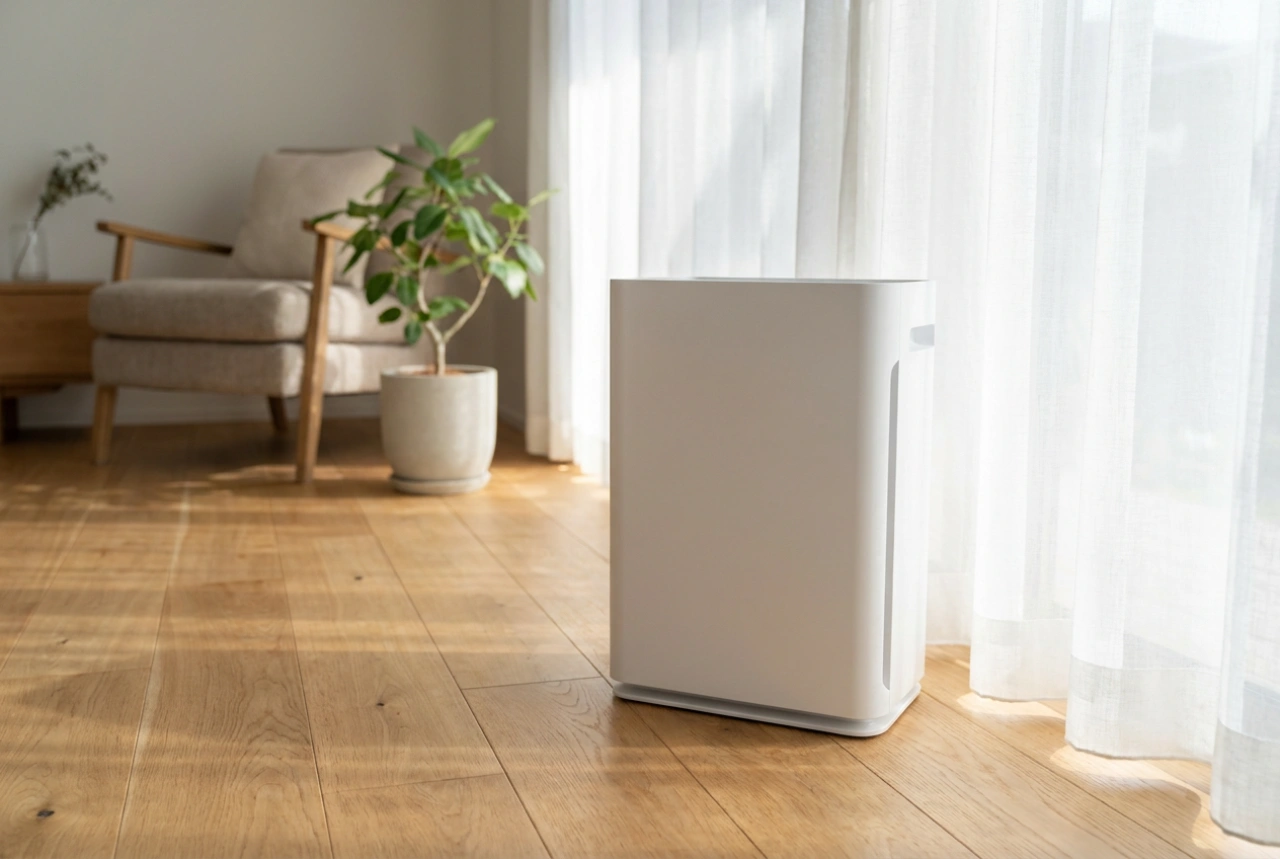
An air purifier is only as effective as the room’s air circulation pattern. To clear a space efficiently, the machine must establish a continuous toroidal airflow pattern, drawing contaminated air from the lower half of the room and projecting filtered air upward and outward to circulate the entire air volume. Placing a purifier in a corner or directly behind a sofa restricts intake and creates "dead zones" where air stagnates, allowing dust to settle undisturbed.
For optimal results, position the unit at least thirty to fifty centimetres away from walls and furniture. Ideally, place it near the source of entering particulates—such as close to a window during pollen season—or in high-traffic areas where movement constantly kicks settled dust back into the breathing zone. Ensure the clean air output is directed toward the center of the room to facilitate continuous air turnover.
Operational Protocols for Dust and Pollen Control
Managing indoor air quality is a matter of consistent physical operation rather than quick, high-speed blasts. Running an air purifier on low or medium speed continuously is far more effective than running it on maximum speed for only an hour. Continuous operation maintains a steady state of low particulate concentration, preventing the accumulation of allergens on surfaces.
Furthermore, regular maintenance is critical to prevent the filter from becoming a secondary source of dust. Pre-filters, which capture large lint and hair, must be vacuumed or washed every two to four weeks. When cleaning a reusable pre-filter, always perform the operation outdoors or use a vacuum equipped with its own sealed HEPA system to prevent releasing captured spores and dust back into your living space.