

Achieving the perfect indoor air quality requires balancing water vapour emission with your home's natural thermal dynamics. Running a humidifier blindly often leads to localized condensation, structural damp, and microbial growth if the relative humidity exceeds critical thresholds.
Understanding the Physics of Relative Humidity and Dew Point
To manage indoor moisture effectively, you must understand relative humidity (RH). Relative humidity is the ratio of current water vapour in the air to the maximum amount the air can hold at a specific temperature. Warm air has a higher capacity for moisture than cold air. When warm, humidified air meets a cold surface, such as a window pane or an uninsulated exterior wall, its temperature drops rapidly.
This drop in temperature causes the air to reach its dew point—the temperature at which air becomes saturated and water vapour condenses back into liquid water. If your indoor relative humidity exceeds 50%, the risk of condensation on cold surfaces increases significantly. To prevent structural damage, aim to maintain indoor RH between 30% and 50% using a standalone hygrometer placed away from the humidifier itself.
Strategic Placement for Maximum Evaporation
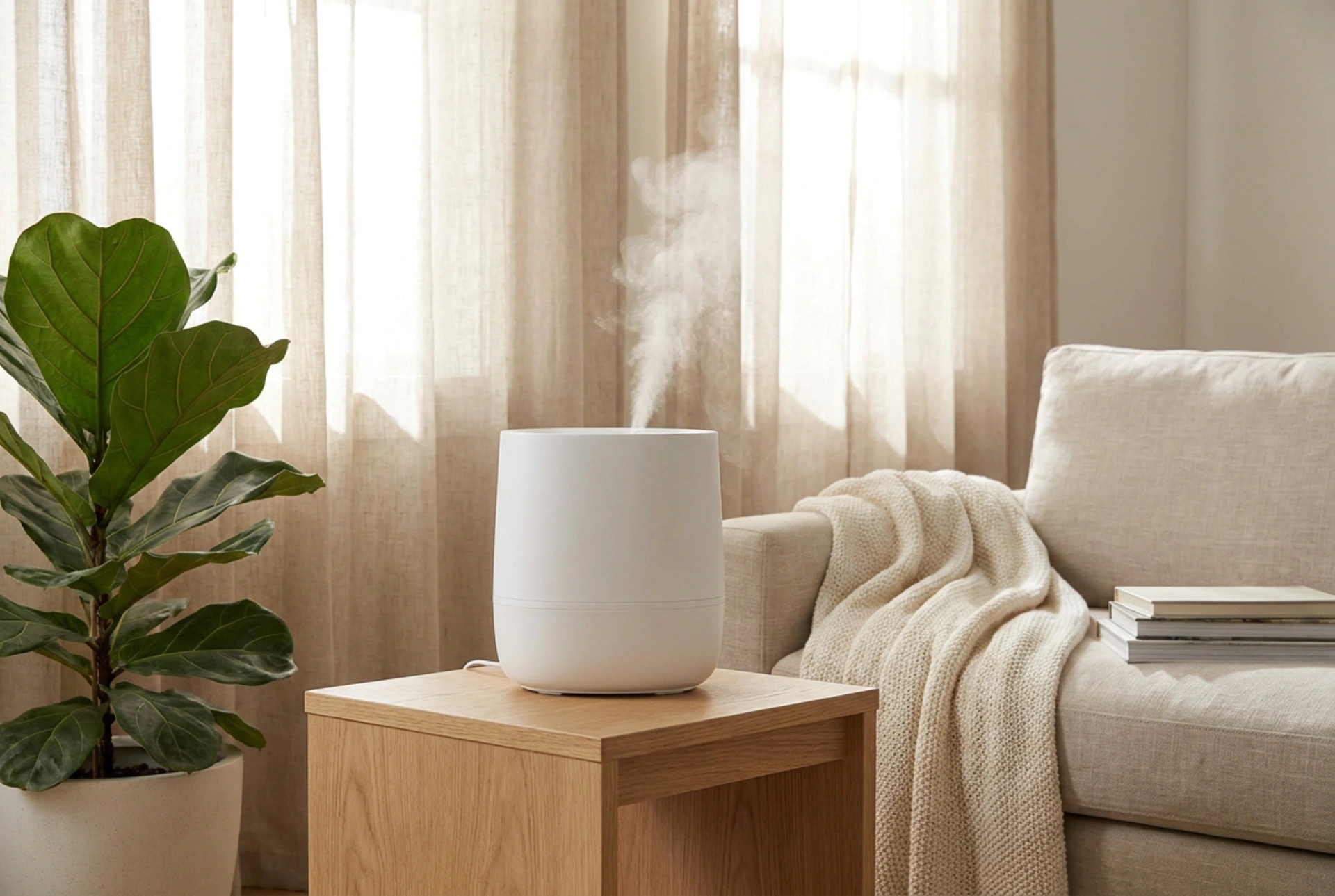
The physical placement of your humidifier dictates how effectively the emitted moisture merges with the ambient air before settling. Placing a humidifier directly on the floor or near a wall limits air circulation, leading to localized pooling of moisture.
- Elevation: Position the unit on a water-resistant table or shelf at least one metre above the ground. This gives the mist or vapour sufficient transit time through the air column to evaporate fully before hitting the floor.
- Airflow Paths: Place the device near a gentle source of air movement, such as an interior doorway or a circulating fan, but never directly in front of a heating vent or air conditioner, which can disrupt the humidity sensors.
- Clearance: Maintain a minimum clearance of 50 centimetres from walls, furniture, and curtains to prevent dry drywall and fabrics from absorbing raw moisture directly from the output nozzle.
Choosing the Right Humidification Mechanism
Humidifiers operate on different physical principles, and choosing the right one affects how moisture disperses. Ultrasonic humidifiers use a piezoelectric transducer vibrating at high frequencies to split water into a fine mist. While energy-efficient, they release all water contents into the air, including dissolved minerals. Evaporative humidifiers, on the other hand, draw dry air through a wet wick filter, allowing natural evaporation. This method is self-regulating: as the ambient humidity rises, the rate of evaporation naturally slows down, making it much harder to over-saturate the room.
Water Chemistry and Prevention of Mineral Buildup
The mineral content of your water supply plays a vital role in both air quality and machine efficiency. Hard tap water contains high levels of calcium and magnesium carbonates. When aerosolized by an ultrasonic humidifier, these minerals dry into a fine white dust that settles on surfaces and can irritate lungs. To prevent this, use distilled or demineralized water. For evaporative models, hard water leads to scale buildup on the wick, reducing capillary action and rendering the system inefficient. Regular descaling using a weak solution of citric acid or distilled white vinegar is essential to break down alkaline scale without damaging the device components.
Operational Routines and Monitoring Checklist
Preventing excess humidity requires active monitoring and strict maintenance habits. Implementing a daily and weekly routine ensures that your humidification remains beneficial rather than hazardous:
- Monitor with a Hygrometer: Never rely solely on the humidifier's built-in sensor, as it only measures the microclimate directly surrounding the device. Use a secondary hygrometer across the room.
- Cycle Operation: Run the device only when rooms are occupied or use a timer to prevent humidity from accumulating in closed, unventilated spaces.
- Empty and Dry: Empty the water tank daily and wipe all surfaces dry. Static, warm water is a primary breeding ground for biofilm and bacterial pathogens.