

Increasing ambient humidity for tropical house plants without creating pools of water on wooden furniture or condensation on cold windowpanes requires an understanding of physics and moisture dynamics. By managing microclimates and evaporation surfaces, you can keep your plants thriving while protecting your home's structural surfaces.
Understanding the Physics: Humidity versus Condensation
Air can hold a specific amount of water vapor depending on its temperature; warmer air holds more moisture than cold air. When highly humid air contacts a cold surface, such as a windowpane or a cold stone windowsill in winter, its temperature drops rapidly. If the surface temperature falls below the dew point, the gas transitions back into liquid water, resulting in condensation. To prevent wet windowsills, the goal is not to saturate the entire room's air to extreme levels, but to create localized zones of elevated relative humidity directly around the plant foliage while ensuring adequate air circulation.
The Science of Pebble Trays: Passive Evaporation without Spills
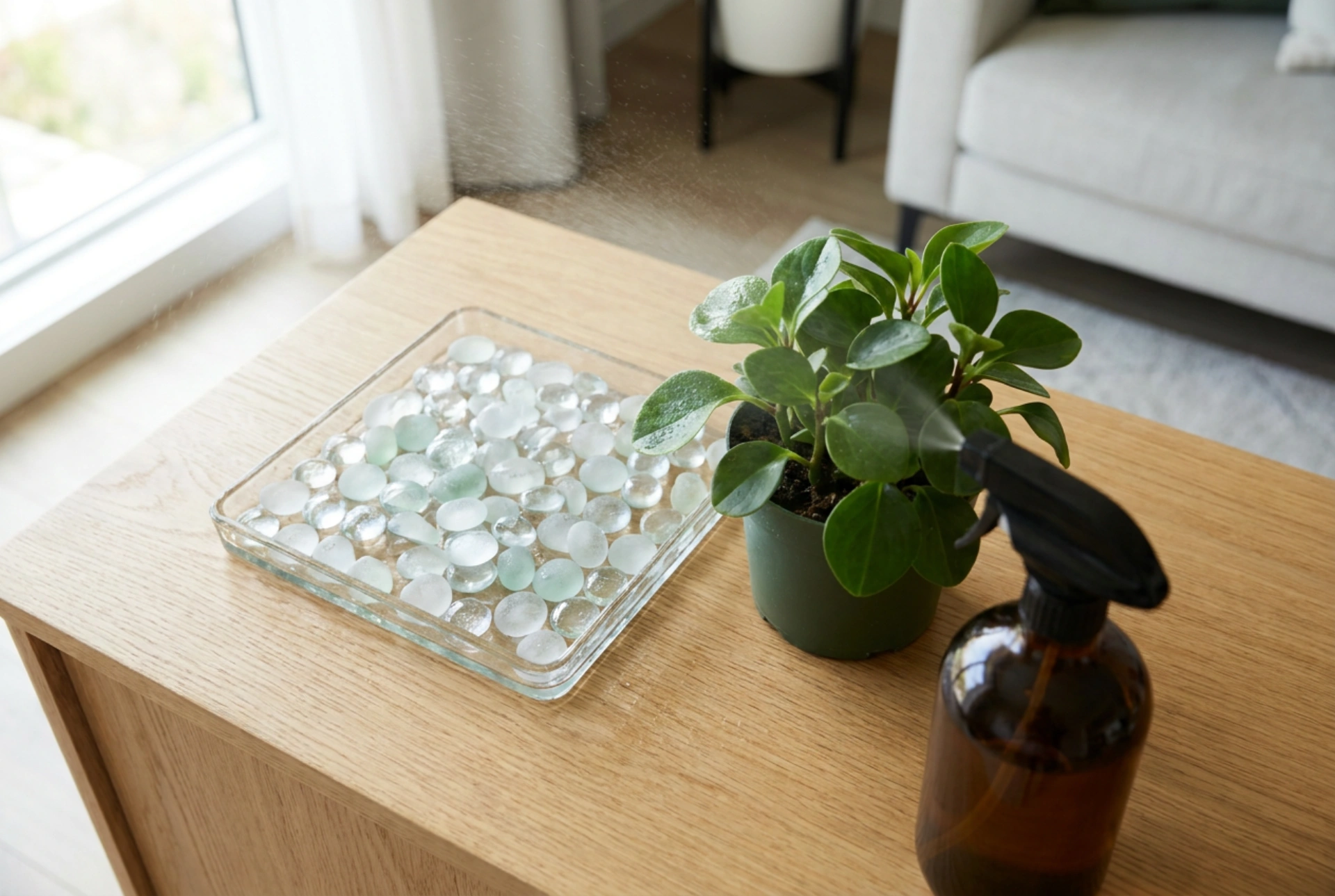
A pebble tray is one of the most effective passive humidification methods because it relies on surface area evaporation rather than active spraying. To set this up correctly without risking water damage to your furniture or windowsill, follow these steps:
- Select a non-porous tray: Use a glazed ceramic, plastic, or glass tray. Avoid unglazed terracotta, as moisture will seep through the clay via capillary action and ruin the surface beneath.
- Fill with inert media: Use washed river stones, glass pebbles, or expanded clay pebbles. These materials do not rot, mold, or dissolve in water.
- Add water below the stone line: Pour water into the tray, but ensure the water level remains strictly below the top surface of the stones. The plant pot must sit dryly on top of the stones. If the bottom of the pot touches the water, the soil will wick the liquid upward, leading to root rot and water spilling over the edges.
As the water in the tray evaporates, it rises directly into the canopy of the plant, creating a localized envelope of moisture. Because the evaporation rate is slow and steady, the moisture dissipates into the wider room before it can condense on nearby cold surfaces.
Creating Plant Microclimates through Transpiration
Plants naturally release water vapor through microscopic pores in their leaves called stomata in a process known as transpiration. You can harness this biological process by grouping several plants closely together. This grouping traps the transpired water vapor within the collective canopy, creating a shared microclimate with significantly higher relative humidity than the rest of the room.
To maximize this effect without trapping stagnant air (which can lead to fungal infections), place larger, hardier plants on the outer perimeter of the group to act as windbreaks and moisture traps, while delicate tropicals sit in the humid center. Ensure there is still a small gap of one to two inches between the leaves of adjacent plants to allow gentle, non-turbulent air movement.
The Mechanics of Safe Misting and Evaporation Zones
Traditional misting with a standard spray bottle often does more harm than good. Large water droplets fall quickly out of the air, landing on leaves where they pool and encourage fungal pathogens, or settling on wooden windowsills where they damage the finish. If you choose to mist, use an ultra-fine mister that produces a true aerosolized fog. Spray upward into the air above the plants rather than directly at them, allowing the microscopic droplets to evaporate before they hit any solid surface. This directly increases the vapor pressure deficit in the immediate air zone without leaving physical water droplets behind.
Using Damp Clay and Absorbent Materials
Another clean method involves using unglazed terracotta or clay objects placed near the plants but away from delicate wooden surfaces. When unglazed clay absorbs water, it acts as a slow-release humidification source. Placing damp, decorative terracotta spheres inside a glazed container allows water to evaporate steadily into the surrounding air without any risk of water pooling or leaking onto your windowsills.