

Coffee oils and microscopic fines inevitably accumulate inside grinders, degrading flavour profiles through oxidation and straining the motor over time. Clearing these internal chambers does not require complex mechanical disassembly if you leverage the principles of oil absorption, mechanical shear, and airflow.
The Physics of Coffee Oil and Electrostatic Clumping
When coffee beans are ground, their cellular structure is shattered, releasing natural lipids (oils). These oils act as a liquid adhesive inside the grinding chamber. Concurrently, the friction of the grinding process generates a strong electrostatic charge—known as the triboelectric effect—between the coffee particles and the grinder's internal components. This charge causes ultra-fine dust (fines) to cling stubbornly to the burrs, static screens, and exit chutes. Over time, the trapped oils oxidize, turning rancid and imparting bitter, stale flavours to fresh coffee, while the accumulated dust restricts the physical flow of grinds, forcing the motor to work harder.
Mechanical Absorption via Hydrophilic Starch Tablets
The most effective method to clear the internal mechanism without opening the casing is using specialised, food-safe cleaning tablets formulated from compressed grains and gluten-free binders. These tablets are engineered with high porosity and hydrophilic properties. As they pass through the burrs, they do not melt or clog; instead, the mechanical shear of the burrs crumbles them into a coarse, scrubbing powder. This powder physically scrapes the oily residue from the steel burrs and absorbs the free lipids. The bound oils and loosened coffee dust are then swept out of the chamber by the flow of the tablet particles. This process dry-cleans the burrs, stripping the adhesive layer that holds the static dust in place.
Leveraging Airflow and Mechanical Agitation
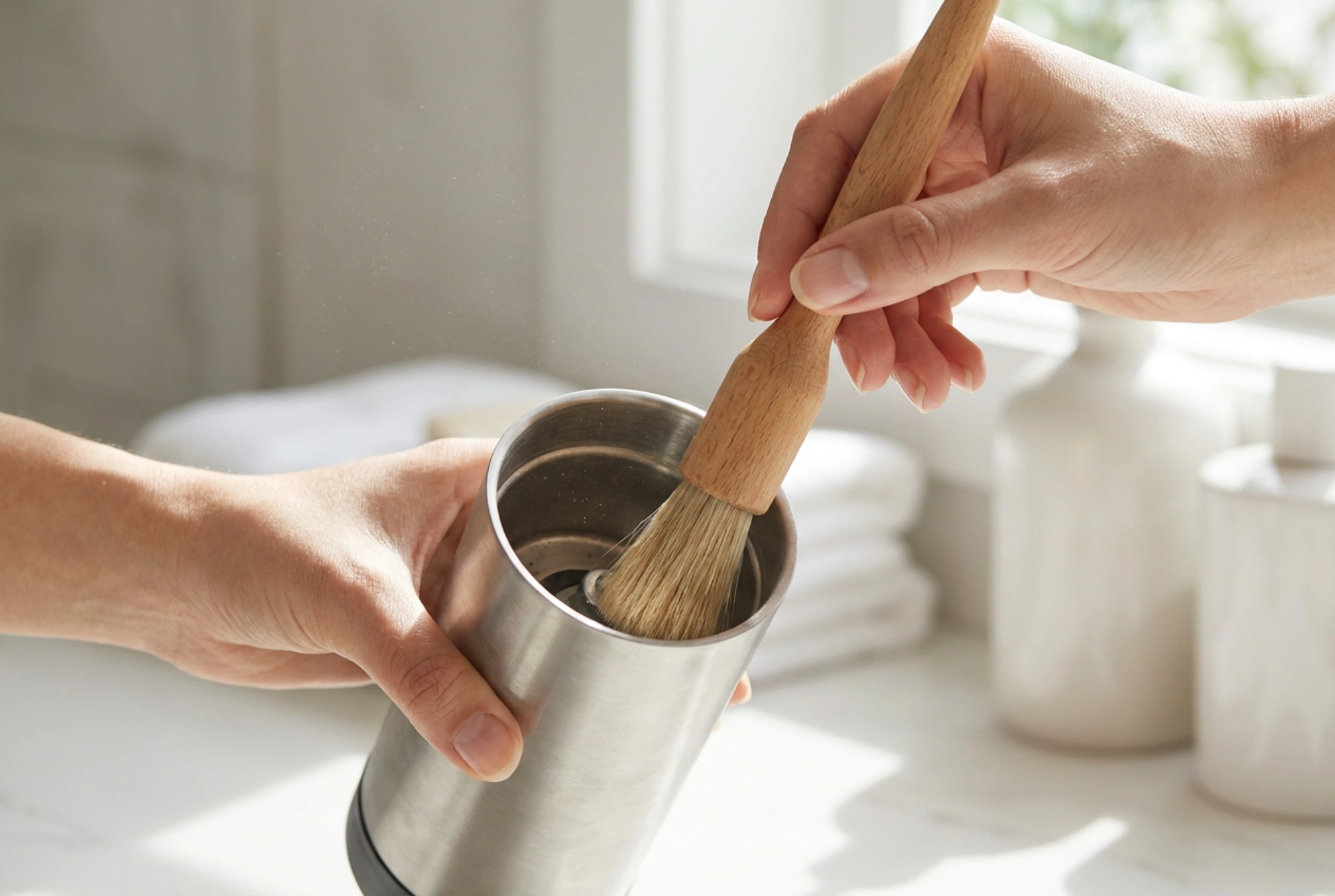
To remove the remaining loose particles without dismantling, a combination of negative pressure and manual agitation is required. A stiff-bristled brush, preferably made from natural fibres like boar hair, should be inserted into the grinds chute. The stiff bristles mechanically disrupt the electrostatic attraction holding the dust to the plastic and metal walls. Simultaneously, utilising a vacuum cleaner with a narrow crevice tool at the exit chute creates high-velocity negative pressure. This pressure differential pulls air rapidly through the hopper and out of the chute, carrying the suspended dust particles with it. For grinders with open paths, a manual rubber bellows placed over the hopper entry can be compressed sharply to create a pulse of positive air pressure, forcing stubborn fines out of the static reduction screen.
Why Water and Solvents Must Be Avoided
Introducing water or water-based detergents into a coffee grinder is highly destructive. Most high-quality grinder burrs are made of carbon steel or tool steel, which oxidize and rust rapidly when exposed to moisture. Even stainless steel burrs are susceptible to micro-corrosion. Furthermore, water reacts with dry coffee dust to form a dense, sticky paste that hardens as it dries, potentially seizing the motor or completely blocking the grinding path. If stubborn residues on accessible parts require a solvent, isopropyl alcohol (99% concentration) should be applied minimally to a cloth. Isopropyl alcohol dissolves lipids effectively and evaporates almost instantly, leaving no moisture behind to trigger rust or clumping.
The Optimised Non-Disassembly Cleaning Routine
For consistent performance and flavour purity, execute this non-disassembly maintenance sequence regularly:
- Vacuum the chambers: Set the grinder to its coarsest setting to open the gap between the burrs, then apply a vacuum nozzle to both the hopper and the exit chute to extract loose fines.
- Run cleaning grains: Return the grinder to a medium setting, feed the recommended quantity of grain-based cleaning tablets, and run the motor until completely empty.
- Purge with coffee: Grind a small handful of sacrificial coffee beans. This step is crucial, as the natural oils of the coffee will coat the freshly stripped metal, seasoning the burrs and pushing out any lingering starch dust.
- Final pulse: Use a manual bellows or a quick blast of compressed air to clear the chute of any remaining loose particles.