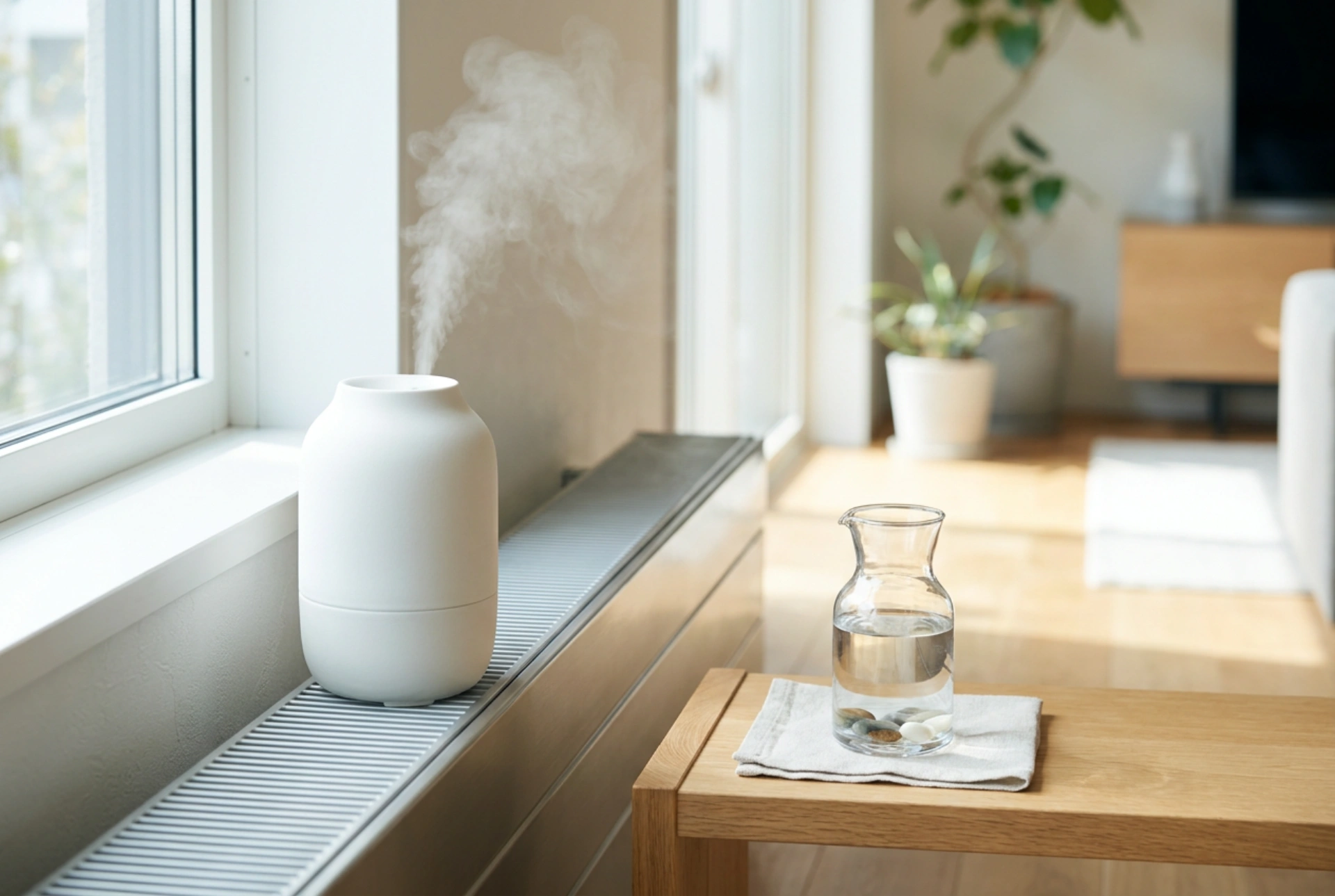


Ceramic radiator humidifiers offer an elegant, passive way to raise indoor humidity during dry winter months, but they quickly become coated in stubborn limescale due to continuous water evaporation. Preventing this mineral build-up requires understanding the chemistry of hard water and implementing a simple, proactive maintenance routine.
The Science of Limescale in Passive Evaporators
To stop limescale, you must first understand why it forms so rapidly in ceramic humidifiers. When tap water is heated by the radiator, pure water molecules escape into the air as vapour. However, dissolved minerals—primarily calcium carbonate and magnesium carbonate—cannot evaporate. They remain behind, steadily concentrating in the shrinking volume of water. Once the solution reaches saturation, these minerals precipitate out of the liquid, crystallising on the porous clay surface of the ceramic. Over time, this chalky white crust clogs the pores of the ceramic, reducing its capillary action and rendering the humidifier less efficient.
Selecting the Optimal Water Source
The most effective way to eliminate limescale is to control the mineral content of the water you put into the vessel. While standard tap water is convenient, its mineral load accelerates scaling.
- Distilled or Demineralised Water: This is the ideal solution. By using water that has undergone distillation or deionisation, you remove virtually all dissolved minerals. Without calcium and magnesium ions, evaporation leaves behind absolutely zero residue.
- Filtered Water: Multi-stage filtration systems or reverse osmosis units significantly lower mineral density. While not completely mineral-free like distilled water, filtered water drastically reduces the frequency of necessary descaling cycles.
- Boiled Water: Contrary to popular belief, simply boiling tap water does not eliminate all minerals; it merely precipitates temporary hardness as scale inside your kettle. While slightly better than raw tap water, boiled water still contains permanent hardness and will eventually cause scaling in your humidifier.
Chemical Descaling Without Material Damage
When minerals inevitably accumulate, harsh synthetic detergents or chlorine-based cleaners are unnecessary and can damage the porous ceramic structure. Instead, rely on weak organic acids to safely dissolve calcium carbonate through a simple chemical reaction.
Citric acid is the superior choice for this task. Unlike acetic acid, citric acid is completely odourless, meaning your home will not smell of vinegar when the radiator heats up. To clean the vessel, dissolve two tablespoons of citric acid powder in warm water, pour it into the humidifier, and let it sit for 30 to 60 minutes. The acid reacts with the insoluble calcium carbonate, converting it into highly soluble calcium citrate, which easily rinses away. Avoid scrubbing the ceramic surface with abrasive metal pads, as this can scratch the glaze or erode the raw clay, creating microscopic crevices where scale can anchor itself even more firmly.
Temperature, Airflow, and Maintenance Protocols
To maintain peak performance throughout the heating season, establish a strict operating routine based on thermodynamic principles.
First, never refill a hot, dry ceramic vessel with cold water. The sudden temperature differential can cause thermal shock, leading to micro-fractures in the ceramic glaze. Always allow the vessel to cool slightly or use lukewarm water. Second, rinse the humidifier thoroughly once a week. Emptying the residual, highly concentrated mineral water before refilling prevents it from reaching the saturation point where precipitation occurs. Finally, ensure the humidifier is suspended securely on the warmest columns of the radiator, where convective airflow is strongest. This maximises the rate of evaporation without needing to boil the water, keeping the relative humidity of your living space balanced and stable.